

AI Summary
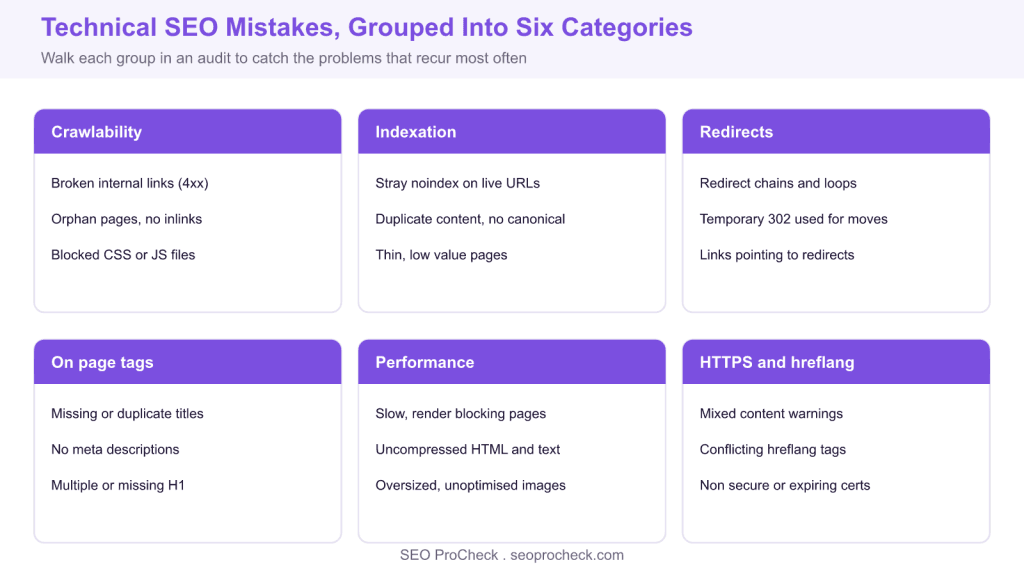
The technical SEO mistakes catalogued in large studies cluster into six stable categories: crawlability, indexation, redirects, on page tags, performance, and HTTPS with hreflang. Auditing each group in turn, using a crawler plus Search Console, catches the large majority of problems that recur across sites.
- Duplicate content is usually a technical artifact fixed with canonicals, not deleted pages.
- Crawl blocks and stray noindex tags do the most damage because the page cannot rank at all.
- Flatten redirect chains to a single 301 and update internal links to the final URL.
- Since 2017 the categories held, but performance became Core Web Vitals and HTTPS became mandatory.
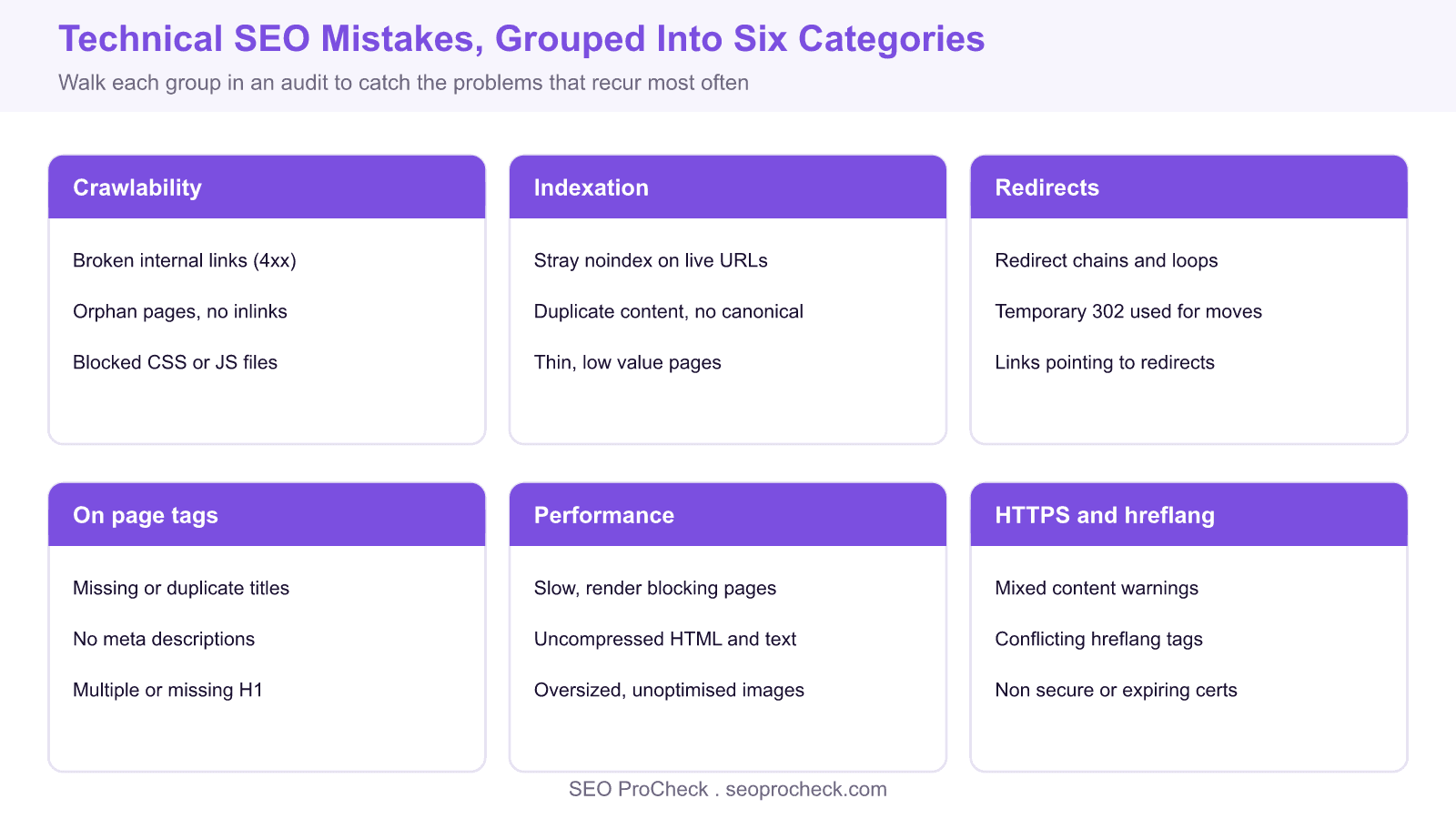
The referenced SEMrush study analysed a large sample of websites and catalogued the technical and on page issues that appeared most often. The exact rankings shift with each rerun, but the categories have proven remarkably stable: the same families of mistakes still dominate audits today. Rather than restate figures from a dated crawl, this guide organises the common mistakes into six groups you can walk through systematically, with the tag or report used to find and fix each one.
Crawlability mistakes
If search engines cannot reach a page, nothing else matters. The frequent offenders are broken internal links returning 4xx errors, orphan pages that no internal link points to, and accidentally blocked CSS or JavaScript that stops Google rendering the page as users see it. Find broken links and orphans with a full crawl in Screaming Frog, and confirm resource blocking with the URL Inspection tool, which flags any blocked resource under the rendered view. Fix broken links at the source rather than redirecting each one, and add internal links to orphaned pages from relevant hubs.
Indexation and duplicate content mistakes
Duplicate content is one of the most reported issues in every large study, usually caused by parameters, session IDs, printer versions, and HTTP versus HTTPS variants creating many URLs for one page. The fix is a self referencing rel=canonical on every page plus canonical tags on variants pointing to the preferred URL. The other recurring indexation mistake is a stray noindex directive, whether a meta tag or an X-Robots-Tag header, left over from staging. The Pages report in Search Console groups both problems clearly under duplicate and excluded categories.
Redirect and link mistakes
Redirects are where migrations go wrong. Chains, where A points to B points to C, waste crawl budget and leak a little equity per hop, and loops block the page entirely. Using a temporary 302 for a permanent move is a classic error that can delay consolidation of signals. And even when redirects are correct, internal links and sitemap entries often still point at the old URL, forcing an extra hop on every visit. Flatten chains to a single 301, use 301 for permanent moves, and update internal links to their final destination.
On page tag mistakes
The most common on page issues are missing or duplicate title tags, missing meta descriptions, and heading problems such as multiple or absent H1 elements. Duplicate titles across many pages signal thin differentiation and make listings less clickable. A crawl reports these in bulk: sort by title and meta description columns to find duplicates and blanks. Write unique, descriptive titles that lead with the primary term, and treat the meta description as ad copy for the search result rather than a ranking factor.
Performance, HTTPS, and hreflang mistakes
Slow pages, uncompressed text resources, and oversized images appear in nearly every audit, and they now feed directly into Core Web Vitals. Enable text compression, serve images in modern formats at the right dimensions, and defer non critical scripts. On the security side, mixed content, where an HTTPS page loads HTTP assets, triggers browser warnings and should be resolved by serving every resource over HTTPS. For international sites, hreflang mistakes such as missing return tags, wrong language or region codes, and conflicting canonicals are common and are best validated with a dedicated hreflang checker before launch.
What has changed since the 2017 study
The categories endured, but the emphasis moved. Performance graduated from a nice to have into Core Web Vitals, a defined set of field metrics, and the interactivity metric changed from First Input Delay to Interaction to Next Paint in 2024. HTTPS is now effectively mandatory rather than an edge advantage. Google also became far better at rendering JavaScript, so blocked resources and client side only content are less catastrophic than they once were, though still slower to index. The duplicate content, redirect, and on page tag mistakes, by contrast, look almost identical to how they did years ago, which is why a category based audit remains the reliable approach.
Mistake category, how to detect, and the fix
| Category | How to detect | The fix |
|---|---|---|
| Crawlability | Crawl for 4xx and orphan pages | Repair links, add internal links, unblock resources |
| Indexation | Pages report duplicate and excluded groups | Add canonicals, remove stray noindex |
| Redirects | Crawl redirect chains, check response codes | Single 301 hop, update internal links |
| On page tags | Crawl for duplicate or blank titles and meta | Write unique titles and descriptions |
| Performance | Lighthouse and Core Web Vitals report | Compress, optimise images, defer scripts |
| HTTPS and hreflang | Mixed content warnings, hreflang validator | Serve all assets over HTTPS, fix return tags |
Related reading
- Fix common technical SEO issues step by step
- Understand the performance metrics behind slow pages
- More technical SEO articles
Frequently asked questions
What are the most common technical SEO mistakes?
Across large studies the recurring offenders are duplicate content without canonicals, broken internal links, missing or duplicate title tags and meta descriptions, redirect chains, slow pages, and hreflang errors on international sites. Grouping them into crawlability, indexation, redirects, on page tags, performance, and HTTPS with hreflang makes an audit systematic and repeatable.
How do I find technical SEO mistakes on my site?
Combine a full site crawl from a tool like Screaming Frog, which surfaces broken links, redirect chains, and duplicate tags, with Google Search Console, which reports indexation status and Core Web Vitals from real users. Use the URL Inspection tool to see how Google renders individual pages and which resources are blocked.
Is duplicate content a technical SEO problem?
Yes, most duplicate content is a technical artifact from parameters, session IDs, printer versions, and protocol variants creating several URLs for one page. It rarely comes from copied text. The fix is a self referencing canonical on every page and canonicals on variants pointing to the preferred version, not deleting pages.
Does the 2017 SEMrush study still apply today?
The specific percentages are dated, but the categories of mistakes it identified are still the ones audits find most often. What has shifted is emphasis: performance is now codified as Core Web Vitals, HTTPS is expected everywhere, and JavaScript rendering is more forgiving. The core crawl, index, redirect, and tag issues are essentially unchanged.
How do I fix redirect chains?
Identify them with a crawl that reports redirect paths, then update each starting URL to point directly at the final destination with a single 301. Also update internal links and sitemap entries so they reference the final URL rather than forcing an extra hop, which is a mistake that persists even after the redirects themselves are correct.
Which technical mistakes hurt rankings the most?
Anything that blocks crawling or indexing has the largest impact, because an inaccessible page cannot rank at all, so stray noindex tags, robots.txt blocks, and broken canonicals top the list. After that, duplicate content that splits signals and severe performance problems that fail Core Web Vitals do the most measurable damage.
Technical SEO provides the foundation for content visibility. Without proper technical implementation, even excellent content may fail to rank. This resource covers technical considerations that enable search engines to effectively crawl, index, and rank your content.
Crawlability Essentials
Search engines must be able to discover and access your content. This requires proper robots.txt configuration, XML sitemaps, internal linking, and server reliability. Technical barriers to crawling prevent content from entering the ranking competition regardless of quality.
Indexation Optimization
Not all crawled pages get indexed. Ensuring pages provide sufficient unique value, avoiding duplicate content issues, and using canonical tags appropriately help control what gets indexed. Monitoring indexation status through Search Console reveals issues requiring attention.
Performance and Experience
Core Web Vitals and page speed affect both user experience and rankings. Technical optimizations including caching, compression, image optimization, and code efficiency improve performance metrics. These optimizations serve users while sending positive signals to search engines.
This resource provides guidance for building and maintaining the technical foundation that enables SEO success.
Source: https://www.semrush.com/blog/biggest-seo-mistakes
Take this with you
The assistant links open with a question about this page already written. Nothing is sent until you press enter.
Claude Vincent is a technical SEO consultant focused on crawlability, rendering, and AI-search visibility. He writes the field guides and case studies at SEO ProCheck, with a bias toward the durable, unglamorous work that decides whether search engines and AI answer engines can actually read and cite a site.
About SEO ProCheck
Technical SEO consulting and GEO strategy with 20 years of enterprise experience. Case studies, resources, and tools for search and AI visibility.
Work With Me
Technical SEO audits, GEO strategy, site migrations, and international SEO. Hourly consulting for teams who need hands-on support, not just reports.
Subscribe to our newsletter!








Recent Posts
- Most Top Sites Never Say Who They Are in Structured Data October 14, 2026
- Homepage Titles Are Mostly Too Short, Not Too Long October 8, 2026
- Who Actually Serves an llms.txt? 184 Top Sites Measured September 29, 2026