

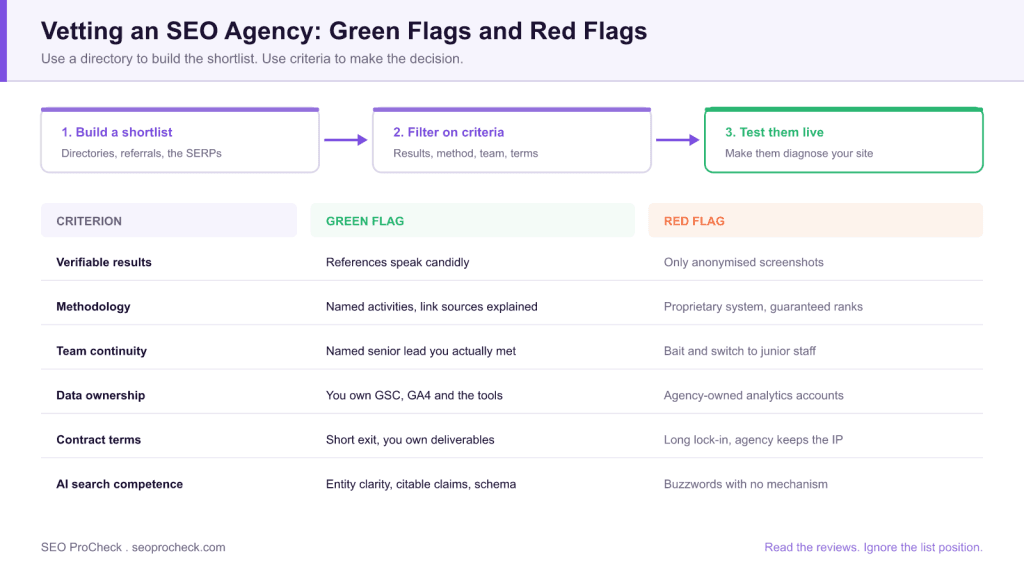
AI Summary
Directory rankings such as Clutch's 2019 list are a discovery tool, not a verdict: position is influenced by review-collection effort and sponsorship, while the review text itself is often genuinely useful. Shortlist from several sources, then decide on verifiable results, methodology transparency, who actually staffs your account, and contract terms.
- Read the two and three star reviews first: they are the least curated part of any directory.
- Insist on owning Search Console, GA4, and every tool account yourself.
- Guaranteed rankings, unexplained link sources, and long lock-in contracts are the clearest red flags.
- Ask each finalist to diagnose something on your site during the pitch: live reasoning beats any case study.

How do you find the best SEO company? Directory rankings like Clutch's 2019 list are a starting point for discovery, not a verdict: listings are shaped by review-collection effort and, on many directories, sponsorship. The reliable method is to shortlist from multiple sources, then evaluate each vendor yourself on verifiable client results, methodology transparency, contract terms, and who will actually work on your account. This page keeps the original directory reference and adds a current, criteria-based evaluation framework.
Key Concepts
Buying SEO is difficult for a structural reason: it is a credence good. You cannot assess the quality of the work by inspecting the deliverable, and the outcome arrives months later, entangled with seasonality, competitor activity, and algorithm updates. That combination means the market cannot reliably price quality, and confident salesmanship substitutes for verifiable skill more often than in almost any other professional service.
Two consequences follow, and both explain why directory position is weak evidence. First, the strongest signal available to a buyer is not claimed results but reasoning: whether a vendor can explain why something works, what would falsify their plan, and what they would refuse to do. Second, the incentives of any directory sit with the vendors who pay for visibility and the vendors who chase review counts, not with you. The review text can still be excellent, because interview-based reviews leak real project detail. The ranking order simply measures something other than quality.
Finally, understand the three engagement shapes on offer, because they fail differently. A consultant sells judgment and is bounded by their own hours. An agency sells capacity across disciplines and is bounded by the quality of its account leads. An in-house hire sells continuity and context and is bounded by the breadth of one person. Most bad outcomes trace back to buying the wrong shape rather than the wrong firm.
Implementation Considerations
Turn the shortlist into a decision with a structured process. The goal at every stage is to make the vendor demonstrate rather than assert.
- Write the brief before you talk to anyone. State the business outcome, the constraints (dev capacity, CMS, compliance, regions), and the budget band. Vendors who reshape their pitch around your constraints are showing you how they will work; vendors who deliver an identical deck regardless are showing you that too.
- Run a paid discovery or small audit against the top two. A short, paid piece of work is far cheaper than a bad twelve-month contract, and it reveals the two things you cannot see in a pitch: quality of thinking and quality of communication.
- Ask for a 90-day plan with named activities and owners. Vague phases ("technical optimisation", "content strategy") are a warning. You want specific deliverables, who produces them, and what evidence will show they worked.
- Interrogate link acquisition directly. Ask exactly where links will come from and what the outreach looks like. Any answer that avoids the mechanism, or leans on unnamed "partner networks", is describing purchased links, which is your risk to carry, not theirs.
- Confirm account ownership in writing. You should own Search Console, GA4, the CMS, the tools, and all content produced. This single clause determines whether leaving is an inconvenience or a catastrophe.
- Define reporting before signing. Agree the metrics, the cadence, and crucially what happens when results are flat. A vendor who has thought about how to report bad news is a vendor who expects to still be there.
Measuring Impact
Once engaged, judge the relationship on leading indicators early and business outcomes later. Expecting revenue movement in month two is how good engagements get cancelled and bad ones get extended.
| Timeframe | What should be visible | What it tells you |
|---|---|---|
| Weeks 1 to 4 | Audit findings, prioritised backlog, tracking verified, quick technical fixes shipped | Whether they can diagnose and actually ship, not just document |
| Months 2 to 3 | Indexation and crawl improvements, impressions rising on target templates | Early evidence the fixes reached the index |
| Months 3 to 6 | Ranking movement on target clusters, non-brand click growth, first content or link results | Whether the strategy is aimed at queries that matter |
| Months 6 to 12 | Non-brand organic sessions, assisted conversions, revenue or pipeline attributed to organic | Whether the programme pays for itself |
| Ongoing | Share of voice, AI answer citations, coverage of new topics | Whether you are gaining ground or standing still |
Insist on brand and non-brand being separated in every report. Brand traffic tends to rise with any marketing activity and is the most common way a flat SEO programme is made to look successful. Where a change is repeatable across a template, ask the vendor to validate it with a controlled experiment rather than a before-and-after chart; the method is set out in our guide to SEO A/B split testing.
What's Changed Since This 2019 List
A 2019 vendor snapshot has a short shelf life, and the market around it has changed in ways that matter to buyers:
- The rankings themselves are stale. Agencies merge, get acquired, lose key staff, or pivot; a firm's 2019 review profile says little about who will staff your account in 2026. Treat any dated list purely as a discovery pool.
- Directory incentives are better understood. Buyers now widely recognize that most B2B directories mix organic reviews with paid visibility placements. Reviews remain useful signal; list position is not.
- The service scope expanded. Post-2022, credible vendors must speak to AI search, meaning how content earns citations in AI Overviews, ChatGPT, and Claude, alongside classic rankings work. A pitch that never mentions AI surfaces is dated.
- Google's quality systems raised the stakes. The helpful-content system and its successors, plus scaled-content-abuse policies, mean a bad vendor can now do sitewide damage, not just waste budget. Vetting methodology matters more than it did in 2019.
- Deliverable inflation. AI writing tools made "content packages" cheap to produce. Volume-based deliverables (X posts per month) are a weaker value signal than ever; outcome orientation and editorial quality control are the differentiators.
How to Evaluate an SEO Vendor in 2026: Criteria Table
| Criterion | What to ask / verify | Green flag | Red flag |
|---|---|---|---|
| Verifiable results | Ask for 2 to 3 client references in your vertical or business model; verify outcomes in conversation, not slides | References speak candidly, including what didn't work | Only anonymized screenshots; "confidentiality" for everything |
| Methodology transparency | Ask exactly what they will do in months 1 to 3 and how links are acquired | Named activities, white-hat link earning explained plainly | "Proprietary system", guaranteed rankings, unexplained link sources |
| Team & continuity | Meet the people who will run the account, not just sales | Named senior lead with relevant experience | Bait-and-switch to junior staff after signing |
| Reporting & access | Confirm you keep owner access to Search Console, GA4, and any tools | You own all properties; reporting tied to business outcomes | Agency-owned analytics; rank-only reporting |
| Contract terms | Review exit clauses and IP ownership of content and links | Monthly or quarterly exit; you own all deliverables | 12-month lock-in; content ownership retained by agency |
| AI-search competence | Ask how they approach AI Overviews and assistant citations | Concrete answer-engine tactics: entity clarity, citable claims, structured data | Blank stare, or pure buzzwords with no mechanism |
| Risk practices | Ask what could get you penalized and how they avoid it | Frank discussion of scaled-content and link-scheme risks | Claims their methods carry no risk |
Using Directories Without Being Misled
Directories such as Clutch, G2, and UpCity are genuinely useful for one thing: assembling a shortlist quickly, with review text that sometimes surfaces real project detail (budget bands, engagement length, named contacts). Read the two-star and three-star reviews first: they are the least curated. Then leave the directory: cross-check the agency's own organic footprint (an SEO firm that cannot rank for anything is a signal), look at team profiles for continuity, and run your shortlist through the criteria table above. Ask each finalist to walk you through a technical finding on your site during the sales process; how they diagnose live is more informative than any case study. Expect competent vendors to talk fluently about structured data implementation (see our guide to JSON-LD structured data for the baseline you should expect them to exceed) and about winning modern SERP real estate such as People Also Ask and AI assistant citations.
Frequently Asked Questions
The review text is often genuinely informative because Clutch conducts some reviews as interviews with project details. The ranking order is less reliable, since visibility on B2B directories is influenced by sponsorship and review-collection effort. Use reviews as input, never list position as a decision.
Ranges vary enormously by market and scope, from a few hundred dollars monthly for local small-business packages to five figures for competitive national programs. Rather than anchoring on a number, anchor on scope: what activities, what seniority of staff, and what outcomes the fee actually buys. Be wary at both extremes.
The highest-signal five: What exactly will you do in the first 90 days? How do you acquire links? Who specifically will work on my account? What could go wrong and how do you limit risk? How do you address AI search surfaces alongside Google rankings?
Guaranteed rankings, "secret relationships with Google", refusal to explain link sources, agency-owned analytics accounts, long lock-in contracts with agency-retained content ownership, and rank-only reporting disconnected from revenue.
Depends on scale and duration. Freelancers and consultants suit audits, strategy, and small sites; agencies suit sustained multi-skill execution (content, technical, digital PR); in-house pays off when SEO is a core, permanent channel. Many mature teams combine in-house ownership with specialist outside help.
Technical fixes can move things in weeks; content and authority programs typically need one to two quarters before trend lines are readable, longer in competitive niches. Any vendor promising specific positions on a specific date is guessing or worse, but a good one will commit to leading indicators (indexation, impressions, coverage) on a timeline.
This resource contributes to the knowledge base SEO practitioners need for effective optimization in an evolving search landscape.
Source: https://clutch.co/seo-firms
Take this with you
The assistant links open with a question about this page already written. Nothing is sent until you press enter.
Claude Vincent is a technical SEO consultant focused on crawlability, rendering, and AI-search visibility. He writes the field guides and case studies at SEO ProCheck, with a bias toward the durable, unglamorous work that decides whether search engines and AI answer engines can actually read and cite a site.
About SEO ProCheck
Technical SEO consulting and GEO strategy with 20 years of enterprise experience. Case studies, resources, and tools for search and AI visibility.
Work With Me
Technical SEO audits, GEO strategy, site migrations, and international SEO. Hourly consulting for teams who need hands-on support, not just reports.
Subscribe to our newsletter!








Recent Posts
- Most Top Sites Never Say Who They Are in Structured Data October 14, 2026
- Homepage Titles Are Mostly Too Short, Not Too Long October 8, 2026
- Who Actually Serves an llms.txt? 184 Top Sites Measured September 29, 2026