

AI Summary
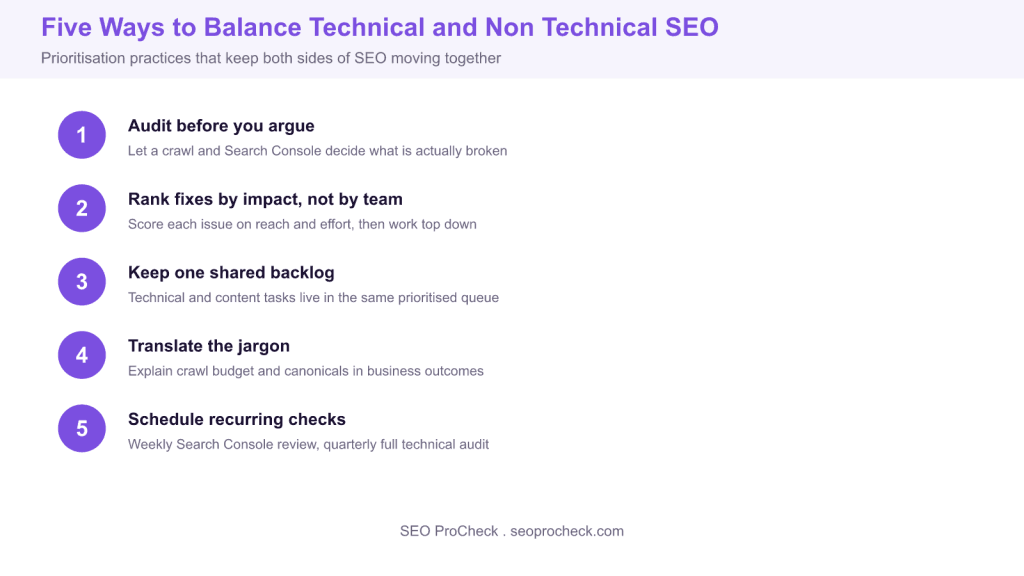
Balancing technical and non technical SEO is a prioritisation problem, not a fifty fifty time split. Let an audit decide the current constraint, then score technical and content tasks on one shared backlog so neither side starves the other.
- Audit first: let crawl and Search Console data set the agenda, not opinions.
- Rank every fix by impact and effort on a single rubric that technical and content share.
- Keep one prioritised backlog so trade offs and dependencies are visible.
- Schedule recurring checks because technical health decays quietly between projects.
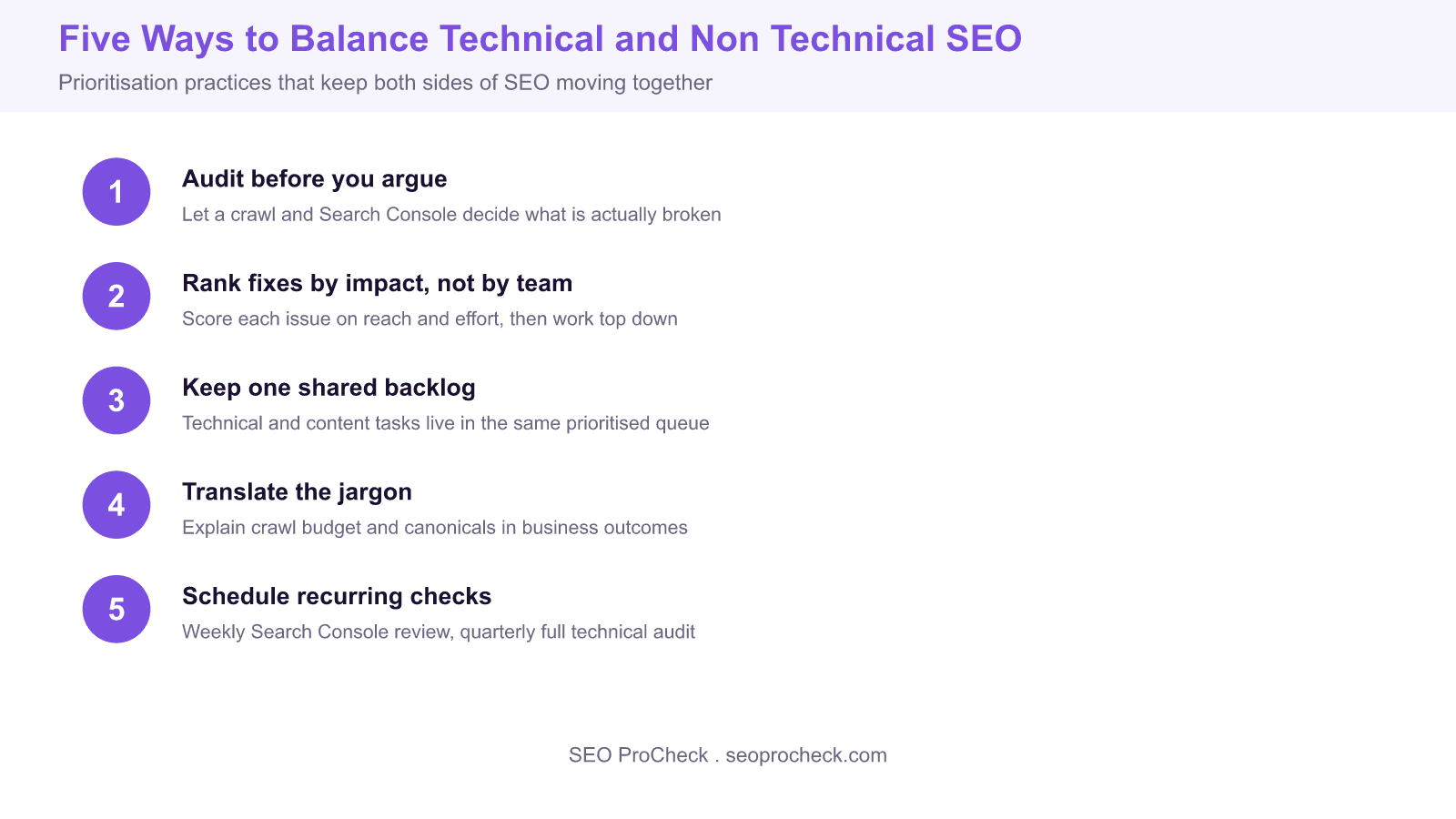
Technical SEO and non technical SEO, meaning content, on page optimisation, and link earning, are often run by different people with different instincts, and that is where sites lose momentum. One side wants to fix crawl paths and Core Web Vitals; the other wants to publish and promote. Balancing them is not about splitting time evenly, it is about a shared way to decide what matters most this month. These five practices keep both sides pulling in the same direction.
1. Audit before you argue
Most debates about where to spend effort evaporate once you have data. Run a crawl with a tool like Screaming Frog, pull the Pages and Core Web Vitals reports from Search Console, and look at which queries and pages actually drive traffic. That evidence tells you whether the constraint right now is technical, for example a swathe of pages excluded by noindex, or editorial, for example strong pages that simply lack depth or links. Let the audit, not the loudest voice, set the agenda.
2. Rank fixes by impact, not by team
Score every candidate task on two axes: the size of the opportunity, meaning traffic or revenue at stake, and the effort to ship it. A canonical fix that recovers a whole product category outranks a blog refresh, and a high intent article that can rank in weeks may outrank a marginal speed tweak. When technical and content items compete on the same scoring rubric, priority stops being a turf war and becomes a calculation everyone can see.
3. Keep one shared backlog
Separate to do lists guarantee that one side gets starved. Put technical fixes and content work in a single prioritised backlog, whether that lives in Jira, Asana, or a spreadsheet, with each item tagged by type, impact score, and owner. A shared queue makes trade offs explicit: when a developer sprint has capacity, the top technical item is obvious, and when the writers have room, the top content item is too. It also surfaces dependencies, such as a redesign that must ship before new landing pages can go live.
4. Translate the jargon
Technical SEO stalls when stakeholders cannot see why it matters, so frame it in outcomes rather than mechanics. Crawl budget becomes how quickly new products get discovered. Canonical consolidation becomes stopping our own pages from competing with each other. Core Web Vitals becomes fewer visitors bouncing before the page loads. When a writer or an executive understands the business result, technical work stops being a mysterious cost and starts being an obvious investment.
5. Schedule recurring checks
Technical health decays quietly: a plugin update reintroduces a noindex, a migration breaks redirects, a template change drops structured data. Build a rhythm so problems surface early. Review Search Console for new errors weekly, run a full crawl based audit quarterly, and always audit before and after any migration or redesign. Meanwhile the content side keeps producing and refreshing. The cadence is what keeps the balance from tipping back into neglect the moment attention moves elsewhere.
What has changed since this idea was first written
The balancing act was framed years ago, and the fundamentals hold, but two shifts are worth noting. First, the line between technical and content work has blurred: Core Web Vitals, structured data, and JavaScript rendering all sit at the intersection, and helpful, people first content is now judged continuously by the core algorithm rather than a separate filter. Second, generative results and AI overviews raise the stakes on both sides at once, since being cited depends on content that genuinely answers the query and on technical delivery clean enough for machines to parse. The practices above still apply, they simply span a wider surface.
Technical and non technical SEO side by side
| Dimension | Technical SEO | Non technical SEO |
|---|---|---|
| Focus | Crawl, index, render, speed | Content, keywords, links, brand |
| Typical owner | Developers, technical SEO | Writers, editors, outreach |
| Main tools | Screaming Frog, Search Console, Lighthouse | Keyword tools, CMS, digital PR |
| Payoff timing | Often fast once a blocker clears | Compounds over weeks and months |
| Failure mode | Great content that cannot be crawled | A fast site with nothing worth ranking |
Related reading
- Common technical SEO issues and how to fix them
- The most frequent technical SEO mistakes at scale
- More technical SEO articles
Frequently asked questions
What is the difference between technical and non technical SEO?
Technical SEO covers how search engines crawl, index, render, and experience your site, including robots directives, canonicals, site speed, and structured data. Non technical SEO covers content quality, keyword targeting, on page optimisation, and earning links. Technical work makes pages accessible and fast, while non technical work gives search engines something worth ranking.
Which matters more, technical or content SEO?
Neither wins in the abstract, because they depend on each other: excellent content that cannot be crawled never ranks, and a flawless technical site with thin content has nothing to rank. The right priority depends on your current constraint, which an audit reveals. Fix whichever side is holding results back first.
How do I prioritise technical fixes against content work?
Score every task on the same rubric: the potential impact in traffic or revenue and the effort to deliver it. Put both technical and content items in one prioritised backlog so they compete fairly. This turns priority from a turf war into a transparent calculation everyone can agree on.
How often should technical SEO be checked?
Review Search Console for new errors weekly, run a full crawl based audit quarterly, and always audit before and after any migration or redesign. Technical health decays quietly through plugin updates, template changes, and migrations, so a regular cadence catches regressions before they cost traffic.
How do I explain technical SEO to non technical stakeholders?
Translate mechanics into business outcomes. Describe crawl budget as how fast new pages get found, canonical fixes as stopping your pages competing with each other, and Core Web Vitals as fewer visitors leaving before the page loads. When people see the result, the work stops looking like an abstract cost.
Can one person handle both technical and non technical SEO?
On smaller sites, yes, and many generalist SEOs do exactly that. As a site grows the volume usually justifies specialists, at which point a shared backlog and a common prioritisation rubric become essential so the two disciplines reinforce rather than block each other.
Technical SEO provides the foundation for content visibility. Without proper technical implementation, even excellent content may fail to rank. This resource covers technical considerations that enable search engines to effectively crawl, index, and rank your content.
Crawlability Essentials
Search engines must be able to discover and access your content. This requires proper robots.txt configuration, XML sitemaps, internal linking, and server reliability. Technical barriers to crawling prevent content from entering the ranking competition regardless of quality.
Indexation Optimization
Not all crawled pages get indexed. Ensuring pages provide sufficient unique value, avoiding duplicate content issues, and using canonical tags appropriately help control what gets indexed. Monitoring indexation status through Search Console reveals issues requiring attention.
Performance and Experience
Core Web Vitals and page speed affect both user experience and rankings. Technical optimizations including caching, compression, image optimization, and code efficiency improve performance metrics. These optimizations serve users while sending positive signals to search engines.
This resource provides guidance for building and maintaining the technical foundation that enables SEO success.
Source: http://searchengineland.com/5-ways-balance-technical-non-technical-seo-280058
Take this with you
The assistant links open with a question about this page already written. Nothing is sent until you press enter.
Claude Vincent is a technical SEO consultant focused on crawlability, rendering, and AI-search visibility. He writes the field guides and case studies at SEO ProCheck, with a bias toward the durable, unglamorous work that decides whether search engines and AI answer engines can actually read and cite a site.
About SEO ProCheck
Technical SEO consulting and GEO strategy with 20 years of enterprise experience. Case studies, resources, and tools for search and AI visibility.
Work With Me
Technical SEO audits, GEO strategy, site migrations, and international SEO. Hourly consulting for teams who need hands-on support, not just reports.
Subscribe to our newsletter!








Recent Posts
- Most Top Sites Never Say Who They Are in Structured Data October 14, 2026
- Homepage Titles Are Mostly Too Short, Not Too Long October 8, 2026
- Who Actually Serves an llms.txt? 184 Top Sites Measured September 29, 2026