

AI Summary
Web governance is the set of standards, roles, and workflows that keep a large site consistent, accessible, and technically clean. Those same disciplines quietly prevent the crawl waste, duplication, and broken markup that erode SEO, which is why good governance and good search performance tend to travel together.
- Governance sets shared standards so every new page ships crawlable, consistent, and correctly marked up.
- Clear ownership means technical and content issues get fixed rather than ignored between teams.
- Accessibility and quality checks built into the workflow protect both users and rankings.
- Planned content retirement curbs index bloat and stops thin pages from competing with each other.
What web governance means
Web governance is the boring machinery that keeps a website coherent as it grows: the documented standards for how pages are built, the roles that say who owns what, the workflow that content passes through before it goes live, and the quality gates that catch problems early. On a five page site none of this feels necessary. On a five thousand page site run by many contributors, the absence of governance is exactly what produces the sprawling technical debt that SEO audits keep rediscovering.
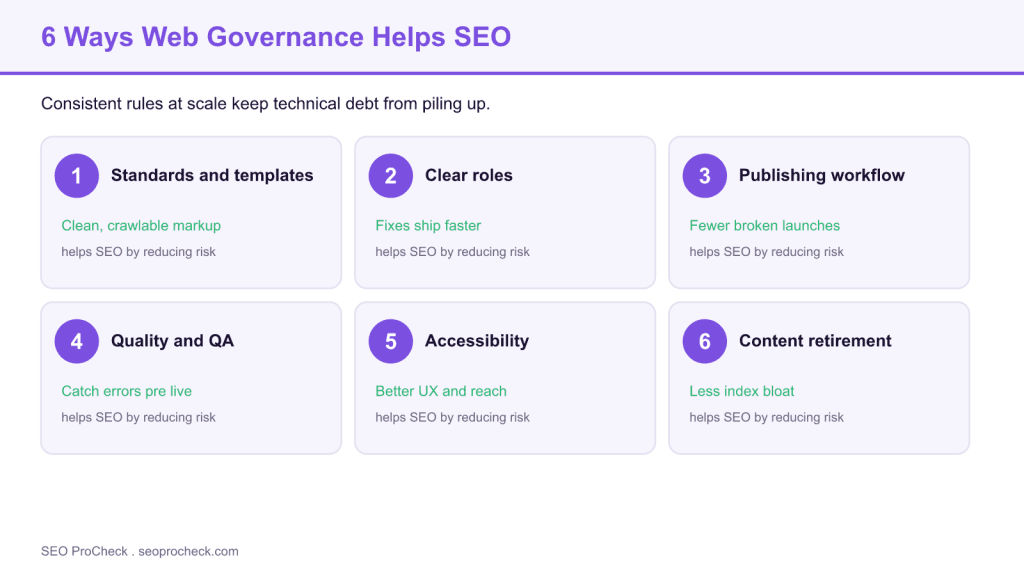
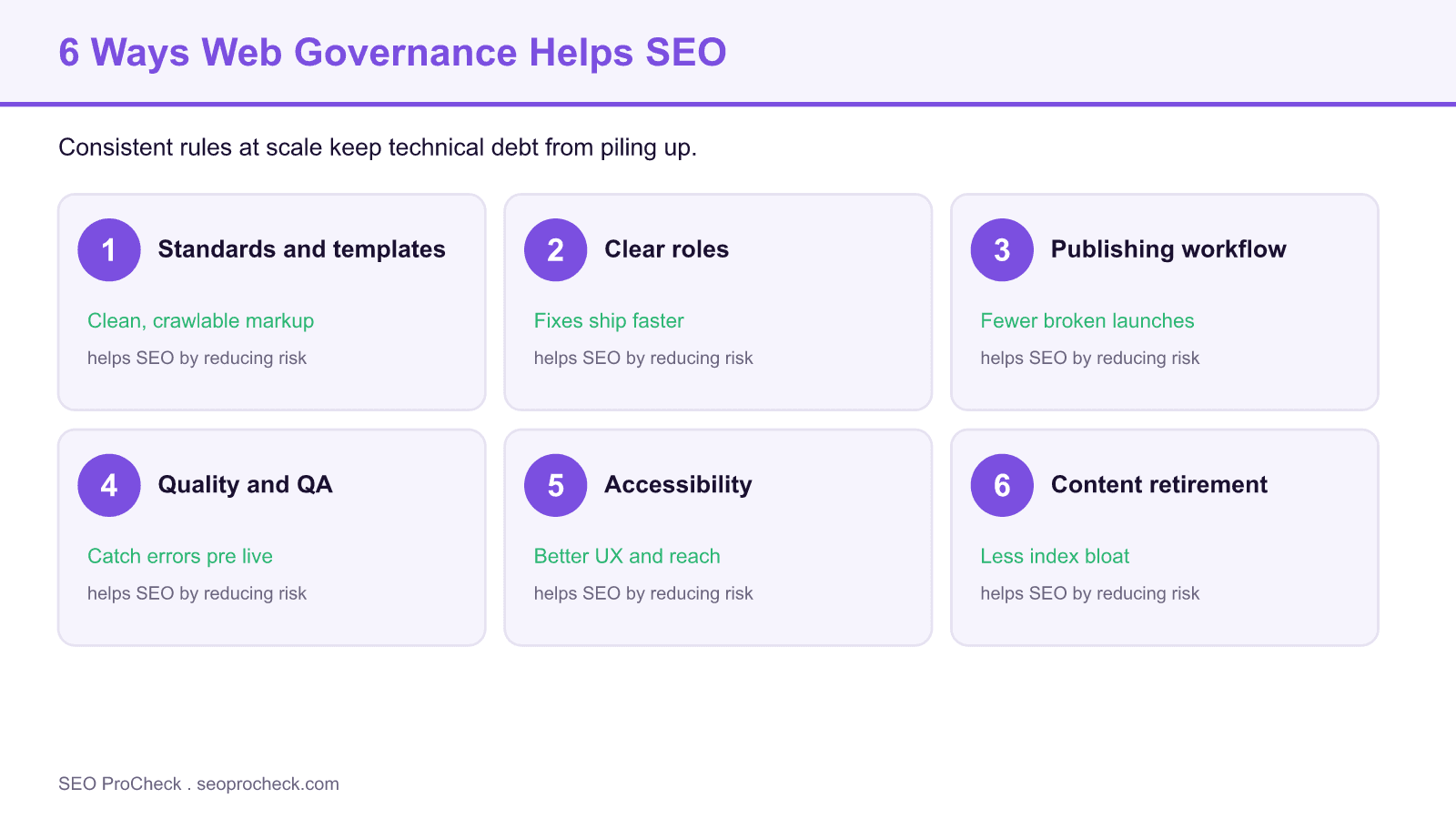
The source for this post frames governance as an SEO ally, and that is the right way to see it. Most large scale SEO problems, duplicate templates, inconsistent markup, orphaned pages, thin content piling up, are governance failures wearing an SEO costume. The six pillar diagram above maps each governance discipline to the risk it removes.
How governance turns into rankings
Standards and templates mean a new page arrives with clean, crawlable markup by default instead of depending on whoever built it. Clear roles mean that when a crawl surfaces a broken canonical or a missing title, someone actually owns the fix. A publishing workflow with review steps stops broken launches, redirect chains, and accidental noindex tags from reaching production. Quality assurance catches errors before users and crawlers do.
Accessibility, treated as part of governance rather than an afterthought, improves the experience for everyone and keeps your markup honest, which search engines reward indirectly. And deliberate content retirement, deciding when to update, consolidate, or remove a page, prevents the slow accumulation of thin, overlapping URLs that dilute topical authority. You can catch the symptoms of weak governance with checks like URLs with duplicate content and indexed with issues.
Making governance stick
Governance only helps if it is lightweight enough to follow. Write the standards down, bake them into templates and the content management system so the right thing is the easy thing, and assign clear owners for technical health, content quality, and accessibility. Add a small number of automated checks to the publishing pipeline so regressions are caught at the source rather than in a quarterly audit. Validate your markup as part of that pipeline; the structured data validation errors and accessible text for graphics checks are good candidates to run continuously.
Six governance pillars and their SEO payoff
| Governance pillar | What it controls | SEO payoff |
|---|---|---|
| Standards and templates | How pages are built | Clean, crawlable markup by default |
| Clear roles | Who owns each fix | Issues get resolved, not orphaned |
| Publishing workflow | How content ships | Fewer broken or accidental launches |
| Quality and QA | Pre launch review | Errors caught before crawlers see them |
| Accessibility | Inclusive markup | Better UX and honest, reachable content |
| Content retirement | When to prune or merge | Less index bloat and cannibalization |
What has changed since
Governance has only grown more important. The rise of scaled and AI assisted content makes it easy to publish thousands of pages quickly, which turns weak governance into index bloat almost overnight, exactly the pattern Google targets when it emphasizes helpful content. AI crawlers now consume your site alongside traditional bots, so consistent, accessible markup pays off across more surfaces. And accessibility has moved from nice to have toward a baseline expectation, backed by growing legal pressure in many regions. The disciplines in this post are the same; the cost of skipping them is higher.
Frequently asked questions
What is web governance?
Web governance is the set of documented standards, roles, and workflows that keep a website consistent, accessible, and technically sound as it grows and as many people contribute to it.
How does web governance help SEO?
It prevents the root causes of common SEO problems, such as duplicate templates, broken markup, orphaned pages, and thin content, by enforcing standards and clear ownership before issues reach production.
Is accessibility part of web governance?
Yes. Treating accessibility as a governance standard rather than an afterthought produces cleaner, more honest markup that helps users, search engines, and increasingly meets legal expectations.
What is content retirement and why does it help SEO?
Content retirement is the deliberate practice of updating, consolidating, or removing pages that no longer earn their place. It reduces index bloat and stops thin, overlapping pages from competing with one another.
Who owns web governance?
Effective governance assigns clear owners for technical health, content quality, and accessibility, rather than leaving these to chance. Ownership is what turns standards into fixes that actually ship.
Does governance matter for small sites?
Even small sites benefit from basic standards and templates, but governance pays off most as a site scales and more contributors are involved, where the absence of shared rules creates compounding technical debt.
Original summary and source
6 Ways Web Governance Helps SEO provides valuable insights for SEO practitioners. This resource examines approaches and considerations that can improve organic search performance.
Key Concepts
Understanding the fundamental principles behind this topic helps inform strategic decisions. Whether optimizing for traditional search or emerging AI platforms, foundational concepts remain relevant. This resource covers the essential knowledge practitioners need.
Implementation Considerations
Moving from concept to execution requires understanding practical constraints and opportunities. Different situations call for different approaches. This resource provides guidance for applying concepts in real-world contexts.
Measuring Impact
SEO efforts require measurement to demonstrate value and guide optimization. Identifying appropriate metrics, establishing baselines, and tracking progress enables data-driven improvement. This resource addresses how to evaluate success.
This resource contributes to the knowledge base SEO practitioners need for effective optimization in an evolving search landscape.
Source: https://monsido.com/blog/ways-web-governance-helps-seo
Claude Vincent is a technical SEO consultant focused on crawlability, rendering, and AI-search visibility. He writes the field guides and case studies at SEO ProCheck, with a bias toward the durable, unglamorous work that decides whether search engines and AI answer engines can actually read and cite a site.
About SEO ProCheck
Technical SEO consulting and GEO strategy with 20 years of enterprise experience. Case studies, resources, and tools for search and AI visibility.
Work With Me
Technical SEO audits, GEO strategy, site migrations, and international SEO. Hourly consulting for teams who need hands-on support, not just reports.
Subscribe to our newsletter!







Recent Posts
- Can AI Crawlers Actually Read Your Site? I Measured 400 of the Biggest September 5, 2026
- The Pre-Publish Quality Gate for AI-Assisted Content August 6, 2026
- AGENTS.md vs llms.txt vs llms-full.txt: Which Agent File Does What July 18, 2026