

AI Summary
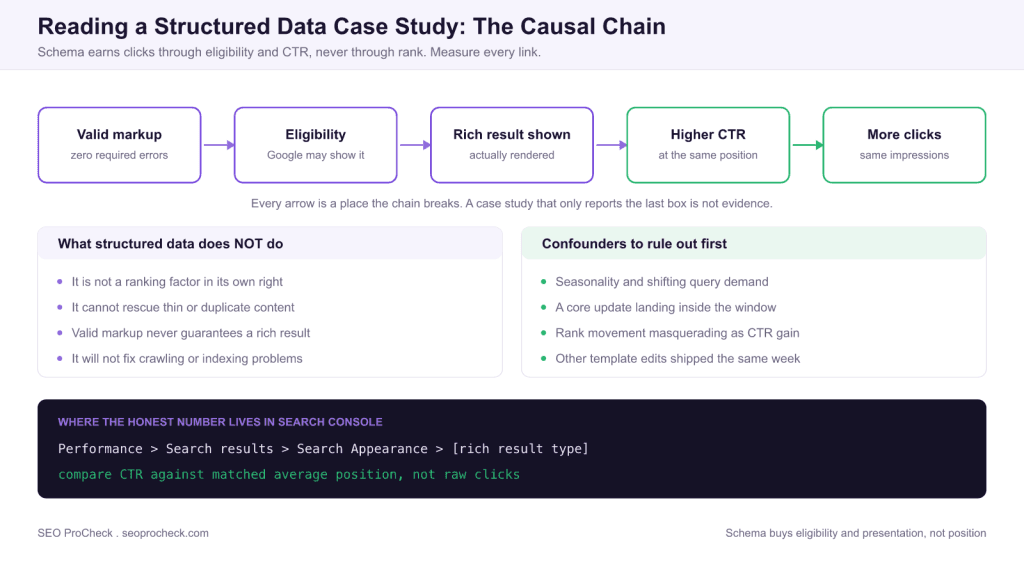
Structured data case studies are only useful when they trace the full causal chain: valid markup buys rich result eligibility, eligibility sometimes produces a rendered rich result, and a rendered rich result can lift click through rate at an unchanged position. Schema is not a ranking factor, so any case study reporting a rank increase as the direct result of markup has almost certainly measured something else.
- Read every case study against the chain: markup validity, eligibility, rendering, CTR, then clicks.
- The honest number lives in Search Console under Performance, Search results, filtered by Search Appearance for the specific rich result type.
- Compare CTR at a matched average position. Raw click totals conflate presentation gains with rank movement.
- Rule out seasonality, core updates and simultaneous template changes before claiming schema caused the lift.
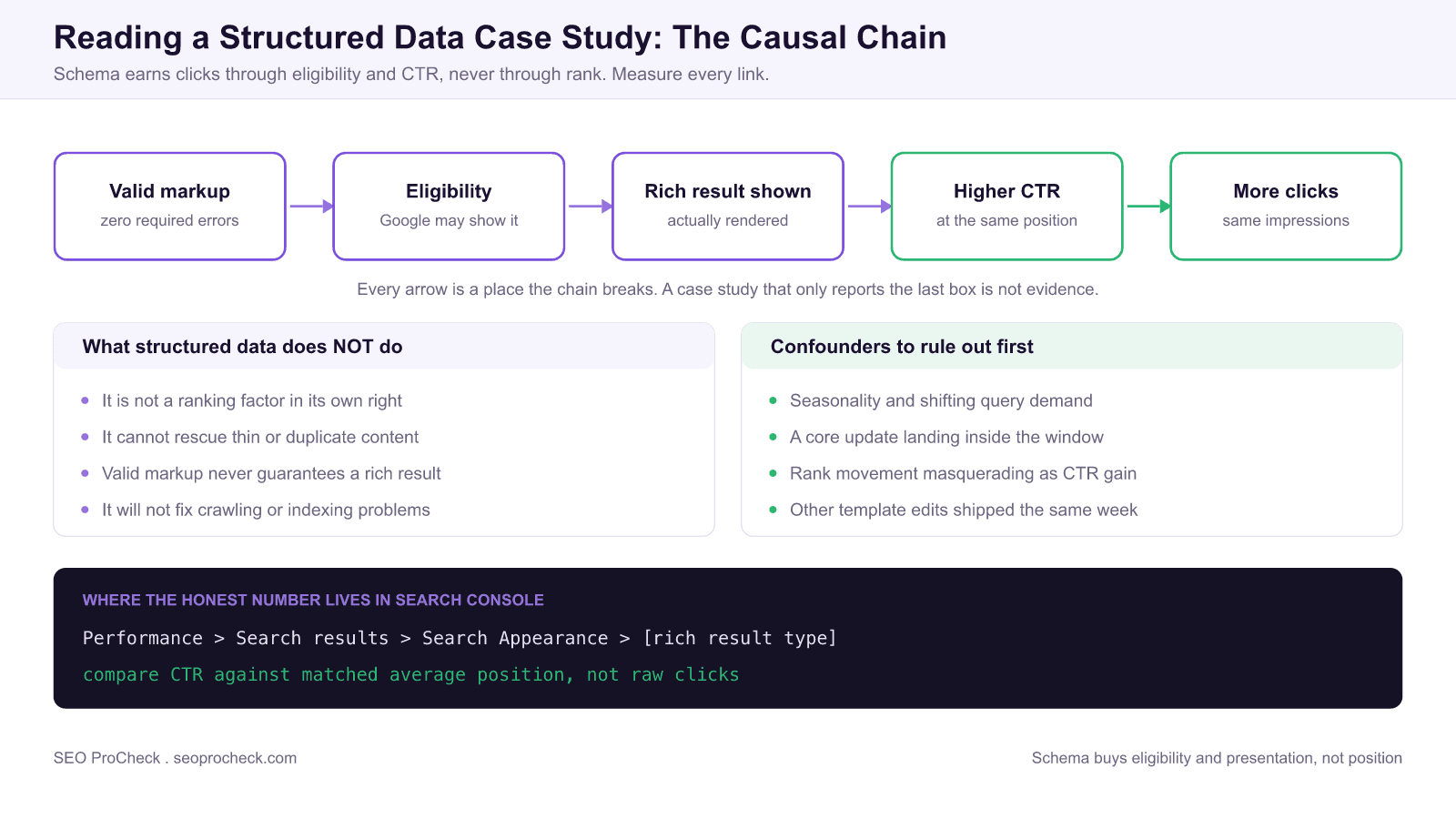
Structured data case studies are the most over cited and least scrutinised artefact in technical SEO. A number gets published, the number gets repeated in conference slides, and three years later it is quoted as though it were a property of schema markup rather than a property of one site, one template and one quarter. The useful skill is not collecting more case studies. It is knowing how to read one, and knowing how to run one on your own site so the result survives contact with a sceptical stakeholder.
This page sets out the evaluation framework: the causal chain that schema actually operates through, the measurement design that isolates it, and the confounders that produce most of the inflated numbers in circulation. The source case studies collected below are worth reading with that framework in hand.
Schema Types and Applications
Different schema types serve genuinely different purposes, and the distinction that matters for measurement is whether a type has a visible SERP treatment attached to it. A type with a distinct rendering gives you something to filter on and attribute against. A type with no current visual treatment may still improve machine comprehension of your entities while producing no measurable click change at all, which is a perfectly reasonable reason to implement it and a terrible basis for a case study.
| Schema type | Visible SERP treatment | What a lift is attributable to | Measurement difficulty |
|---|---|---|---|
| Product | Price, availability, review stars in the snippet | Strong. Price and stock state visibly change the listing | Low, filter Search Appearance by product snippets |
| Recipe | Image, rating, cook time, carousel entry | Strong. Carousel placement is a distinct surface | Low |
| Event | Date and venue in an event listing block | Strong, though highly seasonal | Medium, seasonality dominates |
| VideoObject | Thumbnail, key moments, video carousel | Strong when the thumbnail renders | Low |
| BreadcrumbList | Path replaces the raw URL in the listing | Moderate. Small but broad CTR effect | Medium, effect is diffuse across the site |
| FAQPage | Heavily restricted since 2023 | Weak now. Treatment mostly withdrawn | High, historic case studies no longer replicate |
| Organization and WebSite | Knowledge panel and sitelinks inputs | Indirect. Entity clarity rather than a snippet | High, no clean attribution path |
That last row explains a lot of disappointing implementations. Organization markup is worth deploying because it clarifies who you are to search engines and increasingly to AI answer engines, but nobody should promise a click through rate lift from it. Match the claim to the mechanism. If you are choosing which types to prioritise, the individual property guides for Product schema and Breadcrumb schema set out the required fields for each, and the FAQ schema guide explains precisely what changed in 2023 and why older FAQ case studies no longer reproduce.
Implementation Best Practices
JSON-LD is the recommended format, and the reason is operational rather than theoretical: it lives in a single block, it can be injected without touching page templates, and it can be diffed and validated in isolation. Microdata scattered through markup is far harder to audit and far easier to break during an unrelated template change.
Beyond format choice, four practices separate implementations that survive an audit from ones that quietly rot:
- Complete the required properties, then the recommended ones. Google's documentation splits properties into required and recommended for each type. Required properties gate eligibility. Recommended properties frequently gate how rich the rendering is, so treating them as optional caps your upside.
- Mirror what is visible on the page. Markup must describe content the user can actually see. This is a policy requirement, not a stylistic preference, and it is the single most common cause of manual actions against rich results.
- Connect the entities rather than emitting islands. A page that emits four disconnected JSON-LD blocks tells search engines far less than one graph where the Article, the Organization and the WebPage reference each other by identifier. The guide to graph nesting and entity connection covers the identifier pattern in detail.
- Validate continuously, not once. Schema breaks silently during unrelated deployments. Testing before launch catches the initial implementation. Monitoring the enhancement reports catches the regression six months later, which is when most breakage actually happens.
When markup is valid but nothing renders, the debugging path is specific and worth learning properly. The walkthrough on validating and debugging structured data when rich results do not appear covers the sequence, from the Rich Results Test through to the enhancement reports and the eligibility conditions that no validator can check for you.
Rich Results Impact
Here is the part most case studies get wrong. Schema is not a ranking factor, so it cannot move you from position eight to position three. What it can do is change the amount of vertical space, visual weight and pre click information your listing carries at whatever position you already hold. That means the correct dependent variable is click through rate at a controlled position, and the correct instrument is the Search Appearance dimension in Search Console.
The measurement design that holds up is straightforward. Establish a baseline of at least four weeks of click through rate and average position for the target templates. Deploy the markup to one template group while holding a comparable group unchanged as a control. Wait for the enhancement report to confirm the valid item count has actually risen, which is the proof that Google has processed the change rather than merely received it. Then compare the treated group against the control across the same window, reading click through rate rather than clicks, and segmenting by device because rich result rendering differs between mobile and desktop.
| Claim in a case study | What to check before believing it | Common innocent explanation |
|---|---|---|
| Rankings improved after adding schema | Was anything else shipped in the same window? | Content or internal linking changes bundled into the same release |
| Traffic rose 30% after markup | Did average position also move? | Rank gain from an unrelated cause, misattributed to schema |
| CTR doubled on FAQ rich results | What date range does the study cover? | Pre 2023 data, when FAQ treatment was still widely shown |
| Impressions increased sharply | Impressions for which search appearance? | New eligibility surface counted alongside existing listings |
| Revenue rose after Product schema | Was there a promotion, price change or seasonal peak? | Commercial calendar rather than markup |
| Rich results appeared within days | Site crawl frequency and index coverage | Fast recrawl on a high authority domain, not a general rule |
How to Run a Case Study Worth Publishing
If you want your own result to be credible, constrain the experiment before you start. Choose one schema type and one template group. Write down the expected mechanism in advance, naming the specific rich result treatment you expect to earn, so you cannot retrofit an explanation to whatever the data does. Hold a control group. Define the measurement window and the success metric before you look at any data.
Then report honestly, which mostly means reporting the denominators. State how many URLs received the markup, how many became valid in the enhancement report, how many actually earned the rich result, and what average position did across the window. A case study that reports a percentage lift without those four numbers is not reproducible, and reproducibility is the entire point of publishing one.
It is also worth extending the framework beyond classical search. Structured data increasingly feeds systems that never render a blue link at all, and the note on schema markup for AI search covers how machine readable data is consumed by answer engines, where the payoff shows up as citation and inclusion rather than as click through rate.
Frequently Asked Questions
Is structured data a ranking factor?
No. Google has stated repeatedly that structured data is not a ranking signal in its own right. What it does is make a page eligible for rich result treatments, and those treatments change how the listing looks, which changes click through rate. The traffic gain is real but it arrives through presentation rather than through position.
How do you prove a structured data change actually caused a traffic lift?
Isolate the rich result type in the Search Console Performance report using the Search Appearance filter, then compare click through rate at a matched average position rather than comparing raw clicks. If average position moved at the same time, the click change is contaminated. Ship the markup to one template group at a time so an unchanged group acts as a control.
Why does valid markup sometimes produce no rich result at all?
Validity is a necessary condition, not a sufficient one. Google decides whether to render a rich result based on page quality, query intent, device, and its own confidence in the data, so a technically perfect implementation can still show a plain blue link. Eligibility is the only thing markup buys you.
How long should you wait before measuring the impact?
Wait until Google has recrawled and reprocessed a meaningful share of the affected URLs, which usually means two to four weeks on a mid sized site. Check the relevant enhancement report in Search Console to confirm the valid item count has actually risen before you start reading traffic data. Measuring before the markup is processed produces a null result that looks like failure.
Which schema types tend to produce the clearest measurable results?
Types tied to a visible SERP treatment show the clearest effects, because there is something concrete to attribute the change to. Product with price and availability, Recipe, Event, Video and Breadcrumb all have distinct renderings you can filter for in Search Appearance. Types with no current visual treatment may still help machine understanding while producing no measurable click change.
Can structured data hurt a site?
Yes, in two ways. Markup that describes content not visible on the page violates Google's structured data policies and can trigger a manual action against the site's rich results. Separately, a rich result can reduce clicks when it answers the query so completely that users no longer need to visit, which is a real trade worth measuring rather than assuming.
Read the collected case studies below with the causal chain in mind. The ones that hold up will tell you which schema type was deployed, on how many URLs, what the enhancement report confirmed, and what happened to click through rate at a stable average position. The ones that do not will give you a single percentage and a logo.
Source: https://econsultancy.com/case-studies-structured-data-seo
Take this with you
The assistant links open with a question about this page already written. Nothing is sent until you press enter.
Claude Vincent is a technical SEO consultant focused on crawlability, rendering, and AI-search visibility. He writes the field guides and case studies at SEO ProCheck, with a bias toward the durable, unglamorous work that decides whether search engines and AI answer engines can actually read and cite a site.
About SEO ProCheck
Technical SEO consulting and GEO strategy with 20 years of enterprise experience. Case studies, resources, and tools for search and AI visibility.
Work With Me
Technical SEO audits, GEO strategy, site migrations, and international SEO. Hourly consulting for teams who need hands-on support, not just reports.
Subscribe to our newsletter!






Recent Posts
- Finding a Competitor's Sitemap, and Turning It Into a Change Log September 15, 2026
- AI Crawler User Agents: The Current Names, and Which Ones Sites Actually Block September 9, 2026
- Can AI Crawlers Actually Read Your Site? I Measured 400 of the Biggest September 5, 2026