AI Summary
Google expanded its translated results feature to more languages and countries, so it can show your page to searchers who queried in a language you never targeted by machine translating the title, snippet, and landing page. Clicks from translated results count as normal organic visits, which widens your reach but rewards clear, well structured writing over clever wordplay.
- Google translates your title, snippet, and the destination page on the fly for the searcher.
- The feature grew to cover more languages and regions during 2024.
- Traffic from translated results appears as ordinary organic traffic in your reports.
- Real hreflang and localized pages still outperform machine translation when you actively serve a market.

Google's Now Translating SERPs Into More Languages provides valuable insights for SEO practitioners. This resource examines approaches and considerations that can improve organic search performance.
What Google changed
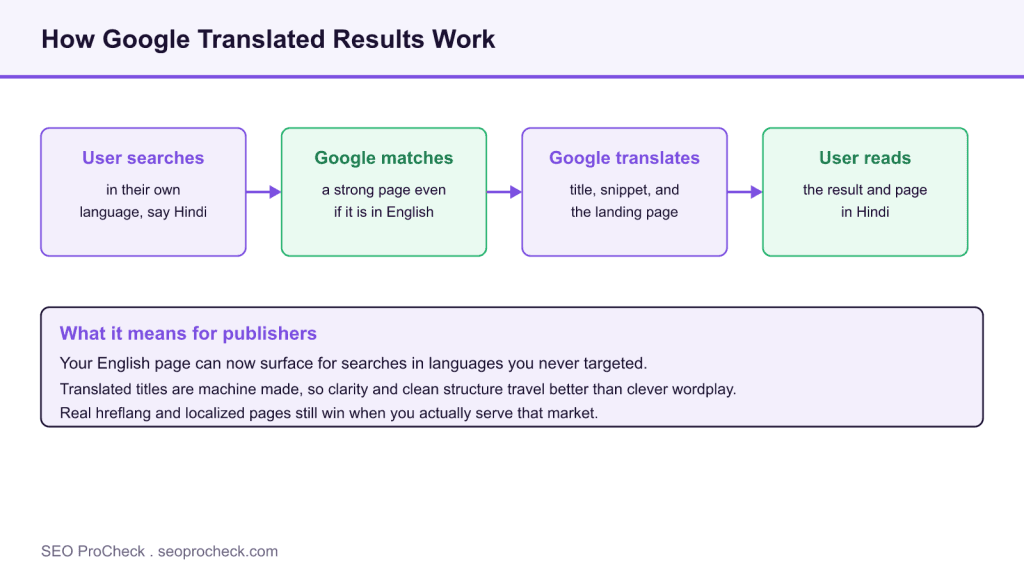
Google translated results let a searcher find and read a page that was written in another language. When someone searches in, say, Hindi and the strongest answer is an English page, Google can show a translated title and snippet, and on click, machine translate the landing page itself so the searcher reads it in Hindi. In 2024 Google expanded this to more languages and countries, which means pages can now surface for audiences their authors never explicitly targeted. The source below has Google's announcement.
How translated results work
The flow is four steps, shown in the diagram above. A user searches in their own language. Google matches a strong page even if it is in a different language. Google machine translates the title, the snippet, and, on click, the destination page. The user reads the whole experience in their language. The translation is Google's, applied on the fly, so you do not create or host the translated version, and you cannot fully control its wording. For the vocabulary here, our SERP glossary entry and international SEO entry give the background.
What it means for your traffic and reporting
The upside is genuine reach: your content can earn clicks from markets you never built pages for, at no extra cost. The reporting wrinkle is that a click from a translated result is counted as normal organic traffic, so it appears in Search Console and analytics like any other visit, sometimes under queries in a language you do not publish in. If you see impressions or clicks for unexpected languages, translated results are a likely cause rather than an error. This is reach you did not plan, which is good, but it is not a substitute for deliberately serving a market.
How to make your pages translate well
Because the machine does the translating, the pages that survive translation best are the ones written plainly and structured cleanly. Idioms, puns, and clever headlines often translate into nonsense, while direct sentences and clear headings carry across.
| Translates well | Translates poorly |
|---|---|
| Plain, direct sentences | Idioms, puns, and cultural references |
| Clear, descriptive headings | Clever or vague clickbait headlines |
| Standard terminology for the topic | Invented brand jargon with no equivalent |
| Short sentences and clean structure | Long, clause heavy sentences |
None of this asks you to write worse. It asks you to write clearly, which is the same discipline that helps human readers and AI systems parse your page.
What has changed since, and the limits
Translated results are reach, not a market strategy. If you actually sell into a language or region, machine translation is no replacement for genuinely localized pages with real hreflang, local currency, and local search terms, which will outrank a translated foreign page when you compete directly. The honest way to read this feature: it is a free bonus that widens your visibility and a reason to keep your writing clear, but the moment a market matters to your business, invest in localizing it properly. Our guides to translation versus localization and localization versus internationalization cover where that line sits.
Frequently asked questions
They are search results where Google shows a page written in another language by machine translating the title, snippet, and, on click, the landing page into the searcher's language. This lets people find helpful pages even when they were not written in the language they searched in.
Yes. A click on a translated result is counted as normal organic traffic to your page, so it appears in Search Console and analytics like any other visit. You may see it under queries in languages you do not publish in.
No. Translated results add reach for markets you did not target, but they are machine translations you do not control. When you actively serve a market, genuinely localized pages with proper hreflang, local currency, and local terms will outperform a translated foreign page.
Translated results are a common cause. If Google decides your page is a strong answer for a query in another language, it can translate and show it, which surfaces your page to audiences you never explicitly targeted. It usually reflects extra reach, not a tracking error.
Write plainly and structure it clearly. Direct sentences, descriptive headings, and standard terminology translate accurately, while idioms, puns, and clever headlines often become nonsense. The same clarity that helps machine translation also helps human readers and AI systems.
Google has expanded the feature to a growing list of languages and countries, most recently widening it in 2024. Google maintains the current list, and because it keeps adding coverage, the practical assumption is that more language pairs are supported over time.
This resource contributes to the knowledge base SEO practitioners need for effective optimization in an evolving search landscape.
Source: https://www.searchenginejournal.com/googles-now-translating-serps-into-more-languages/521843/
Claude Vincent is a technical SEO consultant focused on crawlability, rendering, and AI-search visibility. He writes the field guides and case studies at SEO ProCheck, with a bias toward the durable, unglamorous work that decides whether search engines and AI answer engines can actually read and cite a site.
About SEO ProCheck
Technical SEO consulting and GEO strategy with 20 years of enterprise experience. Case studies, resources, and tools for search and AI visibility.
Work With Me
Technical SEO audits, GEO strategy, site migrations, and international SEO. Hourly consulting for teams who need hands-on support, not just reports.
Subscribe to our newsletter!