Warren Hance on LinkedIn: There’s an elephant in the room that needs addressing…. The Misleading…
- July 29, 2024
- General
AI Summary
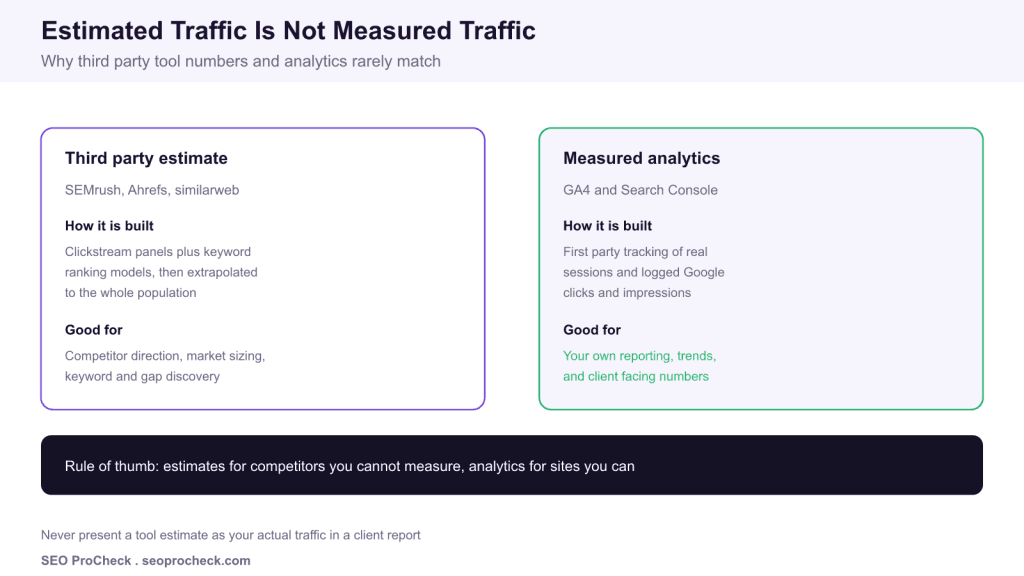
Third party tools such as SEMrush and Ahrefs estimate traffic from clickstream panels and ranking models, so their numbers can differ sharply from a site's measured Google Analytics data. Use estimates for competitor and market direction, and use GA4 plus Search Console for any traffic figure you report as fact.
- Estimates are modelled and extrapolated, not counted.
- Different vendors use different panels, so estimates disagree by design.
- GA4 and Search Console are first party and belong in client reporting.
- Never present a tool estimate as your actual measured traffic.
Warren Hance raised an uncomfortable point on LinkedIn: the elephant in the room is that third party SEO tools report estimated traffic, yet those estimates are routinely presented to clients as measured fact. He notes he regularly sees large gaps between SEMrush style traffic figures and a site's actual Google Analytics data. This page keeps his source reference and adds a practitioner view of why the gap exists and how to work with it honestly.
Estimated is not measured
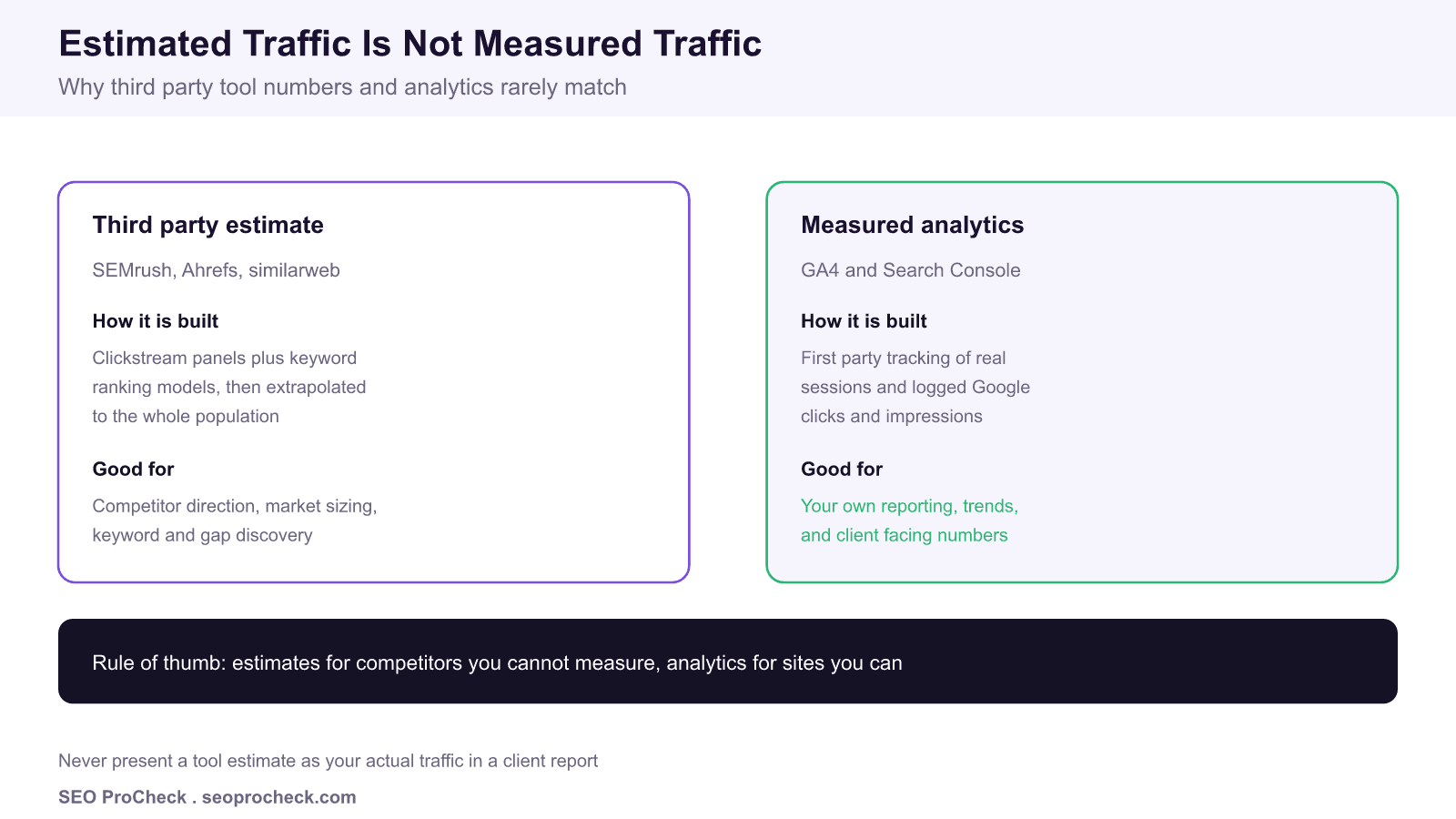
Tools like SEMrush, Ahrefs, and similarweb do not have access to your visitors. They build traffic figures from clickstream panels, keyword ranking databases, and modelled click through curves, then extrapolate that sample to the full population. Google Analytics 4, by contrast, records real sessions through first party tracking, and Search Console reports clicks and impressions logged by Google itself. The two approaches answer different questions, so they seldom agree, and the gap can be wide.
Why two tools disagree with each other too
It is not only tool versus analytics. Two estimation tools frequently disagree with each other for the same domain, because each vendor uses a different panel size, a different keyword universe, and a different extrapolation model. That is expected behaviour, not a bug. It is also the reason a single estimated number should never be treated as precise.
Use the right source for the job
| Question you are answering | Best source | Why |
|---|---|---|
| How much organic traffic did my site get | GA4 and Search Console | First party, measured, defensible |
| How is my traffic trending | Search Console clicks over time | Consistent Google logged data |
| Roughly how big is a competitor | Third party estimate, as a range | You cannot measure a site you do not own |
| Where are my keyword and content gaps | Third party tools | Ranking and coverage models are their strength |
How to present competitor numbers honestly
- Label every third party figure as an estimate, and show a range rather than a single value.
- Cross reference at least two tools so the reader sees the spread, not a false precision.
- Support the traffic claim with rankings and visibility data you can verify.
- For your own site, reconcile any estimate against GA4 and Search Console for the same period before it reaches a slide.
The takeaway
Estimation tools are excellent for direction, discovery, and competitive context. They become misleading only when their modelled numbers are dressed up as measured traffic. Keep the line clear: estimates for the sites you cannot measure, first party analytics for the sites you can.
Related reading: our internal linking complete guide, anchor text best practices, and the anchor text distribution study for evidence based reporting.
Frequently asked questions
Why does SEMrush traffic differ so much from Google Analytics?
Third party tools do not see your real visitors. They model traffic from clickstream panels and keyword rankings, then extrapolate to the whole population. Google Analytics counts actual sessions on your site, so the two are measuring different things and often diverge substantially.
Which number should I put in a client report?
Use your measured first party data, GA4 for sessions and conversions and Search Console for clicks, impressions, and position. Reserve third party estimates for competitors and markets you cannot measure directly.
Are third party traffic tools useless then?
No. They are valuable for what they are designed to do: competitive direction, market sizing, keyword discovery, and content gap analysis. The mistake is presenting an estimate as if it were a measured fact.
Why can two SEO tools show different traffic for the same site?
Each vendor uses a different panel, a different keyword database, and a different extrapolation model. Those methodology differences produce different estimates for the same domain, which is normal and expected.
How do I sanity check an estimate?
When you own the property, compare the tool estimate against GA4 and Search Console for the same period. For competitors, cross reference two or more tools and treat the range, not a single figure, as the signal.
What is the honest way to talk about competitor traffic?
Frame it as an estimate with a range and a direction rather than a precise number. Say a competitor appears to attract materially more organic traffic in a segment, then support the point with rankings and visibility data you can verify.
Claude Vincent is a technical SEO consultant focused on crawlability, rendering, and AI-search visibility. He writes the field guides and case studies at SEO ProCheck, with a bias toward the durable, unglamorous work that decides whether search engines and AI answer engines can actually read and cite a site.
About SEO ProCheck
Technical SEO consulting and GEO strategy with 20 years of enterprise experience. Case studies, resources, and tools for search and AI visibility.
Work With Me
Technical SEO audits, GEO strategy, site migrations, and international SEO. Hourly consulting for teams who need hands-on support, not just reports.
Subscribe to our newsletter!