

What happens to crawling and Google search rankings when 67% of a site’s indexed urls are pagination
- November 18, 2021
- General
AI Summary
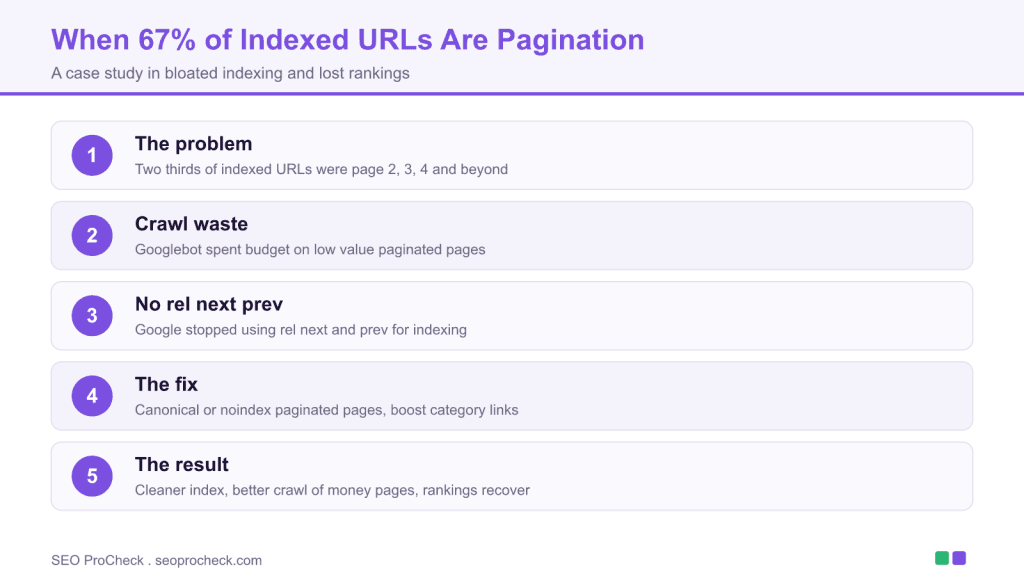
In this case, 67% of a site's indexed URLs were pagination pages such as page 2, 3 and beyond, which wasted crawl budget on low value URLs and weighed on rankings for the pages that mattered. Cleaning up how the paginated series was crawled and indexed restored crawl focus to money pages and helped rankings recover.
- Google confirmed in 2019 that it no longer uses rel next and prev for indexing.
- Each paginated page should self canonicalise, not canonical back to page one.
- Strong internal links to key products and categories reduce reliance on deep pagination.
- A bloated index of paginated URLs is a crawl efficiency problem, not just cosmetic.
The situation
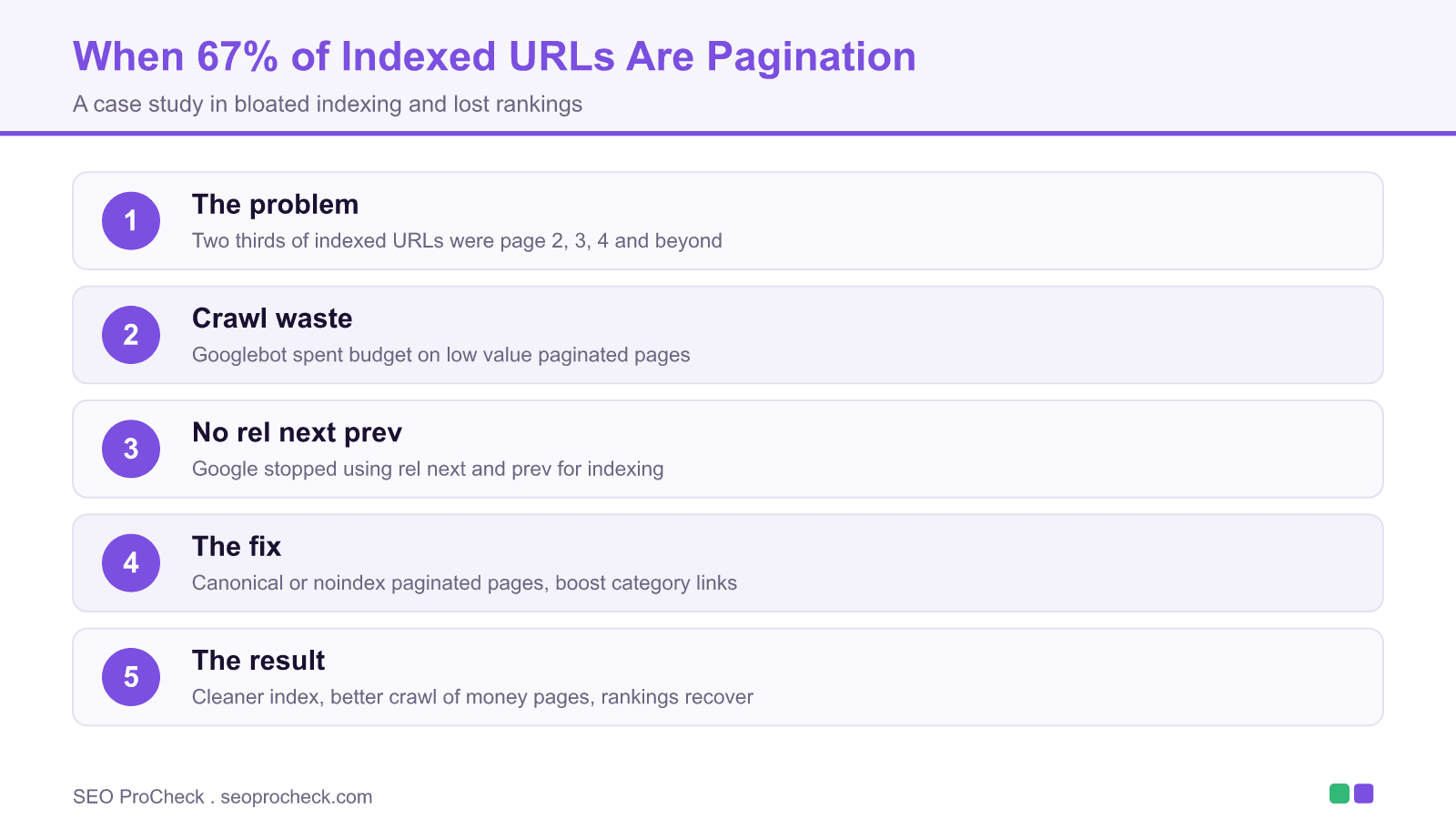
The source case study from GSQI examined a site where roughly two thirds of all indexed URLs were pagination pages: page 2, page 3, page 4 and deeper across many category and listing series. When 67% of what Google has indexed is paginated list pages, the crawl and index are dominated by low value URLs, and the pages that actually earn revenue compete for attention with a mountain of near duplicate lists.
Why pagination bloat hurts
Paginated pages are rarely strong landing pages. They repeat similar layouts, carry little unique content, and split link signals across a long chain. When they dominate the index they waste crawl budget, slow the crawl of new and updated content, and can drag on the site's overall quality signals. The problem compounds on large stores where faceted filters and pagination interact, a pattern covered in our large ecommerce guide.
| Handling option | How it works | When to use |
|---|---|---|
| Self canonical | Each page points its canonical to itself | Default for genuine multi page series you want crawled |
| noindex, follow | Deep pages excluded from index, links still followed | When deep pages add crawl paths but no search value |
| View all page | One page shows the full list, canonical target | When the full list is not too large to load fast |
| Stronger internal links | Link key items directly from hubs | Always, to reduce reliance on deep paging |
The rel next and prev history
For years the recommended fix was rel="next" and rel="prev" link elements to signal a paginated series. In 2019 Google confirmed publicly that it had not used those signals for indexing in a long time, and it removed them from its documentation. That leaves two supported approaches: let each page self canonicalise and be crawled as part of the series, or apply noindex, follow to deep pages so they stay out of the index while Google still follows their links to products. Pointing every paginated page's canonical at page one is a mistake, because it tells Google the deeper pages do not exist and the products only linked from them can be missed.
The fix and the result
The remedy is to stop the paginated series from dominating the index while keeping products reachable. Ensure each paginated page self canonicalises, or noindex the deep pages, and above all strengthen internal linking so important products and categories do not depend on deep pagination to be found. Monitor the Pages report in Search Console to watch the count of indexed paginated URLs fall and the count of indexed money pages hold or rise. As the index cleans up, crawl budget shifts back to the pages that matter, which is exactly the crawl efficacy outcome described in our crawl efficacy research. Prioritise the individual fixes with an ICE scoring pass, and make sure your robots.txt rules are not compounding the problem.
What has changed since this case study
The core lesson is durable, but the tooling has moved. The old Index Coverage report is now the Pages report, which groups URLs by why they are or are not indexed, making pagination bloat easier to spot under labels like crawled but not indexed. Google's position on rel next and prev has not reversed; those elements remain unused for indexing, so self canonical or noindex plus strong internal linking is still the correct playbook.
Background reference and source
Technical SEO provides the foundation for content visibility. Without proper technical implementation, even excellent content may fail to rank. This resource covers technical considerations that enable search engines to effectively crawl, index, and rank your content.
Crawlability Essentials
Search engines must be able to discover and access your content. This requires proper robots.txt configuration, XML sitemaps, internal linking, and server reliability. Technical barriers to crawling prevent content from entering the ranking competition regardless of quality.
Indexation Optimization
Not all crawled pages get indexed. Ensuring pages provide sufficient unique value, avoiding duplicate content issues, and using canonical tags appropriately help control what gets indexed. Monitoring indexation status through Search Console reveals issues requiring attention.
Performance and Experience
Core Web Vitals and page speed affect both user experience and rankings. Technical optimizations including caching, compression, image optimization, and code efficiency improve performance metrics. These optimizations serve users while sending positive signals to search engines.
This resource provides guidance for building and maintaining the technical foundation that enables SEO success.
Frequently asked questions
Is it bad if most indexed URLs are pagination pages?
Yes. When pagination dominates the index, crawl budget is spent on low value list pages, new content is crawled more slowly, and near duplicate lists compete with the pages that earn revenue. It signals a crawl and index efficiency problem.
Does Google still use rel next and prev?
No. Google confirmed in 2019 that it had not used rel next and prev for indexing for some time and removed them from its guidance. Rely on self canonical pages or noindex on deep pages instead.
Should paginated pages canonical to page one?
No. Pointing every page's canonical at page one tells Google the deeper pages do not exist, so products linked only from those pages can be missed. Each paginated page should self canonicalise.
How should I handle deep pagination?
Either let each page self canonicalise so the series is crawled, or apply noindex, follow to deep pages so they stay out of the index while their links are still followed. In both cases, add strong internal links to key products.
How do I monitor pagination in Search Console?
Use the Pages report, which replaced Index Coverage. It groups URLs by indexing status, so you can watch the number of indexed paginated URLs fall while your important pages hold or rise.
Will fixing pagination improve rankings?
It can, indirectly. Removing paginated bloat frees crawl budget for valuable pages, speeds discovery of new content and improves overall index quality, which supports recovery for the pages that matter.
Take this with you
The assistant links open with a question about this page already written. Nothing is sent until you press enter.
Claude Vincent is a technical SEO consultant focused on crawlability, rendering, and AI-search visibility. He writes the field guides and case studies at SEO ProCheck, with a bias toward the durable, unglamorous work that decides whether search engines and AI answer engines can actually read and cite a site.
About SEO ProCheck
Technical SEO consulting and GEO strategy with 20 years of enterprise experience. Case studies, resources, and tools for search and AI visibility.
Work With Me
Technical SEO audits, GEO strategy, site migrations, and international SEO. Hourly consulting for teams who need hands-on support, not just reports.
Subscribe to our newsletter!








Recent Posts
- Most Top Sites Never Say Who They Are in Structured Data October 14, 2026
- Homepage Titles Are Mostly Too Short, Not Too Long October 8, 2026
- Who Actually Serves an llms.txt? 184 Top Sites Measured September 29, 2026