

AI Summary
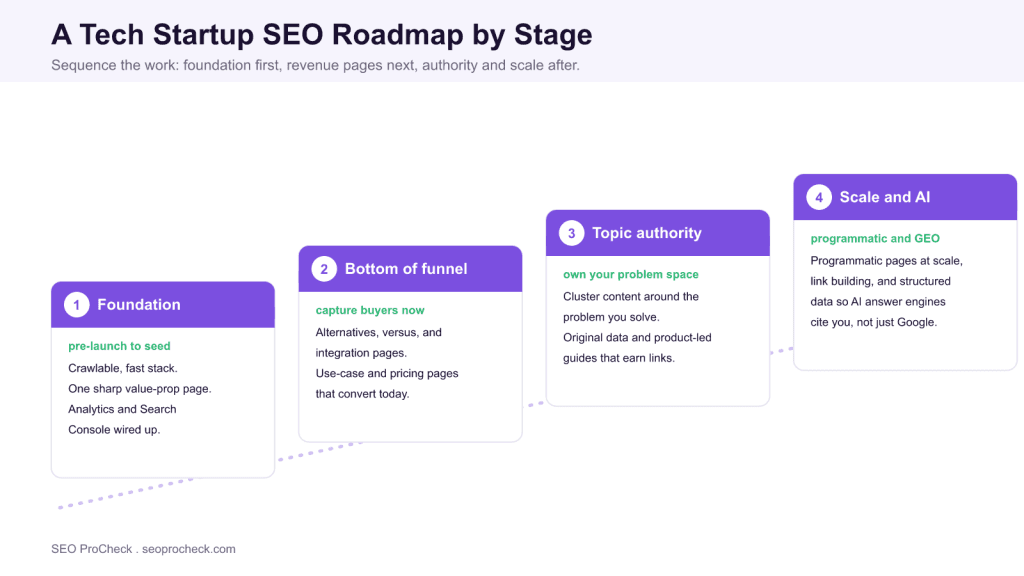
A tech startup should sequence SEO by stage rather than doing everything at once: fix the technical foundation, capture bottom of funnel buyers who are ready now, build topic authority around the problem you solve, then scale with programmatic pages and AI answer engine visibility. Startups lack domain authority and runway, so the winning move is compounding, product-led content and revenue pages first, not a blog that only pays off in year two.
- Start with a crawlable, fast technical foundation and analytics before publishing content.
- Win bottom of funnel pages first: alternatives, versus, integration, and use-case pages that convert today.
- Build topic clusters around your problem space to earn authority a young domain lacks.
- Optimize for AI answer engines early, since startups can win citations faster than in crowded Google results.

Tech startups run SEO under constraints that established companies do not face: a brand new domain with no authority, a short runway that demands visible traction, and an engineering team that would rather ship product than SEO fixes. The instinct to start a blog and wait is exactly wrong, because generic top of funnel content takes a year or more to pay off on a young domain. The startups that win compound faster by sequencing the work. This guide lays out that sequence, from technical foundation to programmatic scale and AI visibility.
The pattern is proven. See how one team documented scaling a startup to a million monthly visits in our case study on how they scaled a startup to 1M monthly traffic, and how another grew with lean programmatic SEO in programmatic SEO on a 50 dollar per month stack.
Sequence the work by stage
Doing everything at once dilutes a small team. Order the work so each stage funds the next, and so the earliest wins are the ones closest to revenue.
| Stage | Focus | Content type | What to measure |
|---|---|---|---|
| Foundation | Crawlability, speed, tracking | Value-prop and product pages | Indexation, Core Web Vitals |
| Bottom of funnel | Capture ready buyers | Alternatives, versus, integrations | Signups, trials |
| Topic authority | Own the problem space | Cluster guides, original data | Rankings, referring domains |
| Scale and AI | Programmatic and GEO | Templated pages, structured data | Indexed pages, AI citations |
Get the foundation right first
Before a single article ships, make sure the site is fast, crawlable, and measured. Many startups on modern JavaScript frameworks accidentally serve content that crawlers cannot read, so confirm your key pages render in HTML and return clean status codes. Set up Google Search Console and analytics on day one so you can prove what is working. A sharp, keyword aware value proposition page and clear product pages are the foundation everything else links back to. Get this wrong and no amount of content will rank.
Win bottom of funnel before top of funnel
The highest ROI content for an early startup targets people already looking for a solution like yours. These pages convert immediately and rank faster because the queries are less contested than broad informational terms:
- Alternatives pages: "[competitor] alternatives" captures shoppers actively comparing.
- Versus pages: "[you] vs [competitor]" wins the comparison query, and you control the framing.
- Integration pages: "[your product] plus [popular tool]" captures users of adjacent products.
- Use-case and pricing pages: intent rich queries from buyers close to a decision.
These pages build revenue while your authority is still growing, which buys the time that top of funnel content needs to mature.
Build topic authority around your problem
Once revenue pages are in place, earn authority by owning the topic your product solves. Build content clusters: a pillar page on the core problem, supported by detailed articles on every facet, all interlinked. This concentrates relevance and helps a young domain rank for competitive terms. Product-led content, guides that teach the problem while naturally featuring your product, converts far better than detached blog posts. For the linking model, follow our guide to an internal linking strategy for topic clusters. Original data and research are the startup's sharpest link magnet, because journalists and other sites cite numbers they cannot get elsewhere.
Scale with programmatic SEO, carefully
When you have a repeatable page pattern backed by real data, for example a page per city, per integration, or per template, programmatic SEO can generate hundreds of useful pages from one template. The danger is thin, near duplicate pages that trigger the helpful content systems. Every programmatic page must offer genuine value: unique data, real utility, and a reason to exist beyond a keyword permutation. Start small, confirm the pattern earns traffic and stays indexed, then scale.
Establish E-E-A-T on a young domain
A new domain has no trust reservoir, so you build it deliberately: real author bios with genuine expertise, an about page that establishes the team, customer proof, and links from reputable sources. Our guide to E-E-A-T signals for small sites covers how to look trustworthy to Google before you are a known brand.
Optimize for AI answer engines early
Startups have a rare advantage in AI search: answer engines like ChatGPT, Perplexity, and Google AI Overviews can cite a well structured young site faster than it could ever rank on page one of classic Google. Write clear, extractable answers, use structured data, and make your key facts machine readable so AI systems can quote them. Our research on machine-readable web standards covers how to format content so answer engines can parse and cite it. Building this in from the start is far cheaper than retrofitting later.
Key takeaways
Tech startup SEO is about sequence and leverage, not volume. Fix the foundation, capture bottom of funnel buyers first, build topic authority around your problem, scale with disciplined programmatic pages, establish E-E-A-T on a young domain, and optimize for AI answer engines from day one. Each stage funds the next, so the site compounds toward durable, revenue linked organic growth instead of waiting on a blog that pays off too late.
With the technical foundation and measurement, then bottom of funnel pages. Make the site fast and crawlable, wire up Search Console and analytics, publish a sharp value proposition page, then build alternatives, versus, and integration pages that convert buyers who are already searching.
Because it converts immediately and ranks faster. Comparison, alternatives, and integration queries are less contested than broad informational terms, so a young domain can win them sooner, and the buyers behind them are close to a decision. This funds the slower top of funnel content.
It can be powerful once you have a repeatable page pattern backed by real data, since one template can generate hundreds of useful pages. The risk is thin, duplicate pages that get demoted. Each page must offer genuine value, so start small, confirm it earns traffic, then scale.
Bottom of funnel pages can rank within weeks to a few months because their queries are less contested. Broad, competitive terms usually take a year or more on a new domain. Sequencing revenue pages first is what makes the wait for authority survivable.
Publish original data and research that others cite, build topic clusters around your problem space, add real author bios and customer proof, and earn links from reputable sources. This deliberate E-E-A-T building substitutes for the trust an established brand already has.
Yes, and early. Answer engines can cite a well structured young site faster than it can rank on page one of Google. Write clear, extractable answers, add structured data, and make key facts machine readable so tools like ChatGPT, Perplexity, and AI Overviews can quote you.
Is your startup building SEO in the wrong order?
Most early teams start a blog and skip the revenue pages that rank first. An audit maps the fastest path from a new domain to compounding organic growth.
Claude Vincent is a technical SEO consultant focused on crawlability, rendering, and AI-search visibility. He writes the field guides and case studies at SEO ProCheck, with a bias toward the durable, unglamorous work that decides whether search engines and AI answer engines can actually read and cite a site.
About SEO ProCheck
Technical SEO consulting and GEO strategy with 20 years of enterprise experience. Case studies, resources, and tools for search and AI visibility.
Work With Me
Technical SEO audits, GEO strategy, site migrations, and international SEO. Hourly consulting for teams who need hands-on support, not just reports.
Subscribe to our newsletter!







Recent Posts
- Can AI Crawlers Actually Read Your Site? I Measured 400 of the Biggest September 5, 2026
- The Pre-Publish Quality Gate for AI-Assisted Content August 6, 2026
- AGENTS.md vs llms.txt vs llms-full.txt: Which Agent File Does What July 18, 2026