

AI Summary
SearchPilot ran a controlled SEO split test on a US ecommerce site, replacing British English clothing terminology with American equivalents on product pages, and measured approximately a 24 percent increase in organic traffic to the variant pages. The result is a positive and statistically significant one, and it makes a point that hreflang implementations routinely miss: serving the right page to the right country is worthless if the page uses vocabulary that country does not search with.
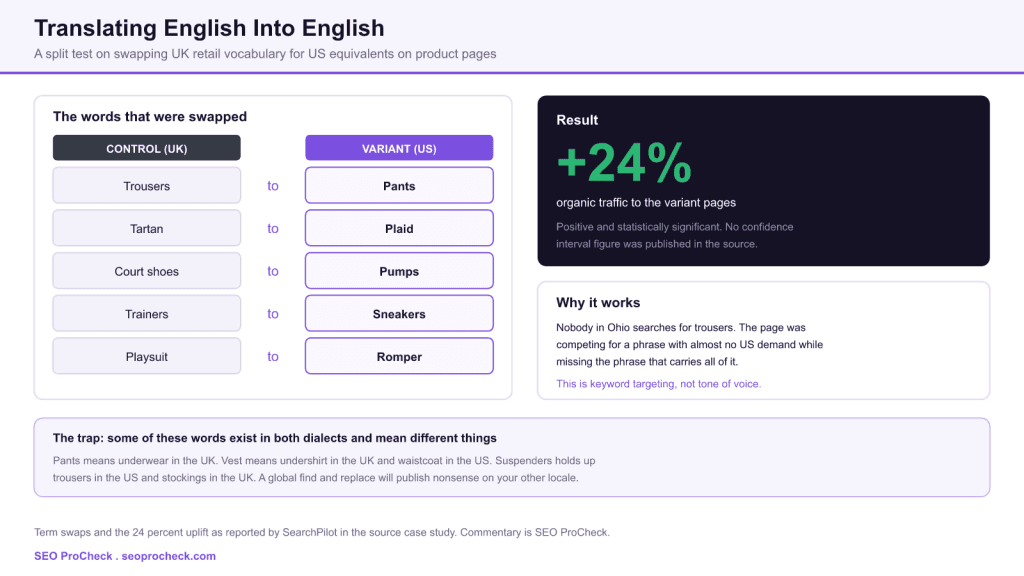
- Terms swapped included trousers to pants, tartan to plaid, court shoes to pumps, trainers to sneakers and playsuit to romper.
- Approximately 24 percent organic traffic uplift, positive and statistically significant. No confidence interval figure was published in the article.
- The change is keyword targeting rather than tone of voice, since each pair represents separate search demand.
- The site's conclusion was to localise future US product rollouts from day one rather than retrofitting them.

A US shopper looking for what they call sneakers will not type trainers, and no amount of hreflang will bridge that gap. This test put a number on the cost of that mismatch, roughly 24 percent of organic traffic, on a change that requires no new content, no development work beyond a templating change, and no ongoing spend. It is one of the highest return per hour opportunities available to any retailer operating across both markets, and the reason it goes unclaimed is that the pages look perfectly fine to the British team reviewing them.
International SEO discussions get dominated by infrastructure. Which domain structure, which hreflang syntax, which geotargeting setting. Those decisions matter, but they are the plumbing. This case study addresses the part everyone assumes is already handled because the language on both sides is called English, and demonstrates that the assumption is expensive.
The hypothesis and the change
The team predicted that localising clothing terminology from British to American English would improve rankings and organic traffic for US market visitors. The change itself was narrow: product page content was updated with US English equivalents of specific UK retail terms.
| UK term (control) | US term (variant) | What a US shopper understands by the UK term |
|---|---|---|
| Trousers | Pants | Recognised but archaic or formal, and not what they would type into a search box |
| Tartan | Plaid | Understood as specifically Scottish, so the general pattern goes unfound |
| Court shoes | Pumps | Largely unrecognised as a product category |
| Trainers | Sneakers | Read as a person who trains, not as footwear |
| Playsuit | Romper | Ambiguous, and in some contexts read as children's clothing |
Term pairs as listed in the source SearchPilot case study. The third column is SEO ProCheck commentary.
The third column is where the ranking mechanism lives. These are not synonyms with a stylistic preference attached. In two of the five cases the UK term is close to meaningless in the US market, and in one case it actively misleads. A product page titled with a term that carries no local search volume is not ranking badly for its keyword, it is ranking for the wrong keyword entirely.
How the test was run
This was a controlled SEO split test, which is worth explaining because it is what separates this result from an anecdote. You cannot serve search engines two versions of the same URL without cloaking, so an SEO split test splits pages rather than users. Comparable product pages are randomly assigned to control and variant groups, the change ships to the variant group only, and a model forecasts what the variant pages would have done had nothing changed, using the control group as the baseline. The result is the deviation from that forecast.
That design is what isolates the effect from algorithm updates, seasonality and competitor activity, because those hit both groups equally. For an apparel retailer, seasonality alone would swamp any before and after comparison, so the control group is not a nicety here, it is the only thing that makes the number meaningful.
The result, and how precisely to state it
The test returned a positive, statistically significant result of approximately a 24 percent increase in organic traffic to the variant pages. The source article does not publish a confidence interval figure alongside that number, so if you cite this study, cite the uplift and the significance and stop there. Attaching a specific confidence interval to it would be invention.
Some context on the size. A 24 percent traffic uplift from an on-page change is at the very high end of what split testing usually returns; most tested changes land in low single digits or come back inconclusive. The reason this one is so large is that it is not an optimisation of an existing target. It is a correction of the target itself, moving the page from a term with negligible US demand onto the term that carries essentially all of it. Do not expect similar magnitudes from tests that refine a page already aimed at the right keyword.
The trap: false friends across the two dialects
Before anyone runs a global find and replace, the ambiguous terms need separating from the safe ones. Several words exist in both dialects carrying different meanings, and a site-wide replacement will publish errors on whichever locale you were not thinking about.
| Word | British English | American English | Replacement risk |
|---|---|---|---|
| Pants | Underwear | Trousers | High. Replacing trousers with pants on a UK page changes the product category |
| Vest | Undershirt | Waistcoat | High. Two entirely different garments in two different departments |
| Suspenders | Holds up stockings | Holds up trousers | High. Lingerie against menswear |
| Jumper | Sweater | A sleeveless dress | Medium. Jumper to sweater is safe one way, not the other |
| Braces | Holds up trousers | Orthodontics | Medium. Context usually disambiguates but titles are short |
| Trainers | Sneakers | People who train | Low in one direction. Safe to replace on US pages |
Dialect comparison compiled by SEO ProCheck as an implementation caution. Not from the source case study.
The practical consequence: scope every replacement to the target locale's templates and content records, never to the global content store, and hand review anything on the high risk rows. Our guide to translation versus localisation covers where the boundary between the two sits.
Implementing this without creating a maintenance burden
The failure mode after a win like this is that someone edits 300 product pages by hand, the change works, and then six months of new product launches quietly reintroduce the UK vocabulary because nothing in the pipeline prevents it. Fix it at the source of the data instead.
- Build the term list from search data, not a dictionary. For each candidate pair, pull US volume for both terms. Most will confirm the obvious. A few will surprise you, and those are the ones where the dictionary answer is wrong for your category.
- Add a locale attribute to the product record. Store the US name alongside the UK name as a first class field rather than deriving it at render time. Derived strings drift.
- Order the edits by ranking weight. Title tag first, then H1, then breadcrumb and category name, then body copy, then alt text and internal anchor text. The first three are a small fraction of the words and most of the effect.
- Add a build-time guard. A simple test that fails the build when a banned UK term appears in an en-US template is the difference between a fix and a permanent fix.
- Check internal anchors and site search synonyms. A US page correctly titled Sneakers that is linked from navigation labelled Trainers sends a contradictory signal, and your on-site search will return nothing for the term half your customers will use.
# fails the build if UK vocabulary reaches a US template
BANNED_EN_US = {
    'trousers': 'pants',
    'trainers': 'sneakers',
    'tartan':   'plaid',
    'playsuit': 'romper',
    'jumper':   'sweater',
}

def check(locale, text, path):
    if locale != 'en-US':
        return []
    low = text.lower()
    return [f'{path}: use "{us}" not "{uk}"'
        for uk, us in BANNED_EN_US.items() if uk in low]
Where this sits alongside hreflang
It is worth being precise about the division of labour, because teams conflate these two jobs constantly. Hreflang is a routing and duplication instruction. It tells search engines that your en-GB and en-US pages are alternates of one another and which audience each is intended for, which prevents the wrong version surfacing and prevents the two being read as duplicates of each other.
<link rel="alternate" hreflang="en-GB" href="https://example.com/uk/trousers/" />
<link rel="alternate" hreflang="en-US" href="https://example.com/us/pants/" />
<link rel="alternate" hreflang="x-default" href="https://example.com/" />
What hreflang cannot do is make the en-US page rank for pants when the page says trousers. The two mechanisms are complementary and neither substitutes for the other. A site with perfect hreflang and unlocalised vocabulary is efficiently delivering the wrong page to the right people. Our hreflang implementation guide covers the routing half, and the localisation versus internationalisation guide covers the strategic split.
What has changed since this test
Two developments since this test was published make the underlying finding more important rather than less, and one adds a caveat.
The more important change is the rise of AI generated answer surfaces above the organic results. Those systems retrieve and summarise based on the words in the query and the words on the page. A product page using vocabulary from the wrong dialect is not just missing a keyword match, it is less likely to be retrieved as a relevant source at all. The vocabulary mismatch penalty compounds rather than shrinking.
The caveat concerns how you validate the term list. Search engines have become considerably better at semantic matching than they were, so a US page saying trousers is more likely to surface for pants queries now than it once was. That narrows the gap in theory. It does not close it, because the title tag, the internal anchors and the user's own recognition of the product name all still depend on the literal word, and the conversion argument is untouched by any amount of semantic matching. A shopper who does not recognise the product name does not buy it.
The final point the source itself makes is the durable one. Rather than treating this as a remediation project, the site concluded that future products rolled out in the US should be correctly localised from day one. That is the difference between a 24 percent win and a 24 percent win that stays won. For the broader product page fundamentals this sits on top of, see our ecommerce product page SEO guide.
FAQ
Yes, and considerably more than most teams assume. This split test reported roughly a 24 percent organic traffic uplift from swapping UK retail terms for US equivalents on a US ecommerce site. The reason is not tone: trousers and pants are different keywords with different search volumes, so a page using the wrong one is competing in a market that barely exists.
No. Hreflang tells search engines which version to serve to which audience, which solves a targeting and duplication problem. It does nothing about the words on the page. If your en-US page still says trousers, hreflang will faithfully deliver the wrong vocabulary to the right country.
Translation converts between languages. Localisation adapts content to how a specific market actually speaks, which includes vocabulary, spelling, sizing conventions, currency, date formats and units. This case study is the clearest possible demonstration that localisation is required even when no translation is, because the source and target language are both English.
Not safely. Several of these words exist in both dialects with different meanings, so a global replacement will publish errors on your other locale. Pants means underwear in British English, and a vest is an undershirt in the UK and a waistcoat in the US. Scope any replacement to the target locale's templates and review the ambiguous terms by hand.
Prioritise the terms that appear in title tags, H1s and category names, because those carry the most ranking weight and are the smallest number of edits. Within apparel the highest impact swaps are usually trousers to pants, trainers to sneakers, jumper to sweater and tights to pantyhose. Validate each one against actual US search volume before committing, since local demand does not always follow the dictionary.
Fix it at the point of data entry rather than in the published page. Add a locale-specific attribute to the product feed so US titles are generated from a US vocabulary list, and add a build-time check that fails when a banned UK term appears in an en-US template. The source case study reached exactly this conclusion, noting that future US product rollouts are now localised from day one.
Selling the same catalogue into more than one English speaking market?
An audit checks whether your locale templates, hreflang routing and product vocabulary are actually aligned, or only appear to be.
Claude Vincent is a technical SEO consultant focused on crawlability, rendering, and AI-search visibility. He writes the field guides and case studies at SEO ProCheck, with a bias toward the durable, unglamorous work that decides whether search engines and AI answer engines can actually read and cite a site.
About SEO ProCheck
Technical SEO consulting and GEO strategy with 20 years of enterprise experience. Case studies, resources, and tools for search and AI visibility.
Work With Me
Technical SEO audits, GEO strategy, site migrations, and international SEO. Hourly consulting for teams who need hands-on support, not just reports.
Subscribe to our newsletter!







Recent Posts
- Finding a Competitor's Sitemap, and Turning It Into a Change Log September 15, 2026
- AI Crawler User Agents: The Current Names, and Which Ones Sites Actually Block September 9, 2026
- Can AI Crawlers Actually Read Your Site? I Measured 400 of the Biggest September 5, 2026