

Google exploit via XML Sitemaps to manipulate search results
- March 27, 2018
- Crawling and Indexing
AI Summary
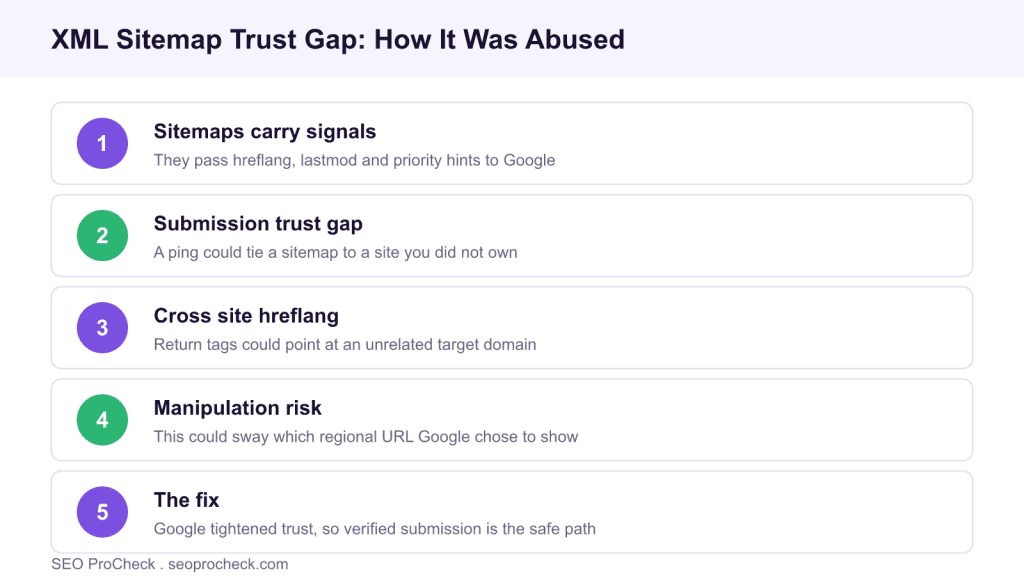
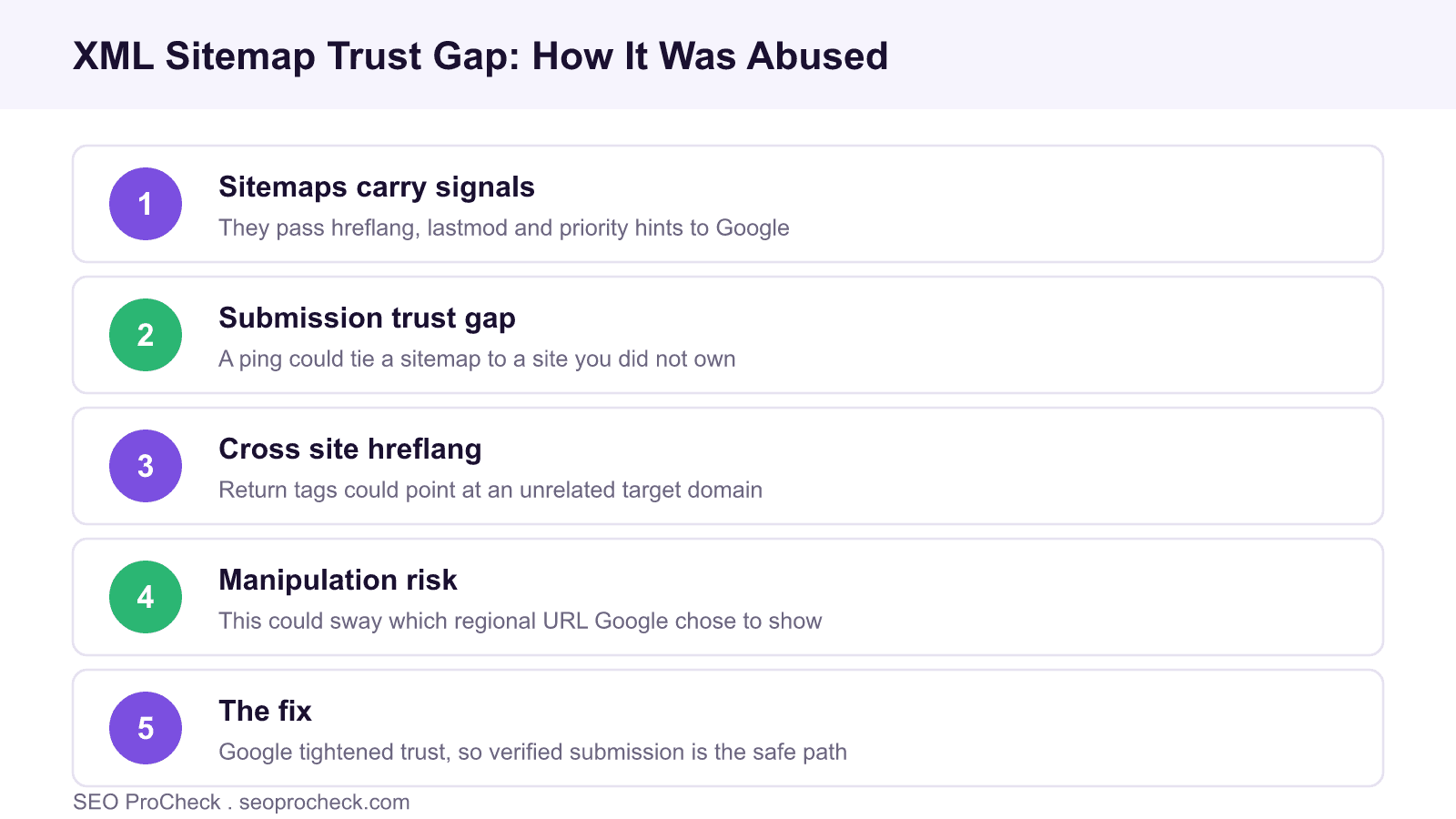
Tom Anthony reported that Google would, under the right conditions, trust an XML sitemap that a site owner did not fully control, which let hreflang annotations inside that sitemap influence which regional URL Google showed. The lesson for practitioners is durable even though Google patched it: sitemap signals are only as trustworthy as the way the sitemap was submitted, so verified submission and reciprocal hreflang matter.
- XML sitemaps can carry hreflang, lastmod and priority hints, not just a list of URLs.
- The vulnerability chained a sitemap submission trust gap with cross site hreflang annotations.
- It could sway which country version of a URL Google surfaced, a black hat manipulation vector.
- Google tightened trust, so submit sitemaps through verified Search Console or a robots.txt declaration.
This case study is based on the security research published by Tom Anthony, who disclosed the issue to Google through its bug bounty programme. We keep the original summary and source below, then explain the mechanism and the defensive takeaways in practitioner terms without turning it into a how to.
This SEO case study documents a successful optimization initiative, providing actionable insights for practitioners. The documented approach demonstrates how strategic SEO implementation drives measurable results.
Initial Situation
Understanding the starting point is essential context for evaluating any case study. This documentation covers the initial challenges, competitive position, and business objectives that shaped the SEO strategy.
Strategy and Approach
The strategic approach combined multiple SEO disciplines to address identified opportunities. Key decisions around prioritization and resource allocation provide a template for similar initiatives.
Implementation
Moving from strategy to execution required specific technical implementations, content development, and process changes. This case study documents the practical steps that translated strategy into action.
Results and Learnings
The outcomes demonstrate effectiveness through measurable improvements in rankings, traffic, and business metrics. Analysis of successes and challenges provides learning value for practitioners.
Case studies like this contribute to the SEO knowledge base, helping practitioners learn from documented real-world experiences.
Source: https://www.tomanthony.co.uk/blog/google-xml-sitemap-auth-bypass-black-hat-seo-bug-bounty/
Why a sitemap is a trust signal, not just a list
An XML sitemap is often treated as a simple list of URLs, but it can also carry hreflang alternates, lastmod timestamps and priority hints. Google uses these as inputs when it decides which URL to crawl, which localised version to show, and how fresh a page is. That means the question of who is allowed to make claims inside a sitemap is a security question, not just a housekeeping one.
How the manipulation worked in principle
The research showed a gap between the act of submitting a sitemap and the proof that the submitter owned the URLs it described. By combining that gap with cross site hreflang annotations, an attacker could point return tags at a target domain they did not own and influence which version Google served in a given country. Because hreflang is designed to swap in the right regional URL, abusing it is a quiet way to interfere with a competitor rather than a loud hack. If you want the honest mechanics of choosing a single preferred URL, our note on a curious case of canonicalization is a good companion read.
| Sitemap submission method | How Google establishes trust | Practitioner verdict |
|---|---|---|
| Verified Search Console property | Tied to a verified owner of the property | Preferred for control and reporting |
| robots.txt Sitemap directive | Declared on the same host as the URLs | Solid, and easy to keep in version control |
| Legacy ping endpoint | Weak binding between submitter and owner | Avoid, this class of gap is why it was risky |
| Cross host hreflang claims | Requires reciprocity to be trusted | Only trust return tags that point back |
Defensive takeaways
Three habits protect you. First, submit sitemaps only through a verified Search Console property or a robots.txt Sitemap declaration on the same host, so the ownership signal is unambiguous. Second, make hreflang strictly reciprocal: every alternate you name should name you back, and non reciprocal claims should be treated as untrusted. Third, monitor which URLs Google actually shows for your brand across regions, so a sudden swap surfaces quickly. Delivering hreflang and canonical hints through headers can also reduce ambiguity, as covered in why the canonical HTTP header can be faster than the HTML tag.
What has changed since this disclosure
Google fixed the specific weakness after the responsible disclosure, and it later retired the standalone sitemap ping endpoint entirely, directing site owners to Search Console and robots.txt declarations instead. Reciprocity checks on hreflang are also stricter than they were. The underlying principle is the part worth remembering: any signal you can submit about your site is only trusted to the extent that Google can prove you own what you are describing, so keep submission verified and keep annotations reciprocal.
Frequently asked questions
Can someone still hijack my hreflang today?
The specific hole Tom Anthony reported was patched, and Google now expects reciprocal hreflang plus verified submission. The general advice stands: keep your alternates reciprocal and submit sitemaps only from properties you own so there is no ambiguity to exploit.
What signals can an XML sitemap actually carry?
Beyond the URL list, a sitemap can include lastmod timestamps, changefreq and priority hints, and hreflang alternate annotations. Google treats these as inputs rather than commands, but they still influence crawling and which localised URL is shown.
Is the sitemap ping endpoint still usable?
No, Google deprecated the standalone ping endpoint. Submit through a verified Search Console property or declare the sitemap with a Sitemap directive in robots.txt on the same host as the URLs.
Why is reciprocal hreflang so important?
Reciprocity is how Google confirms that two URLs genuinely agree they are regional alternates. If a return tag is missing or points somewhere unrelated, Google can distrust or ignore the claim, which is exactly the safeguard against the abuse described here.
How would I notice regional URL manipulation?
Monitor which of your URLs appears for brand and priority queries across the countries you target. An unexpected swap to the wrong language or domain is the visible symptom, so set up periodic checks by locale.
Is studying this exploit safe and ethical?
Yes, when the goal is defence. Tom Anthony disclosed it responsibly and Google fixed it, so the value now is understanding why verified submission and reciprocal hreflang protect you, not attempting anything against another site.
Claude Vincent is a technical SEO consultant focused on crawlability, rendering, and AI-search visibility. He writes the field guides and case studies at SEO ProCheck, with a bias toward the durable, unglamorous work that decides whether search engines and AI answer engines can actually read and cite a site.
About SEO ProCheck
Technical SEO consulting and GEO strategy with 20 years of enterprise experience. Case studies, resources, and tools for search and AI visibility.
Work With Me
Technical SEO audits, GEO strategy, site migrations, and international SEO. Hourly consulting for teams who need hands-on support, not just reports.
Subscribe to our newsletter!







Recent Posts
- Can AI Crawlers Actually Read Your Site? I Measured 400 of the Biggest September 5, 2026
- The Pre-Publish Quality Gate for AI-Assisted Content August 6, 2026
- AGENTS.md vs llms.txt vs llms-full.txt: Which Agent File Does What July 18, 2026