

Increased Google Crawl & Doubled SEO Traffic In 3 Months: A Case Study | Botify
- February 2, 2017
- Crawling and Indexing
AI Summary
This Botify case study documents how increasing Google's crawl of important pages, while cutting crawl waste, roughly doubled organic traffic within three months. The mechanism is simple: when crawlers spend more of their budget on pages that can actually rank, more of those pages get indexed and refreshed, and the traffic follows.
- Crawl budget spent on low value URLs is crawl budget stolen from pages that rank.
- Log file analysis shows where Googlebot actually spends its time.
- Internal links and faster responses steer crawlers toward priority pages.
- Indexation and traffic gains compound as important pages get crawled more often.
This SEO case study documents a successful optimization initiative, providing actionable insights for practitioners. The documented approach demonstrates how strategic SEO implementation drives measurable results.
Initial Situation
Understanding the starting point is essential context for evaluating any case study. This documentation covers the initial challenges, competitive position, and business objectives that shaped the SEO strategy.
Strategy and Approach
The strategic approach combined multiple SEO disciplines to address identified opportunities. Key decisions around prioritization and resource allocation provide a template for similar initiatives.
Implementation
Moving from strategy to execution required specific technical implementations, content development, and process changes. This case study documents the practical steps that translated strategy into action.
Results and Learnings
The outcomes demonstrate effectiveness through measurable improvements in rankings, traffic, and business metrics. Analysis of successes and challenges provides learning value for practitioners.
Case studies like this contribute to the SEO knowledge base, helping practitioners learn from documented real-world experiences.
Source: https://www.botify.com/blog/increased-google-crawl-and-doubled-seo-traffic-in-3-months-a-case-study
How crawl efficiency turns into traffic
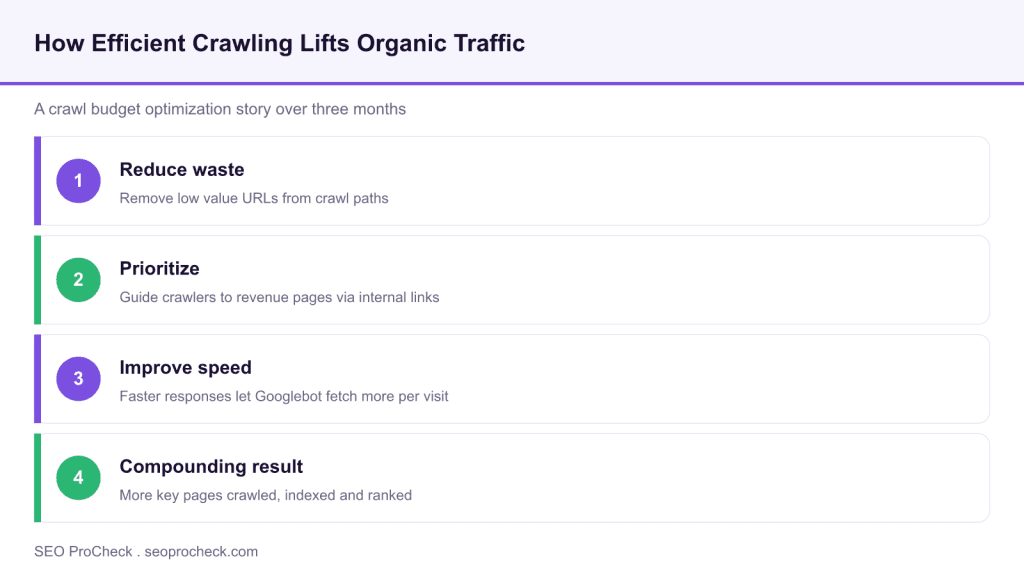
The headline result reads like magic, but the path is mechanical. Search engines allocate a finite amount of crawling to each site. If a large share of that budget is burned on faceted duplicates, parameter noise, dead redirects and thin archives, then the pages you want ranked are crawled less often and refreshed more slowly. Reclaim that budget and redirect it toward valuable templates, and indexing coverage and freshness improve together, which is what lifts traffic. If the idea is new to you, start with this primer on what crawl budget is.
In practice the work is unglamorous. You read server logs to see where Googlebot actually goes, then you remove or deprioritize the URLs that waste its time. The companion study on how a team optimized its crawl budget walks through the same loop of measure, prune and re verify that produced this result.
The levers that actually move the needle
Three levers do most of the work. Reduce waste by trimming low value URLs from crawl paths with robots rules, canonical consolidation and cleaner pagination. Prioritize by pointing strong internal links at the pages that earn revenue, so crawl demand concentrates where it pays off. Improve speed so each Googlebot visit fetches more pages before the crawler moves on.
None of this works without a quality baseline. If the pages you are pushing into the index are thin, the gains stall, which is why this pairs naturally with the discipline in quality indexation for large sites. Crawl efficiency amplifies good content, it does not manufacture it.
A note on sequencing: measure first, change one lever at a time, then re read the logs before touching the next. Bundling every change into a single release makes it impossible to tell which lever moved the numbers, and it multiplies the chance of accidentally blocking something valuable.
| Lever | Action | Expected effect |
|---|---|---|
| Reduce waste | Block or canonicalize thin and duplicate URLs | More budget for pages that can rank |
| Prioritize | Strengthen internal links to key templates | Higher crawl demand on priority pages |
| Improve speed | Cut response time and payload weight | More pages fetched per crawl session |
| Verify | Re read logs after each change | Confirmation that budget shifted as intended |
What's changed since
Google now says most sites do not need to think about crawl budget, and for a small brochure site that is true. The advice still applies squarely to large, template driven sites with millions of URLs, which is exactly the profile in this case. Log analysis remains the honest way to see crawler behavior, and Search Console crawl stats have improved enough to complement it.
On the performance side, the metrics moved on: Core Web Vitals replaced older speed proxies, and Interaction to Next Paint replaced First Input Delay as the responsiveness metric. The strategy is unchanged, spend crawl budget on pages that deserve it, but the measurement toolkit is sharper than when this study was written.
Frequently asked questions
Does every site need to worry about crawl budget?
No. Small sites with a few hundred pages are usually crawled fully, so crawl budget work brings little return. It matters for large sites with millions of URLs, heavy faceting or frequent content changes, which is the situation this case describes.
How do I know where Googlebot wastes crawl budget?
Server log analysis is the primary source, because it records every real Googlebot request. Look for high crawl volume on parameter URLs, faceted duplicates, redirect hops and thin archive pages, then compare that against the URLs you actually want crawled.
Will blocking pages in robots.txt save crawl budget?
It can, because disallowed URLs are not fetched, but blocked URLs can still be indexed without content if they are linked. Use robots rules for crawl control and use canonical or noindex when you also need to keep pages out of the index.
How quickly can crawl optimization show results?
This case reports a few months, and that is a realistic window for large sites once recrawling propagates. Priority templates react first, while deep or rarely crawled sections take longer to reflect the change.
Does faster page speed really increase crawling?
Faster responses let Googlebot fetch more pages within the same crawl session, so speed and crawl efficiency reinforce each other. It is one of the most reliable levers because it helps users and crawlers at the same time.
What is the risk of aggressive crawl pruning?
The main risk is accidentally blocking or deindexing pages that do have value. Stage changes, watch index coverage closely, and keep backups of your redirect and robots configuration so you can roll back quickly.
Take this with you
The assistant links open with a question about this page already written. Nothing is sent until you press enter.
Claude Vincent is a technical SEO consultant focused on crawlability, rendering, and AI-search visibility. He writes the field guides and case studies at SEO ProCheck, with a bias toward the durable, unglamorous work that decides whether search engines and AI answer engines can actually read and cite a site.
About SEO ProCheck
Technical SEO consulting and GEO strategy with 20 years of enterprise experience. Case studies, resources, and tools for search and AI visibility.
Work With Me
Technical SEO audits, GEO strategy, site migrations, and international SEO. Hourly consulting for teams who need hands-on support, not just reports.
Subscribe to our newsletter!








Recent Posts
- Most Top Sites Never Say Who They Are in Structured Data October 14, 2026
- Homepage Titles Are Mostly Too Short, Not Too Long October 8, 2026
- Who Actually Serves an llms.txt? 184 Top Sites Measured September 29, 2026