

AI Summary
Community platforms can reach large organic numbers quickly because members generate a volume and specificity of questions no editorial team can match. The work that makes it succeed is subtractive: gates that keep most threads out of the index so the ones you publish are worth finding.
- Index community content by exception, not by default. Most threads should stay crawlable for users but noindexed.
- Four mechanical gates cover most of it: has a reply, answer length, moderation passed, not a near duplicate.
- Organise community pages into topic hubs, never a reverse chronological feed, or good answers are buried within days.
- Watch clicks per indexed URL. If it falls while the indexed count rises, the gates are too loose.
Case study overview
This case study documents a successful organic growth strategy, demonstrating how strategic SEO implementation drives measurable business results. The approach provides actionable insights for practitioners facing similar challenges.
Challenge and Context
Every successful SEO initiative begins with understanding the starting position and objectives. This case study reveals the initial challenges, competitive landscape, and business goals that shaped the strategy. Understanding context helps practitioners assess applicability to their own situations.
Strategic Approach
The methodology employed combined technical optimization, content strategy, and authority building in a coordinated approach. Key decisions around prioritization, resource allocation, and tactical execution provide a template for similar initiatives. The strategy balanced quick wins with sustainable long-term growth.
Implementation Details
Moving from strategy to execution required specific technical implementations, content creation processes, and measurement frameworks. This case study documents the practical steps taken, tools used, and workflows developed. These implementation details help practitioners translate strategy into action.
Results and Analysis
The outcomes demonstrate the effectiveness of the approach through measurable metrics: traffic growth, ranking improvements, and business impact. Analysis of what worked best and what could have been done differently provides learning value beyond the raw results.
This case study contributes to the evidence base for effective SEO strategy, helping practitioners learn from documented successes.
Why community platforms can move fast
A content team plans topics. A community produces them. Members ask questions in their own words, at a level of specificity that keyword research usually rounds away, and they do it continuously without a brief or a budget. For long tail informational demand, that is an advantage no editorial calendar can match.
The second advantage is intent alignment. A member asking a question in a peer group is not performing a search query, they are describing a real situation. The resulting page, if it is published carefully, matches how other people in that situation search, including the awkward phrasings that no strategist would have listed.
Neither advantage is automatic. The same properties that make community content abundant make it dangerous at scale: it is unstructured, frequently duplicated, occasionally wrong, and in sensitive categories it can be harmful. The engineering work that turns it into an organic asset is almost entirely about what you refuse to publish.
Index by exception, not by default
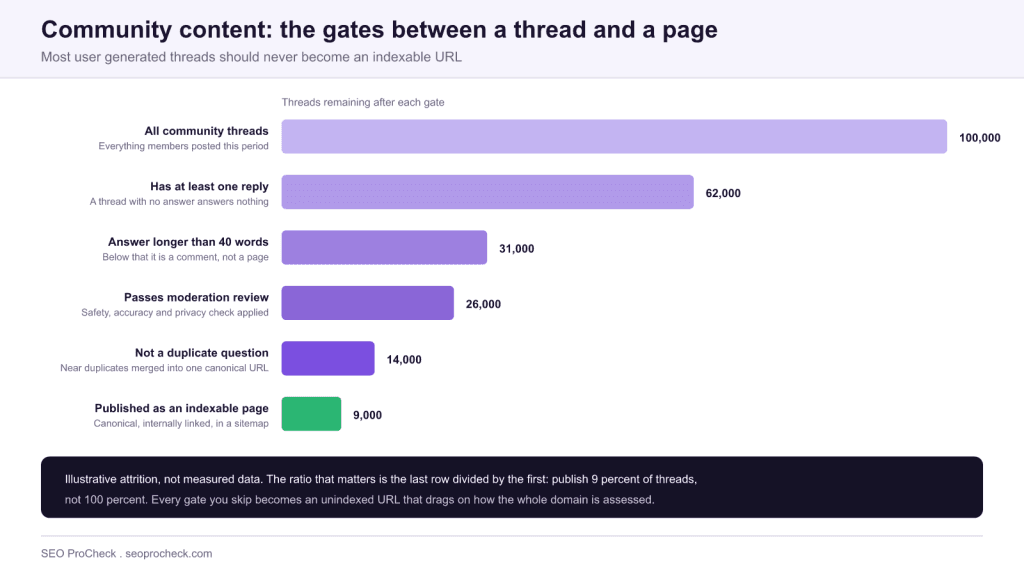
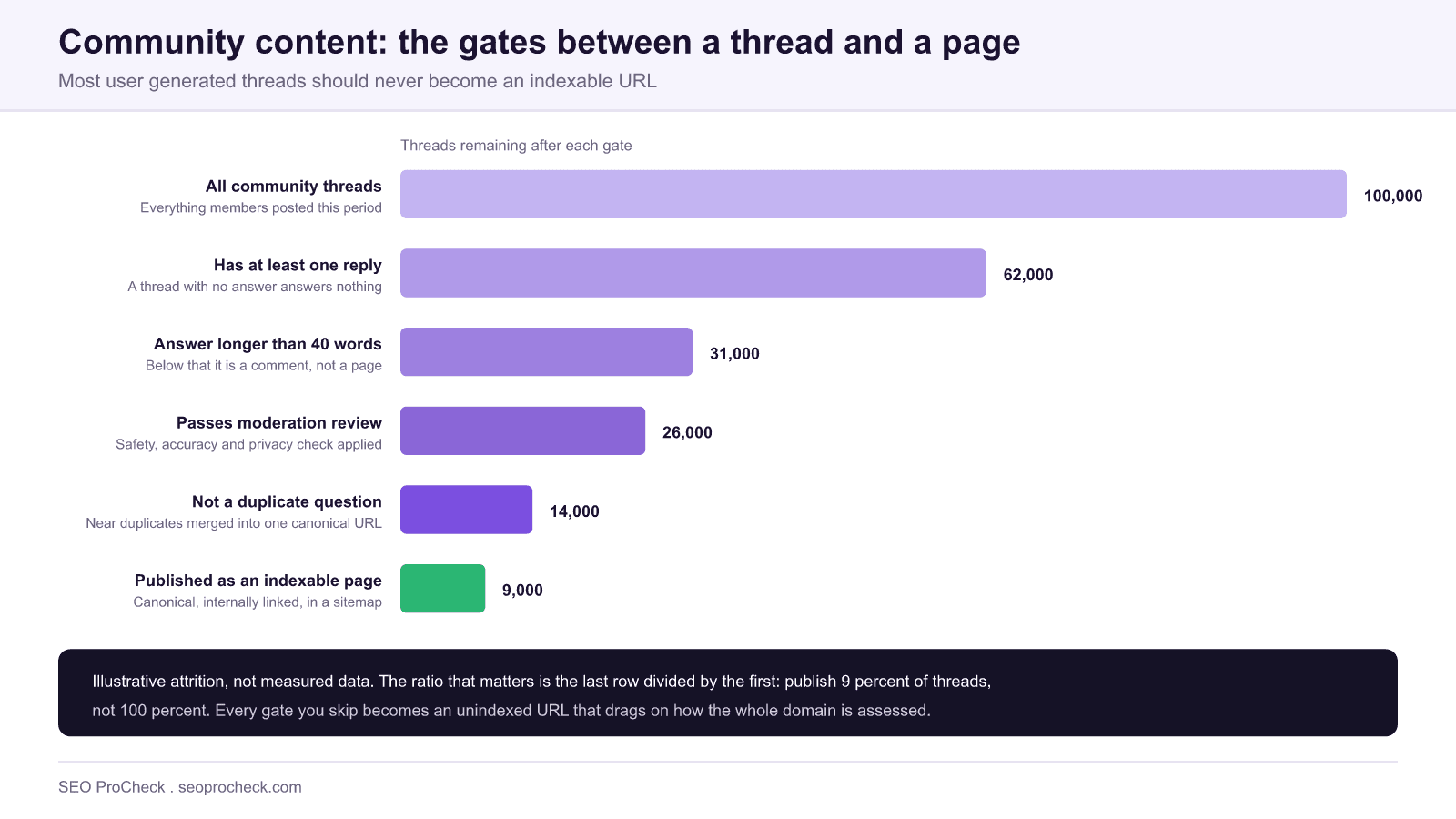
The default setting on most community platforms is that every thread gets a public URL and every public URL is indexable. On a small forum that is harmless. At the volume where community content becomes a growth lever, it produces tens of thousands of URLs where the majority say almost nothing, and search engines assess the whole domain partly on that population.
Inverting the default is the single highest leverage decision. Threads stay public and crawlable so members and links still work, but the robots meta directive is noindex until a thread earns its way in. The gates in the diagram above are the earning conditions, and every one of them can be evaluated by a script rather than a person.
| Gate | Rule that can be automated | Why it exists | What happens to threads that fail |
|---|---|---|---|
| Has an answer | At least one reply from another member | An unanswered question is a query with no result. It satisfies nobody | Noindex, keep crawlable and visible to logged in members |
| Answer substance | Best reply above a minimum word count, for example 40 words | A one line reply cannot support a page, and short pages in volume look like thin content | Noindex until a substantive reply arrives, then re evaluate |
| Moderation passed | Automated flags plus human review on sensitive categories | Anything you index is content you publish. Unsafe or personal information must not be indexed | Removed, redacted or permanently noindexed |
| Not a near duplicate | Similarity check against already indexed threads on the same topic | Twenty versions of the same question split signals and compete with each other | Canonicalise to the strongest version, or merge into a topic page |
| Has a topic home | Thread is assigned to at least one topic hub and linked from it | A thread reachable only from a dated feed will be crawled once and forgotten | Hold from the sitemap until it is categorised |
| Sitemap membership | Included in a segmented sitemap for community URLs | Indexation of the community set has to be measurable separately from editorial | Excluded until every gate above passes |
When too many low value URLs are already indexed, the cleanup path is in index bloat. When gated URLs are getting crawled but never indexed, the diagnosis is in crawled, currently not indexed, and on community sets that is usually a signal the gates are still too loose.
Architecture: topic hubs, not feeds
The most common structural mistake in community SEO is organising by recency. A reverse chronological feed is correct for members and wrong for search, because a thread's discoverability decays with every new post, and its position in the site gives no indication of what it is about.
The architecture that works looks like this:
- Topic hub pages that persist, one per meaningful subject, with a real introduction and an editorially chosen list of the strongest threads.
- Thread pages that link back up to their hub and across to two or three closely related threads.
- Editorial guides that sit above the hubs and link down into them, giving the cluster an authoritative anchor.
- No orphan feeds. Every indexable thread reachable from a hub within two clicks, never only from a dated archive.
This is a standard cluster structure applied to content you did not commission. The linking mechanics are the same as anywhere else and are covered in the internal linking complete guide. The moderation and policy side, which is what makes any of this publishable, is in user generated content strategy and moderation.
Community and editorial are complements
Teams tend to argue about which type of content to invest in, which is the wrong frame. The two have opposite strengths, and the useful question is how each covers the other's weakness.
| Dimension | Community content | Editorial content | Practical implication |
|---|---|---|---|
| Query coverage | Very wide, including phrasings nobody would plan | Narrow, planned around researched demand | Use community to discover demand, then commission editorial for the terms that repeat |
| Cost per URL | Near zero to produce, real cost in moderation and curation | High per URL | The community budget belongs in moderation and information architecture, not production |
| Accuracy risk | High, especially on health, legal and financial topics | Controlled through review | Sensitive categories need a review layer before indexing, not after complaints |
| Freshness | Continuous by nature | Requires a deliberate refresh loop | Community keeps a topic alive between editorial updates |
| Structure and depth | Weak, fragmented across threads | Strong, organised for a full answer | Editorial hubs should organise and link the best community answers |
| Link acquisition | Rarely earns links directly | Can be built to earn links | Do not expect a community set to build domain authority on its own |
The most valuable line in that table is the first one. A community is a demand discovery engine. Questions that repeat across dozens of threads are a commissioning brief written by your actual audience, and they arrive with the exact phrasing people use. Feeding that list into editorial planning is usually worth more than any individual thread page.
Sensitive categories need the review layer before indexing
Community platforms in health, parenting, finance and legal topics carry a specific responsibility. The moment a thread becomes an indexable page, you are publishing that advice to people who did not join your community and have no context for who wrote it.
Three controls are the minimum. First, sensitive categories get human moderation before indexing, not sampled review after publication. Second, personal information, including anything identifying a child, is stripped or the thread is never indexed. Third, indexed thread pages carry visible context: that this is member discussion, not professional advice, and where to get professional advice instead. That last one costs nothing and is the difference between a useful page and a liability.
What to measure
| Metric | Where to read it | What good looks like | What it means when it degrades |
|---|---|---|---|
| Indexed community URLs | Search Console, Sitemaps report, community segment | Close to the number you deliberately released | Gates are too loose, or the pages are being judged thin |
| Clicks per indexed community URL | Performance report filtered to the community path | Flat or rising as the set grows | Dilution. Tighten the gates before releasing more |
| Share of indexed threads with zero impressions | Performance export joined to the released URL list | Falling over time | You are indexing threads nobody was searching for |
| Crawl requests to the community path | Search Console, Settings, Crawl stats | Proportional to the value of the section | Crawl budget is being spent on threads you gated out |
| Hub page rankings | Performance report filtered to hub URLs | Hubs ranking for the topic head terms | The architecture is not consolidating signals from threads |
The second row is the control metric. A community set can add tens of thousands of indexed URLs and still be shrinking in value per URL, and only that ratio makes it visible. When it falls, the answer is never to release more threads.
FAQ
Only the ones that answer a question well enough to stand as a page on their own. A thread with a real question and a substantive answer is a legitimate result. A thread with no reply, a one line reply, or a question already answered better elsewhere on your site is not, and indexing it dilutes the whole domain. The practical rule is to index by exception rather than by default.
Set explicit gates and apply them mechanically: at least one reply, an answer above a minimum length, moderation passed, and not a near duplicate of an existing indexed thread. Everything that fails stays crawlable for users but carries a noindex directive. Reviewing thread by thread does not scale and produces inconsistent decisions.
It can. Large volumes of near duplicate URLs consume crawl budget and give search engines a lot of low value examples of your site, which affects how the whole domain is assessed. The specific symptom to watch is a growing crawled currently not indexed bucket alongside falling clicks per indexed URL.
Anything you index is content you are publishing, with the editorial responsibility that implies. For sensitive categories such as health, that means a moderation layer that removes unsafe advice and personal information before a thread becomes an indexable page. Indexing an unmoderated thread on a health topic is a reputational risk far larger than the traffic it earns.
It is different, not better. Community content covers a long tail of specific, oddly phrased questions that no editorial team would ever plan, and it does so at a volume no editorial team could match. It is weaker on structure, accuracy and depth. Sites that do well usually run both, with editorial hubs organising and linking to the best community answers.
Through topic hubs rather than by date. A reverse chronological feed buries a good answer within days and gives search engines almost no signal about what a thread is about. Group threads into topic pages, link from those hubs to the strongest threads, and link threads back to the relevant editorial guide.
Sitting on a large community archive and not sure what should be indexed?
An audit measures how much of your user generated set is earning impressions, where the duplication is, and which gates would recover crawl budget.
Source: https://seo.thefxck.com/interviews/peanut-app-seo-growth/
Take this with you
The assistant links open with a question about this page already written. Nothing is sent until you press enter.
Claude Vincent is a technical SEO consultant focused on crawlability, rendering, and AI-search visibility. He writes the field guides and case studies at SEO ProCheck, with a bias toward the durable, unglamorous work that decides whether search engines and AI answer engines can actually read and cite a site.
About SEO ProCheck
Technical SEO consulting and GEO strategy with 20 years of enterprise experience. Case studies, resources, and tools for search and AI visibility.
Work With Me
Technical SEO audits, GEO strategy, site migrations, and international SEO. Hourly consulting for teams who need hands-on support, not just reports.
Subscribe to our newsletter!








Recent Posts
- Most Top Sites Never Say Who They Are in Structured Data October 14, 2026
- Homepage Titles Are Mostly Too Short, Not Too Long October 8, 2026
- Who Actually Serves an llms.txt? 184 Top Sites Measured September 29, 2026