

AI Summary
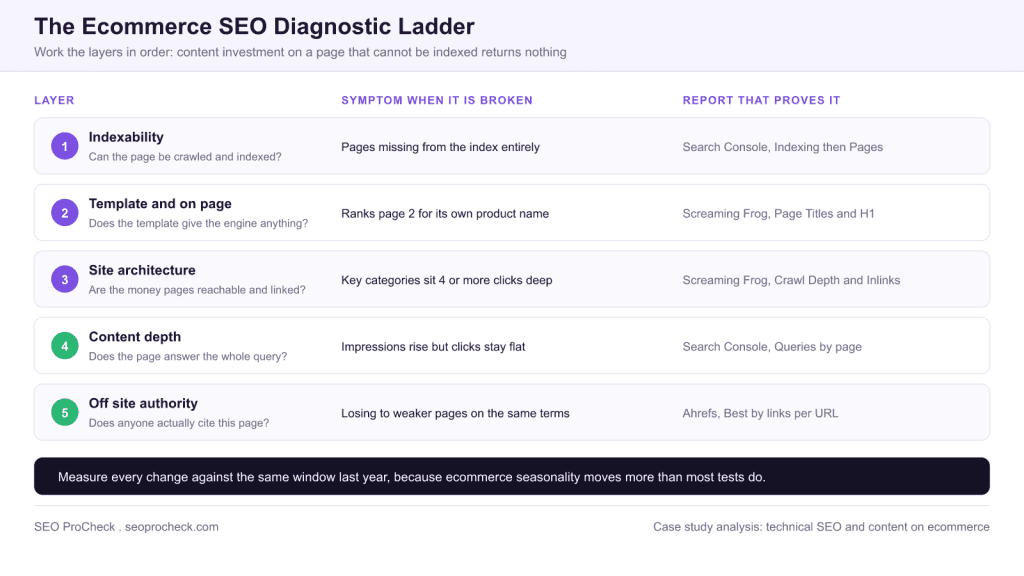
This entry collects a set of ecommerce SEO case studies covering both technical and content work. The useful pattern across results like these is not the headline percentage: it is the diagnostic order, because each layer of an ecommerce site depends on the layers beneath it and fixing the wrong one first produces a flat report and a wrong conclusion.
- Diagnose bottom up: indexability, template, architecture, content, then authority.
- Percentage gains depend on the baseline, so read absolute numbers and the starting position too.
- Compare like for like windows year over year, because catalogue seasonality moves more than most changes do.
- Record the change date and the measurement window, or the result is a claim rather than evidence.

Case studies reporting large ecommerce gains are usually reporting a structural fix that lifted a whole template at once, not a clever tactic applied to one page. To reproduce that kind of result you have to find which layer is actually constraining the site, and the only reliable way is to test the layers in order: can the pages be indexed, does the template give an engine anything to work with, are the commercial pages reachable and internally linked, does the content answer the whole query, and does anything cite the page. Then measure against the same window last year, annotate the change date, and give template level changes four to eight weeks before you read the result.
The case study collection below is summarised from the original source, credited in full at the end of the summary. What follows it is the part that turns other people's results into something you can act on: the diagnostic order, the exact reports that identify each constraint, and a measurement setup that does not fool you.
This case study documents a successful organic growth strategy, demonstrating how strategic SEO implementation drives measurable business results. The approach provides actionable insights for practitioners facing similar challenges.
Challenge and Context
Every successful SEO initiative begins with understanding the starting position and objectives. This case study reveals the initial challenges, competitive landscape, and business goals that shaped the strategy. Understanding context helps practitioners assess applicability to their own situations.
Strategic Approach
The methodology employed combined technical optimization, content strategy, and authority building in a coordinated approach. Key decisions around prioritization, resource allocation, and tactical execution provide a template for similar initiatives. The strategy balanced quick wins with sustainable long-term growth.
Implementation Details
Moving from strategy to execution required specific technical implementations, content creation processes, and measurement frameworks. This case study documents the practical steps taken, tools used, and workflows developed. These implementation details help practitioners translate strategy into action.
Results and Analysis
The outcomes demonstrate the effectiveness of the approach through measurable metrics: traffic growth, ranking improvements, and business impact. Analysis of what worked best and what could have been done differently provides learning value beyond the raw results.
This case study contributes to the evidence base for effective SEO strategy, helping practitioners learn from documented successes.
Source: https://www.samunderwood.co.uk/blog/2021-seo-case-studies/
Practitioner notes: reading a case study without copying the wrong thing
The failure mode with case study collections is straightforward. Someone reports a large gain from, say, rewriting category copy, and three teams go and rewrite category copy on sites where category copy was never the constraint. The gain in the original case came from removing whatever was holding that specific site back. Copying the tactic without the diagnosis copies the wrong half.
Percentages need context too. A gain expressed as a percentage depends entirely on the baseline, and the same absolute improvement reads very differently on a site with a thousand monthly sessions than on one with a million. When you read any case study, look for four things: the starting numbers, the date the change went live, the length of the measurement window, and what else was happening at the same time. If any of those are missing, treat the result as directional rather than proven.
The diagnostic order, and the report that settles each layer
Each layer only pays once the layers beneath it are sound. The table below gives the test, the threshold that means the layer is the constraint, and the typical fix.
| Layer | Exact check | Constraint indicator | Typical fix |
|---|---|---|---|
| Indexability | Search Console, Indexing then Pages, read the excluded reasons | A large share of commercial URLs in Crawled currently not indexed, Duplicate, or Excluded by noindex tag | Remove the directive or parameter rule, consolidate duplicates, resubmit |
| Template and on page | Screaming Frog, Page Titles and H1 tabs, filter Duplicate and Missing | Templated titles across a category set, or product pages ranking behind marketplaces for their own product name | Rewrite the template patterns, add unique content blocks per URL |
| Site architecture | Screaming Frog, Internal tab, sort by Crawl Depth and Inlinks | Revenue categories at depth 4 or greater, or with fewer inlinks than tag pages | Add hub links, flatten the path, feature key categories in navigation |
| Content depth | Search Console, Performance then Pages, then Queries for that page | Impressions climbing while clicks stay flat, or ranking positions stuck between 8 and 20 | Answer the full query on the page: specs, comparisons, buying guidance, FAQs |
| Off site authority | Ahrefs, Site Explorer then Pages then Best by links, per URL | Competing pages that are worse but outrank you, with more referring domains | Digital PR aimed at the specific URL, plus internal links from strong pages |
Setting up measurement before you make the change
Most disputed SEO results are disputed because the measurement was set up afterwards. Five minutes of preparation removes the argument:
- Record the baseline. Export Search Console Performance for the affected URL pattern over the previous 90 days: clicks, impressions, average position, and the count of distinct queries.
- Write down the change and its date. Add an annotation in GA4 under Admin then Data display then Annotations, and keep the same note in your own change log. Future you will not remember which week the deploy happened.
- Pick the comparison window in advance. Same length as the baseline, and also the same calendar window in the previous year for a seasonality reference.
- Choose a control group where you can. If the change hits one category template, leave a comparable category untouched for a cycle. This is the closest thing to a controlled test that most sites can run.
- Confirm the change is live to a crawler. Use the URL Inspection tool and view the rendered HTML. A change that only exists for logged in users, or that renders client side after the crawl, has not happened as far as measurement is concerned.
Confounders that break ecommerce reporting
- Seasonality. The largest confounder in ecommerce by a wide margin. Always hold a year over year comparison next to the before and after view.
- Catalogue changes. Products going out of stock, being discontinued, or a supplier feed changing will move organic performance without anyone touching SEO.
- Core updates. Check the change window against the update timeline before attributing a movement to your own work in either direction.
- Paid search changes. A brand campaign switched on or off changes the click distribution on your own brand terms and shows up in organic reporting.
- Multiple simultaneous changes. Shipping a template rewrite, a link campaign and a navigation change in the same sprint produces a number nobody can attribute.
For the technical layers specifically, the audit structure in how to conduct, structure and communicate a technical SEO audit keeps findings in an order stakeholders can act on, and the content layer is covered in streamlining a content audit and gap analysis.
What to steal from a case study, and what to ignore
- Steal the diagnosis. How the practitioner worked out what was wrong is the transferable part.
- Steal the measurement setup. Baseline, date, window, control. This is reusable on any site.
- Be careful with the tactic. It worked because of that site's constraint, which may not be yours.
- Ignore the headline percentage. Without the baseline it carries almost no information.
- Note what was not tried. Case studies report what worked. The things that were tested and did nothing are usually more useful, and almost never published.
More worked examples, including technical and content led programs, are collected in the growth case study library.
FAQ
Because ecommerce sites usually start with a structural problem that suppresses a large number of URLs at once, so fixing it lifts a whole template rather than a single page. A percentage gain is also sensitive to the starting point: doubling a small base is a much easier result than adding ten percent to a large one, which is why the absolute numbers and the baseline matter as much as the percentage.
Work bottom up: indexability, then template and on page, then architecture, then content, then authority. The reason is that each layer depends on the ones under it. Adding content to a category page that is excluded by a parameter rule produces nothing, and the report will show no change, which usually gets blamed on the content.
Compare the same calendar window year over year rather than month over month, and annotate the change date in GA4 and in your own log. On a seasonal catalogue, a month over month comparison can show a large gain or loss that has nothing to do with anything you did.
It depends entirely on which layer is broken, which is the point of diagnosing in order. On a site where thousands of product URLs are excluded from the index, technical work is the whole game. On a technically sound site losing to better buying guides, content is. Deciding in advance which one you believe in is how teams waste quarters.
For template level changes across many URLs, allow a full crawl and reprocessing cycle, which is typically four to eight weeks before the pattern is readable. For a single page, longer, because you have less data. Always check that the change is actually live and crawlable before starting the clock.
The starting position with real numbers, the specific change made, the date it went live, the measurement window, and the confounders that were ruled out. A case study without a baseline and a date is a claim, not evidence. That is also the standard to hold your own reporting to, not just other people's.
Want this analysed against your own site?
Case studies are only useful once you know which constraint is actually holding your site back. An audit tells you that.
Take this with you
The assistant links open with a question about this page already written. Nothing is sent until you press enter.
Claude Vincent is a technical SEO consultant focused on crawlability, rendering, and AI-search visibility. He writes the field guides and case studies at SEO ProCheck, with a bias toward the durable, unglamorous work that decides whether search engines and AI answer engines can actually read and cite a site.
About SEO ProCheck
Technical SEO consulting and GEO strategy with 20 years of enterprise experience. Case studies, resources, and tools for search and AI visibility.
Work With Me
Technical SEO audits, GEO strategy, site migrations, and international SEO. Hourly consulting for teams who need hands-on support, not just reports.
Subscribe to our newsletter!







Recent Posts
- Finding a Competitor's Sitemap, and Turning It Into a Change Log September 15, 2026
- AI Crawler User Agents: The Current Names, and Which Ones Sites Actually Block September 9, 2026
- Can AI Crawlers Actually Read Your Site? I Measured 400 of the Biggest September 5, 2026