Topic Clusters and Pillar Pages: Strategic Implementation
- December 17, 2025
- Content Architecture, Content SEO
AI Summary
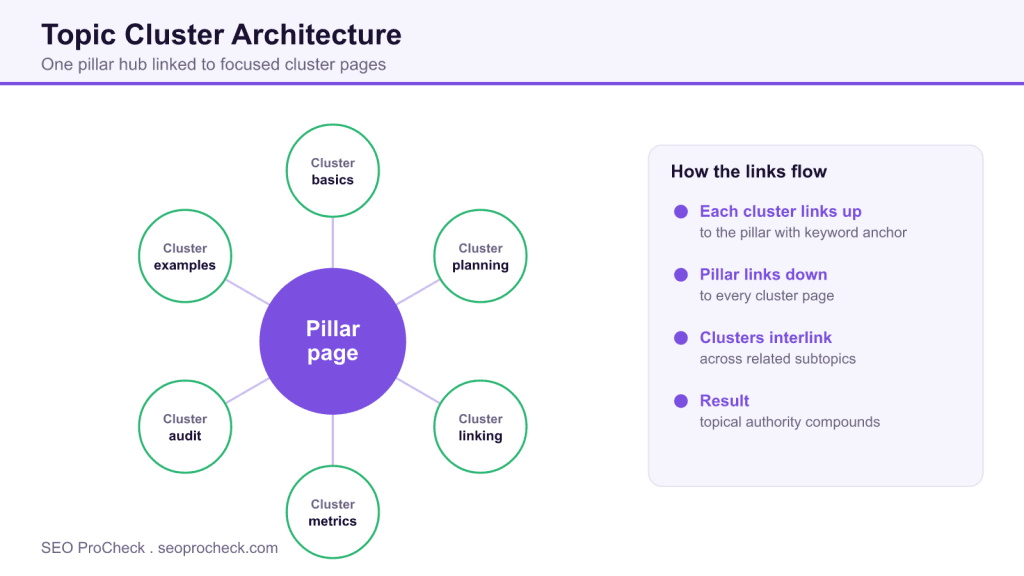
A topic cluster pairs one broad pillar page with many focused cluster pages, all interlinked, so the group signals topical authority that no single article can. The pillar covers the subject at overview depth and links to every cluster, while each cluster covers one subtopic in depth and links back to the pillar with keyword rich anchor text.
- Plan five to ten cluster pages per pillar for a meaningful authority signal.
- Every cluster links up to the pillar; the pillar links down to every cluster.
- Use descriptive keyword anchors, never generic click here or read more.
- Expect cluster benefits to compound over roughly three to six months.
Understanding Topic Clusters
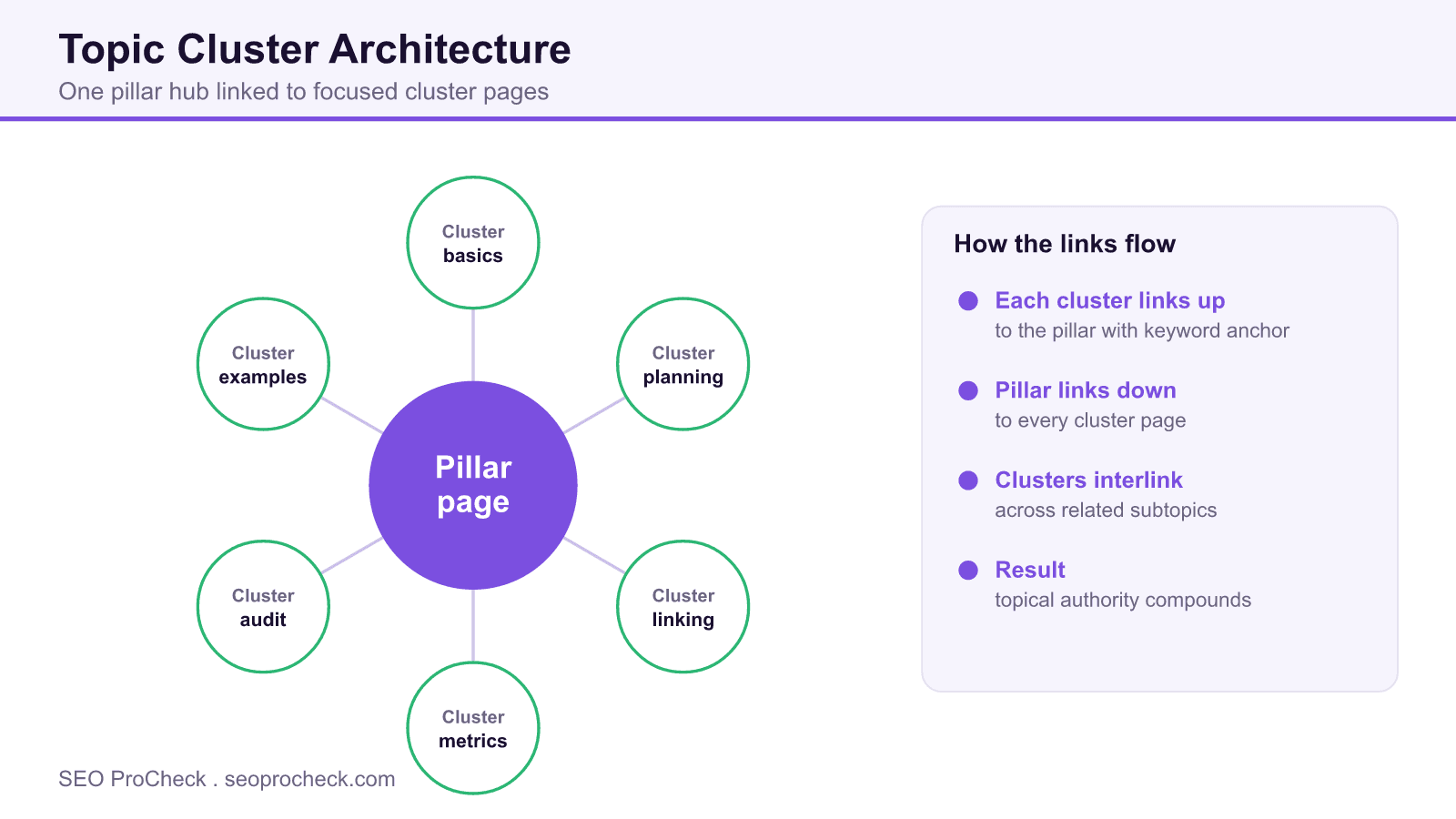
Topic clusters are a content architecture model where a comprehensive "pillar" page covers a broad topic, linked to and from multiple "cluster" pages covering specific subtopics in depth. This structure signals topical authority to search engines, creates logical user navigation paths, and distributes ranking power throughout related content. The model evolved from keyword-focused SEO toward semantic, topic-based approaches that align with how modern search engines understand content relationships.
Pillar Page Characteristics
Pillar pages provide comprehensive coverage of a broad topic, typically targeting high-volume, competitive keywords. They should be substantial (2,000-5,000+ words) but not exhaustive on every subtopic, instead providing overview coverage and linking to cluster pages for depth. Pillar pages are evergreen, updated regularly rather than time-stamped content. They serve as the hub of internal linking for their topic area, with every cluster page linking back to the pillar and the pillar linking out to all clusters.
| Element | Pillar Page | Cluster Page |
|---|---|---|
| Topic Scope | Broad, comprehensive overview | Narrow, specific subtopic |
| Target Keywords | High-volume head terms | Long-tail, specific queries |
| Content Length | 2,000-5,000+ words | 1,000-2,500 words typically |
| Internal Links | Links to all related clusters | Links to pillar and related clusters |
| Update Frequency | Regular updates to maintain comprehensiveness | Updated as subtopic evolves |
Planning Topic Cluster Architecture
Start with keyword research to identify topic opportunities where you can create both pillar and multiple cluster pages. Map search intent across the topic area to ensure coverage of informational, navigational, and transactional queries where appropriate. Audit existing content to identify pieces that can serve as cluster pages or be consolidated. Ensure each cluster topic is distinct enough to warrant its own page while clearly relating to the pillar theme. Plan at least 5-10 cluster pages per pillar for meaningful topical authority signals.
Internal Linking Strategy
Linking structure determines cluster effectiveness. Every cluster page should link to its pillar page with descriptive anchor text containing the pillar's target keyword. The pillar should link to every cluster page, ideally with contextual links within the content plus a linked list or table of contents. Cluster pages should also interlink with related clusters, creating a web of topical connections. Use descriptive anchor text that includes target keywords naturally. Avoid generic "click here" or "read more" anchors that miss opportunities to signal topic relationships.
Measuring Topic Cluster Performance
Track rankings for both pillar and cluster page keywords over time. Monitor organic traffic to the entire cluster as a unit, not just individual pages. Measure internal link click-through using scroll tracking or events in analytics. Watch for ranking improvements across all cluster pages as the structure matures, indicating growing topical authority. Compare performance against non-clustered content to validate the strategy. Typical timeline for seeing cluster benefits is 3-6 months as search engines process the structure and build trust in your topical coverage.
Designing the Cluster Before You Write
Strong clusters are architected, not accumulated. Start from a keyword and intent map for the whole subject, then decide which broad head term the pillar will target and which specific, longer tail questions each cluster will own. The test for a good cluster page is distinctiveness: it must be different enough from its siblings to deserve its own URL, yet clearly a facet of the pillar theme. If two planned clusters would answer the same query, merge them before you write, or they will compete with each other in search results.
Audit what you already have first. Existing articles can often be repurposed as cluster pages or consolidated into the pillar, which is faster than writing from scratch and avoids creating duplicates of content you already rank for. Only after the map is settled should writing begin, because retrofitting links onto an unplanned pile of posts is far harder than building the structure deliberately.
| Cluster Design Question | Good Answer Looks Like |
|---|---|
| How many clusters per pillar? | Five to ten distinct subtopics |
| How do clusters differ? | Each owns one specific query, no overlap |
| What anchor text links up? | The pillar's target keyword phrase |
| Where does the pillar link? | Out to every cluster, contextually |
| When do results show? | Three to six months as trust builds |
Making the Internal Links Do the Work
The link graph is what turns a set of related articles into a cluster. Every cluster page links to its pillar using descriptive anchor text that contains the pillar keyword, and the pillar links back out to each cluster, ideally through contextual links in the body as well as a table of contents. Related clusters should also interlink where the connection is genuine, creating a web rather than a simple hub and spoke. Avoid generic anchors such as click here, because the anchor text is a signal about what the destination is about, and wasting it costs you relevance.
Maintaining a Cluster as a Portfolio
A cluster is a living asset. Measure the whole group as a unit, tracking rankings and organic traffic across pillar and clusters together rather than judging any single page in isolation, because authority earned by one page lifts its neighbours. Feed the cluster from your ongoing content pruning process, folding worthy survivors in and retiring pages that only dilute the theme. When you invest in cluster depth, you are also building exactly the comprehensive coverage that earns citations in Google AI Overviews, so the same structure serves both classic rankings and AI answer surfaces. Underpin all of it with a healthy foundation by periodically running a technical SEO audit, since crawl and indexation problems will quietly cap the authority a well planned cluster can earn.
Frequently Asked Questions
How many cluster pages do I need per pillar?
Aim for at least five to ten distinct cluster pages per pillar to send a meaningful topical authority signal. Fewer than that rarely demonstrates enough coverage, while the exact number depends on how many genuinely separate subtopics the subject supports.
How long should a pillar page be?
Pillar pages are typically substantial, often in the range of 2,000 to 5,000 words, because they cover a broad topic at overview depth. The goal is comprehensive framing that links out to clusters for detail, not exhaustive treatment of every subtopic in one page.
What anchor text should cluster pages use to link to the pillar?
Use descriptive anchor text that contains the pillar's target keyword phrase, placed naturally in context. Avoid generic anchors like click here or read more, since the anchor is a relevance signal about the destination.
How long until topic clusters improve rankings?
Most sites see benefits over roughly three to six months as search engines crawl the new structure and build trust in your topical coverage. Improvement tends to appear across the whole cluster rather than on one page at a time.
Should the pillar link to every cluster?
Yes. The pillar should link out to each cluster page, ideally with contextual links in the body plus a linked table of contents, while every cluster links back to the pillar. That two way linking is what defines the cluster.
Can I turn existing content into a cluster?
Often, yes. Audit current articles to find pieces that can serve as cluster pages or be consolidated into the pillar. Repurposing existing content is usually faster than starting over and avoids creating duplicate pages.
Claude Vincent is a technical SEO consultant focused on crawlability, rendering, and AI-search visibility. He writes the field guides and case studies at SEO ProCheck, with a bias toward the durable, unglamorous work that decides whether search engines and AI answer engines can actually read and cite a site.
About SEO ProCheck
Technical SEO consulting and GEO strategy with 20 years of enterprise experience. Case studies, resources, and tools for search and AI visibility.
Work With Me
Technical SEO audits, GEO strategy, site migrations, and international SEO. Hourly consulting for teams who need hands-on support, not just reports.
Subscribe to our newsletter!