

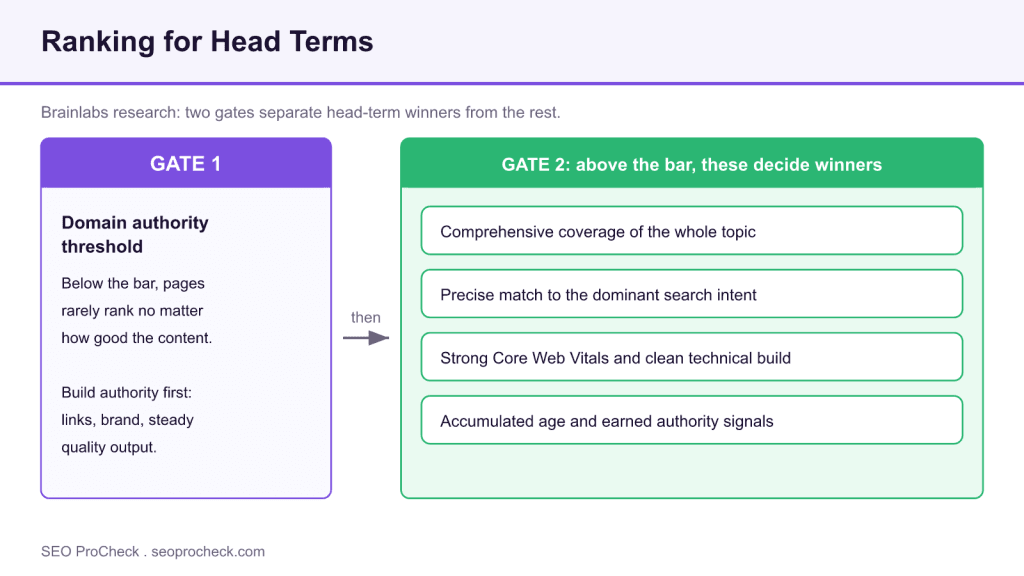
Brainlabs analyzed top pages for highly competitive head terms and found two gates. First, a domain has to clear an authority threshold to even compete; below it, content quality barely matters. Above the threshold, winners are decided by comprehensive coverage, precise intent match, strong technical execution, and accumulated age.
- Head terms are a long game won by compounding authority, not a single optimization.
- Below the authority threshold, pages rarely rank no matter how good the content.
- Above it, comprehensiveness, intent alignment, and Core Web Vitals separate winners.
- Study what already ranks to read the dominant intent before you write.
Brainlabs Digital published research examining what distinguishes pages that rank for highly competitive head terms from those that don't. The study analyzed top-ranking pages across competitive keyword sets to identify patterns in content, authority, and technical factors that correlate with head term success.
Domain Authority Threshold
The research found that most head term winners came from high-authority domains, but the relationship wasn't linear. A minimum authority threshold appeared necessary for competition, but above that threshold, other factors determined winners. Domains below the threshold rarely ranked regardless of content quality, while domains above it competed based on additional factors.
This suggests a two-phase strategy: first, build sufficient domain authority to be competitive (through link building, brand development, and consistent quality content), then optimize specific pages for head term competition. Trying to rank for head terms without adequate domain authority is typically futile.
Content Comprehensiveness
Head term winners typically provided the most comprehensive coverage of their topics. They answered multiple related questions, covered subtopics that competing pages missed, and provided depth that justified being the single result a searcher needed. Length correlated with comprehensiveness but was a symptom rather than cause.
The research noted that comprehensiveness included format diversity: text, images, videos, tables, and interactive elements where appropriate. Pages providing multiple ways to consume information performed better than text-only alternatives. Rich content types may also improve engagement metrics that influence rankings.
User Intent Alignment
Successful head term pages aligned precisely with the dominant user intent for that query. Analyzing SERP composition (what types of pages currently rank) revealed user intent signals that winners matched. Pages misaligned with intent, even if high-quality, failed to rank. Before creating content, study what currently ranks to understand what Google believes users want.
Technical Excellence
Head term winners showed consistently strong Core Web Vitals and technical implementation. At the competitive top of SERPs, technical differentiation can provide edge. Pages with poor load times or mobile experience may rank for less competitive terms but struggle against optimized competitors for head terms.
The Long Game
Most head term winners had significant age and accumulated signals. Few newly published pages rank for head terms quickly. The research recommended targeting head terms as long-term goals while building authority through less competitive keywords. Head term rankings typically result from years of compounding SEO investment rather than single optimizations.
Source: Brainlabs
Applying the Two-Gate Model
The value of this research is that it stops you wasting effort. If your domain sits below the authority threshold for a head term, the highest-quality page in the world will not rank, so pouring resources into that one page is the wrong move. The right move is to earn the authority first through easier wins, then point that accumulated strength at the head term. The table maps each gate to what you build and how you check progress.
| Gate | What to build | How to measure progress |
|---|---|---|
| Gate 1: authority threshold | Links, brand demand, and topical authority from a cluster of supporting pages | Rankings on mid and long-tail terms in the same topic |
| Gate 2: comprehensiveness | Coverage of every sub-question the SERP rewards, with tables and visuals | Content gap analysis against the current top results |
| Gate 2: intent match | A page format that mirrors the dominant search intent already ranking | SERP composition review before you write |
| Gate 2: technical execution | Fast, stable pages with healthy Core Web Vitals | Field data in Search Console and lab tests |
What Has Changed Since This Study
Head terms are now often topped by AI generated summaries and expanded SERP features, which raises the bar again. Being the single most comprehensive, best-sourced page on the query is exactly what both classic ranking and AI answer selection reward, so the strategy holds. The main adjustment is to structure content so key answers are extractable: clear headings, direct answers near the top, and supporting tables. Winning a head term still takes years of compounding work, but that structure helps the same page earn visibility in AI answers along the way.
Frequently Asked Questions
Why can't my high-quality page rank for a competitive head term?
Because head terms have an authority gate. The Brainlabs research found that domains below a minimum authority threshold rarely rank for head terms no matter how good the individual page is. You usually need to build domain and topical authority first, then compete on the specific page.
What is the two-phase strategy for head terms?
First, build enough domain authority to be competitive through links, brand development, and a cluster of quality content. Second, optimize a specific page for the head term. Attempting phase two without phase one is typically futile.
Does content length help rank for head terms?
Length correlates with ranking, but as a symptom of comprehensiveness rather than a cause. Winners cover the whole topic and answer every related question a searcher has, which tends to make them longer. Padding for word count alone does not help.
How do I find the right intent for a head term?
Study the current top results. The mix of page types that already rank, guides, product pages, tools, or videos, reveals the dominant intent Google believes searchers want. Match that format before writing, because a mismatched page rarely ranks even when it is high quality.
Do Core Web Vitals matter for head terms?
At the competitive top of the SERP, yes. Winners showed consistently strong Core Web Vitals and clean technical builds. Poor speed or mobile experience can be the difference that keeps an otherwise strong page out of the top positions.
How long does it take to rank for a head term?
Usually years, not weeks. Most winners had significant age and accumulated signals. Treat head terms as long-term goals, build authority through less competitive keywords first, and expect head term success to come from compounding investment.
Take this with you
The assistant links open with a question about this page already written. Nothing is sent until you press enter.
Claude Vincent is a technical SEO consultant focused on crawlability, rendering, and AI-search visibility. He writes the field guides and case studies at SEO ProCheck, with a bias toward the durable, unglamorous work that decides whether search engines and AI answer engines can actually read and cite a site.
About SEO ProCheck
Technical SEO consulting and GEO strategy with 20 years of enterprise experience. Case studies, resources, and tools for search and AI visibility.
Work With Me
Technical SEO audits, GEO strategy, site migrations, and international SEO. Hourly consulting for teams who need hands-on support, not just reports.
Subscribe to our newsletter!







Recent Posts
- Finding a Competitor's Sitemap, and Turning It Into a Change Log September 15, 2026
- AI Crawler User Agents: The Current Names, and Which Ones Sites Actually Block September 9, 2026
- Can AI Crawlers Actually Read Your Site? I Measured 400 of the Biggest September 5, 2026