

AI Summary
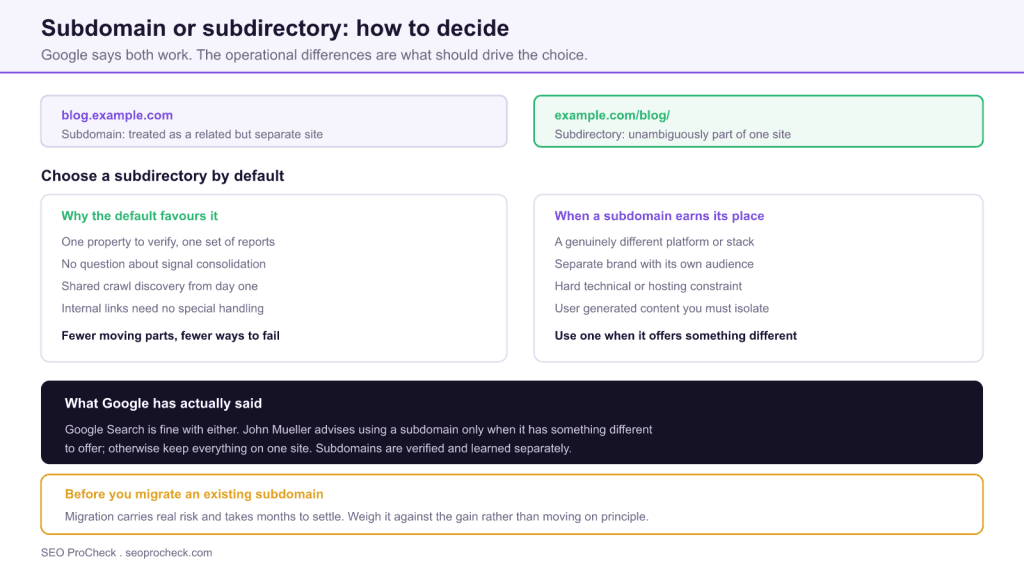
Google has stated that Search is fine with either subdomains or subdirectories, so the choice should be made on operational grounds rather than to chase a ranking advantage. Subdirectories are the sensible default because they remove ambiguity and overhead, not because subdomains are penalised.
- John Mueller's guidance: use a subdomain only when it offers something different, otherwise keep everything on one site.
- Subdomains need separate Search Console verification and are crawled and learned individually, which is friction rather than penalty.
- Subdomains are genuinely correct for user generated content, separate brands, and hard platform constraints where isolation is the goal.
- Migrating an existing, well performing subdomain is usually not worth the risk; apply the default to new sections instead.

Subdomain or subdirectory is one of the oldest arguments in SEO, and it is unusual in that the
strongest position is also the least exciting: Google has said repeatedly that either works, and the
decision should be made on operational grounds rather than in pursuit of a ranking advantage.
That does not make the choice unimportant. It makes it a different kind of decision from the one
most people think they are making.
What Google has actually said
John Mueller has stated that Google Search is fine with using either subdomains or subdirectories,
and that the two are treated the same in Search. His practical advice goes a step further: use a
subdomain when it has something different to offer compared with the rest of the site, and if you do
not particularly care either way, keep everything on the same site using subdirectories.
He has also consistently noted two operational facts. Subdomains must be verified separately in
Search Console, and Google has to learn to crawl them individually. Neither is a penalty. Both are
friction.
It is worth being straightforward about the evidence here. There is no public controlled study that
isolates this variable, because you cannot run one: no site can host the same content at both
addresses simultaneously and compare. What exists is Google's stated position on one side and a large
body of practitioner migration reports on the other, and migration reports always conflate the
structural change with everything else that shipped alongside it. Anyone quoting a precise percentage
for what consolidation is worth is inferring, not measuring.
The differences that are real
| Consideration | Subdomain (blog.example.com) | Subdirectory (example.com/blog/) |
|---|---|---|
| Google's stated handling | Fine for Search, learned and crawled separately | Fine for Search, unambiguously one site |
| Search Console | Needs its own property, or a domain property to combine | Included in the main property automatically |
| Signal consolidation | Not publicly documented in detail, so it stays an open question | No question, everything is one site |
| Analytics | Cross-domain style setup may be needed for session continuity | Works out of the box |
| Hosting and stack | Can run on entirely separate infrastructure | Usually needs a proxy or rewrite rule |
| Cookies and security scope | Isolated, which is useful for untrusted content | Shared with the main site |
| Setup effort | Low, just a DNS record | Higher if the platform differs from the main site |
| Reporting overhead | Two properties, two sets of reports | One property |
The differences that actually vary between the two structures. Note that none of them is a ranking penalty.
Reading down that table, the honest summary is that the subdirectory advantage is mostly about
removing uncertainty and overhead rather than gaining ranking power. You get one Search Console
property instead of two, analytics that works without cross-domain configuration, and no open question
about whether signals consolidate. For most teams that is worth more than it sounds, because every
piece of split reporting is a place where problems hide.
Authority consolidation
Subdirectory structures show clearer authority consolidation than subdomains, in the sense that
there is no ambiguity to reason about at all. Links to subdirectory content contribute to the same
site as everything else by definition. While Google states that it understands subdomain
relationships, the practical experience many practitioners report is cleaner results from subdirectory
consolidation.
The mechanism people usually have in mind is that a new subdomain starts without the crawl history
and established patterns the main domain has accumulated, so it takes longer to get discovered,
crawled at depth, and rated. That is consistent with what Google has said about subdomains being
learned separately, and it matters most in the first months of a new section's life.
When subdomains work
Subdomains are appropriate for distinctly different content types or technical requirements.
International targeting through country-code subdomains is one of the structures Google explicitly
supports. Completely separate products or brands with unique audiences justify subdomain separation.
There is one case where a subdomain is not just acceptable but clearly correct: content you do not
fully control. User generated content, customer subdomains on a SaaS platform, and anything untrusted
belongs on a separate host, because subdomains give you cookie and security isolation that
subdirectories cannot. Here the isolation is the entire point, and consolidation would be the
mistake.
The other genuinely strong case is a hard platform constraint. If your help centre runs on Zendesk
and your site runs on a custom stack, a subdomain is a DNS record while a subdirectory needs a reverse
proxy. That said, the proxy is usually less work than people assume:
# Serving a subdirectory from separate infrastructure
# (nginx reverse proxy: example.com/blog/ backed by another host)

location /blog/ {
    proxy_pass https://blog-backend.internal/;
    proxy_set_header Host $host;
    proxy_set_header X-Forwarded-Proto $scheme;
}

# This is how you get subdirectory URLs without forcing the blog
# onto the main platform. Cloudflare Workers, Fastly and Akamai
# all offer an equivalent.

# Verify it resolves as one host, with no redirect to the subdomain:
curl -sIL https://example.com/blog/ | grep -Ei "^(HTTP|location)"
If your CDN supports edge routing, and most do, the subdirectory becomes achievable without moving
platforms. Weigh that against the reporting and consolidation benefit before defaulting to the
subdomain because it is quicker to set up.
Migration considerations
Moving from subdomains to subdirectories can improve SEO performance. However, migrations require
careful redirect handling to preserve accumulated authority. The transition cost must be weighed
against expected benefits based on the specific situation.
This is where the argument usually goes wrong in practice. The case for subdirectories as a default
for new sections is strong and cheap. The case for migrating an existing subdomain
that is already performing is much weaker, because you are taking on real risk for an uncertain gain.
Every structural migration means a re-crawl period, a stretch of unstable rankings, and months before
performance settles. Our
site migration recovery timelines study
covers what that period typically looks like.
If you do proceed, the mechanics matter more than the decision:
# If you do migrate a subdomain into a subdirectory

# 1. One-to-one 301 map, never a bulk redirect to the homepage
blog.example.com/post-name/  ->  example.com/blog/post-name/

# 2. Apache equivalent
RewriteEngine On
RewriteCond %{HTTP_HOST} ^blog\.example\.com$ [NC]
RewriteRule ^(.*)$ https://example.com/blog/$1 [R=301,L]

# 3. Keep the old property in Search Console to watch the handover
# 4. Use the Change of Address tool only for moves to another domain or subdomain,
#    it does not apply to subdomain to subdirectory moves
# 5. Update internal links to the new URLs directly,
#    do not leave them pointing at the redirects
The two most common ways these migrations go wrong are bulk redirecting everything to the new
homepage instead of mapping URL to URL, and leaving thousands of internal links pointing at the old
subdomain so every click passes through a redirect. Our
site migration planning checklist
covers the full sequence, and we have a dedicated guide to
subdomain to main domain migrations.
Practical recommendation
Default to subdirectories unless specific technical or business requirements necessitate
subdomains. New content and features should typically be placed in subdirectories to maximise
authority benefits. Existing subdomain structures should be evaluated for potential consolidation
opportunities rather than migrated automatically.
| Your situation | Recommended structure | Reasoning |
|---|---|---|
| Adding a blog to an existing site | Subdirectory | No reason to separate, and consolidation is free |
| Adding a help centre on a SaaS platform | Subdirectory via proxy | Worth the rewrite rule if your CDN supports it |
| Launching a distinct brand with its own audience | Subdomain or separate domain | Genuinely different offering |
| Hosting user generated content | Subdomain | Security and cookie isolation matter more than consolidation |
| International language versions | Any of the three, applied consistently | Google supports subdomains, subdirectories and ccTLDs |
| Existing subdomain performing well | Leave it | Migration risk usually outweighs the theoretical gain |
| Existing subdomain underperforming | Consider consolidating | Only with a proper migration plan and redirect map |
A decision table for the common cases. The default is a subdirectory; everything else needs a specific reason.
The reasoning behind the default is worth stating plainly, because it is not "subdomains rank
worse." It is that the subdirectory choice has fewer moving parts. One property, one set of reports,
no cross-domain analytics configuration, no question about how signals are handled, no separate crawl
discovery to establish. When two options are broadly equivalent for ranking, choose the one with less
that can go wrong.
What actually decides performance
It is worth keeping this decision in proportion. A blog on a subdomain with strong content, good
internal linking and sound technical foundations will outperform a blog in a subdirectory with none of
those things, every time. The structural choice is a small multiplier on the work, not a substitute
for it.
If a section of your site is underperforming and it happens to live on a subdomain, check the
ordinary explanations first: is it linked from the main site at all, does it have its own crawlable
navigation, are its pages in the index, does it load acceptably. In our experience the subdomain is
far more often correlated with neglect than it is the cause of the problem, precisely because separate
infrastructure tends to mean separate attention. Our
internal linking guide
covers the connection issue, which is usually the real culprit, and
crawl budget
covers discovery on larger properties.
FAQ
For most sites, yes, but for operational reasons rather than a ranking penalty. Google has stated that Search is fine with either structure. A subdirectory removes any ambiguity about signal consolidation, keeps reporting in one property, and needs no special handling, so it is the lower risk default when nothing pushes you the other way.
Google has said it treats subdomains and subdirectories the same in Search, while also noting that subdomains are verified separately in Search Console and have to be learned and crawled individually. So they are not penalised as separate sites, but they are not automatically handled as one either.
John Mueller's guidance is to use a subdomain only when it has something different to offer compared with the rest of the site. In practice that means a genuinely separate platform or tech stack, a distinct brand with its own audience, a hard hosting constraint, or user generated content you need to keep isolated from your main domain.
It might, but that is not guaranteed and the move carries real risk. Any structural migration involves redirect mapping, a re-crawl period, and months before performance settles. Weigh the expected gain against that cost rather than migrating on principle, particularly if the subdomain is already performing.
No. Subdomains such as fr.example.com are one of the structures Google explicitly supports for international targeting, alongside subdirectories and country-code domains. The important part is consistent hreflang annotation and a clear one-to-one mapping between language versions, not which of the three structures you pick.
Google has described subdomains and subdirectories as being treated the same, which implies signals can flow across. Many practitioners still report cleaner results from consolidating, and because the exact behaviour is not publicly documented in detail, the subdirectory choice simply removes the question. That certainty is the practical argument for it.
Source: Subdomain vs subdirectory research compiled
Weighing a subdomain consolidation?
Structural migrations are the highest risk work in SEO. An audit tells you whether the gain justifies it before you commit engineering time.
Take this with you
The assistant links open with a question about this page already written. Nothing is sent until you press enter.
Claude Vincent is a technical SEO consultant focused on crawlability, rendering, and AI-search visibility. He writes the field guides and case studies at SEO ProCheck, with a bias toward the durable, unglamorous work that decides whether search engines and AI answer engines can actually read and cite a site.
About SEO ProCheck
Technical SEO consulting and GEO strategy with 20 years of enterprise experience. Case studies, resources, and tools for search and AI visibility.
Work With Me
Technical SEO audits, GEO strategy, site migrations, and international SEO. Hourly consulting for teams who need hands-on support, not just reports.
Subscribe to our newsletter!

Recent Posts
- Most Top Sites Never Say Who They Are in Structured Data October 14, 2026
- Homepage Titles Are Mostly Too Short, Not Too Long October 8, 2026
- Who Actually Serves an llms.txt? 184 Top Sites Measured September 29, 2026