AI Summary
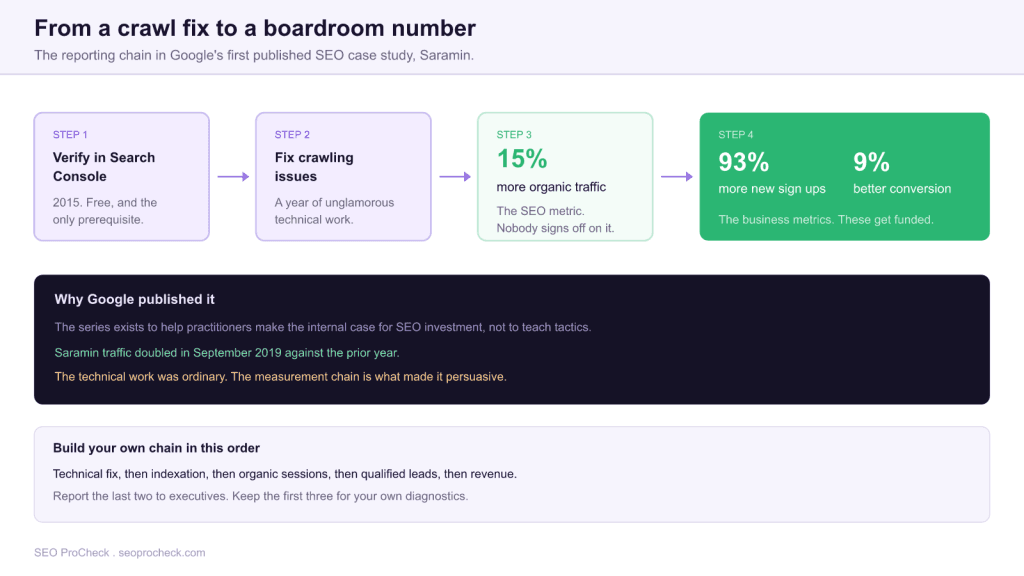
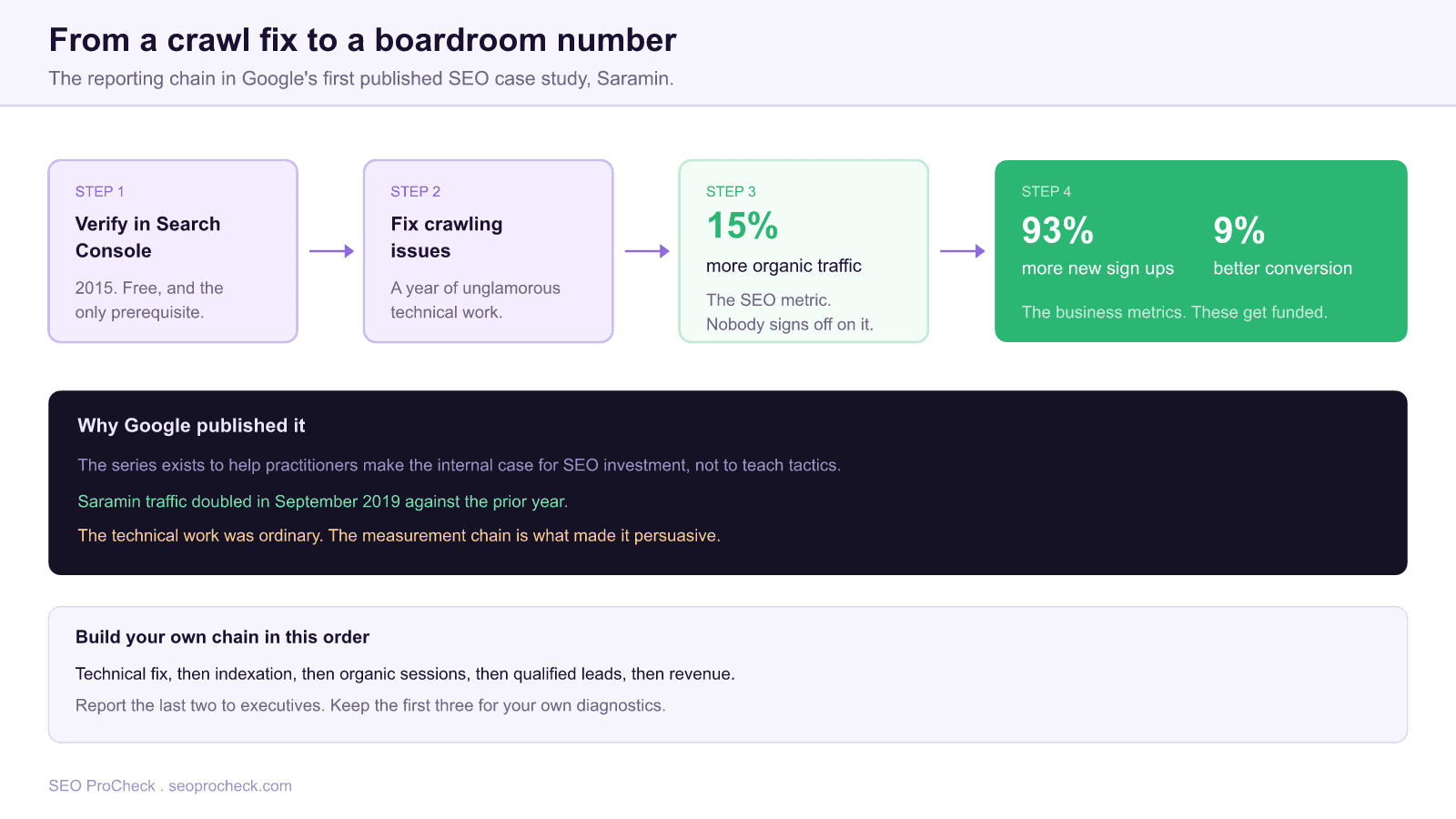
In April 2020 Google began publishing SEO case studies on its Webmaster Central Blog, explicitly to help practitioners make the internal case for investing in search. The first study followed Saramin, a large Korean job platform, whose year of crawl error remediation produced a 15 percent organic traffic gain that eventually translated into a 93 percent rise in new sign ups.
- The technical work was deliberately unremarkable. The measurement chain is what made it fundable.
- Reported figures: 15 percent more organic traffic, 93 percent more new sign ups, 9 percent better conversion.
- Google's purpose was persuasion, giving practitioners citable third party evidence for budget conversations.
- The blog has since been renamed Search Central, and the case studies now live at a dedicated hub.
Search Engine Roundtable's Barry Schwartz flagged this on 8 April 2020: Google had started a series on its Webmaster Central Blog dedicated to SEO case studies and success stories. What made the launch notable was not the tactical content, of which there was little. It was the stated purpose. Google was publishing evidence that practitioners could take to the people who control budgets.
That is a genuinely unusual thing for a search engine to do, and it tells you something about the problem Google was seeing. Not that SEOs did not know what to do, but that they could not get authorisation to do it.
What Google actually published
The first case study followed Saramin, one of Korea's largest job platforms, offering job recommendations, company and salary information, and AI assisted interview and headhunting services. The sequence reported is worth reading slowly, because the anticlimax is the point.
Saramin verified its site in Google Search Console in 2015. It then spent roughly a year identifying and fixing crawling issues. That is the whole intervention. In the words of Saramin's Tae Sung, the task "was simple, but still resulted in a 15% increase in the organic traffic". By September 2019, traffic had doubled against the previous year, and the business outcomes reported were a 93 percent increase in new sign ups and a 9 percent increase in conversion.
| Reported figure | What it measures | Who it persuades | Why it alone is not enough |
|---|---|---|---|
| 15% organic traffic | Direct result of fixing crawl errors | The SEO team, and nobody else | A traffic percentage has no currency attached |
| Traffic doubled | September 2019 against the prior year | Marketing leadership | Spans four years and many other changes |
| 93% new sign ups | Registered users acquired | Executives and finance | Needs a value per sign up to become revenue |
| 9% conversion | Efficiency of the acquired traffic | Executives and product | Proves quality, not volume, so pair the two |
Notice what is absent. No proprietary tooling, no content programme, no link campaign. A free product, a year of patient technical remediation, and a measurement trail connecting it to sign ups. If you have ever struggled to explain why crawl hygiene deserves engineering time, this is the shape of the argument.
Building the internal business case
The reusable lesson is the chain, not the numbers. Saramin's figures belong to Saramin, and quoting someone else's percentages at your own leadership team is a weak move that invites the obvious rebuttal. What transfers is the structure: connect a technical action to an indexation change, an indexation change to sessions, sessions to qualified leads, and leads to revenue. Break any link and the case collapses into a traffic chart nobody funds.
In practice, build it in this order:
- Establish the baseline before you touch anything. Record current indexed URL counts by template, organic sessions, conversion rate and revenue per organic session. Without a baseline you are arguing from anecdote later.
- Quantify the defect, not the opportunity. "We have 40,000 product URLs and 12,000 are indexed" is a fact an engineering manager can act on. "SEO could grow traffic" is not. The Search Console page indexing report is where most of this evidence lives.
- Convert to money with an agreed rate. Get finance or analytics to sign off on a value per lead or per session before you build the model. A number you derived alone will be challenged the moment it becomes inconvenient.
- Present a range, not a point estimate. Conservative, expected and optimistic scenarios survive scrutiny. A single confident figure invites someone to find the one assumption that breaks it.
- State the cost of delay. Recovery is not instant. Crawling, reprocessing and ranking stabilisation take months, which means a deferred decision has a compounding price.
- Report against the baseline afterwards. The reason Saramin's story is citable is that somebody kept measuring for four years. Most internal wins are unprovable because nobody recorded the starting point.
Our practical templates for this sit in how to build SEO business cases, with the attribution mechanics in measuring SEO ROI and the metric definitions in our SEO KPIs glossary entry.
| Layer | Metric | Where to source it | Report it to |
|---|---|---|---|
| Technical | Crawl errors, blocked URLs, response times | Search Console crawl stats, log files, crawler | Engineering only |
| Indexation | Indexed URLs per template against submitted | Page indexing report, split sitemaps | Engineering and SEO leadership |
| Visibility | Impressions and clicks by template | Search Console performance | Marketing |
| Demand | Organic sessions and qualified leads | Analytics, joined to CRM | Marketing leadership |
| Money | Revenue, pipeline, cost per acquisition | CRM and finance, at an agreed rate | Executives and finance |
What has changed since 2020
This post describes an announcement that is now several years old, so a few details have moved and it is worth updating them rather than leaving a stale reference.
- The blog was renamed. Google retired "webmaster" from its terminology, and the Webmaster Central Blog became the Google Search Central Blog. Old links generally redirect, but the name in this post is the historical one.
- The case studies got a permanent home. Rather than living only as scattered blog posts, they are collected at Google's Search case studies hub, which has grown well beyond the single Saramin study described here.
- The submission route changed. At launch, the suggested way to contribute was to propose a talk at a Google Webmaster Conference. Those events were rebranded to Search Central Live, so check the current hub for how submissions are handled today.
- The reporting surfaces evolved. Search Console's Index Coverage report became the Page indexing report, with different naming for the states you will be diagnosing.
- The argument got harder, and more necessary. With AI Overviews and AI Mode absorbing some informational demand, the "traffic will grow" framing is less reliable than it was in 2020. That makes the discipline in this case study more valuable, not less: tie the work to sign ups and revenue rather than to sessions, because sessions are the number most exposed to interface changes outside your control.
Frequently asked questions
Where can I find Google's official SEO case studies?
They are collected at Google's Search case studies hub on developers.google.com, and new ones are announced on the Google Search Central Blog. The collection has expanded considerably since the 2020 launch described in this post, covering structured data implementations and technical migrations as well as general SEO investment.
What results did the Saramin case study report?
Saramin verified its site in Search Console in 2015 and spent about a year fixing crawling issues, which produced a 15 percent increase in organic traffic. Later reporting showed traffic doubling in September 2019 against the previous year, a 93 percent increase in new sign ups, and a 9 percent increase in conversion.
How do I prove the value of SEO to executives?
Build an unbroken chain from the technical action to money: fix, indexation change, sessions, qualified leads, revenue. Agree the value per lead with finance before you model anything, present a range rather than a single figure, and record your baseline in advance so the result is provable later.
Does the Google Webmaster Central Blog still exist?
It was renamed the Google Search Central Blog when Google retired "webmaster" from its terminology, and the documentation moved alongside it. The content and archives largely carried over, so older references such as the one in this post still resolve, but the current name is Search Central.
Can I submit my own SEO case study to Google?
At launch, Google's suggested route was to propose a talk at a Google Webmaster Conference, which has since been rebranded to Search Central Live. Since the process has changed more than once, check the current case studies hub and event pages rather than relying on the 2020 instructions.
Why did Google publish SEO case studies at all?
The stated aim was to help practitioners demonstrate the value of investing in SEO and structured data to decision makers inside their organisations. It is effectively an admission that the constraint on good search work is often authorisation rather than knowledge, and that a citable third party source helps unlock budget.
The enduring value of this series is not any single statistic. It is the demonstration that a boring, well measured technical programme is a fundable business case, provided somebody wrote down where things started.
Source: https://www.seroundtable.com/google-seo-case-studies-series-29288.html
Claude Vincent is a technical SEO consultant focused on crawlability, rendering, and AI-search visibility. He writes the field guides and case studies at SEO ProCheck, with a bias toward the durable, unglamorous work that decides whether search engines and AI answer engines can actually read and cite a site.
About SEO ProCheck
Technical SEO consulting and GEO strategy with 20 years of enterprise experience. Case studies, resources, and tools for search and AI visibility.
Work With Me
Technical SEO audits, GEO strategy, site migrations, and international SEO. Hourly consulting for teams who need hands-on support, not just reports.
Subscribe to our newsletter!