

Schema Implementation ROI Analysis
- January 20, 2025
- Schema and Structured Data, Technical SEO
AI Summary
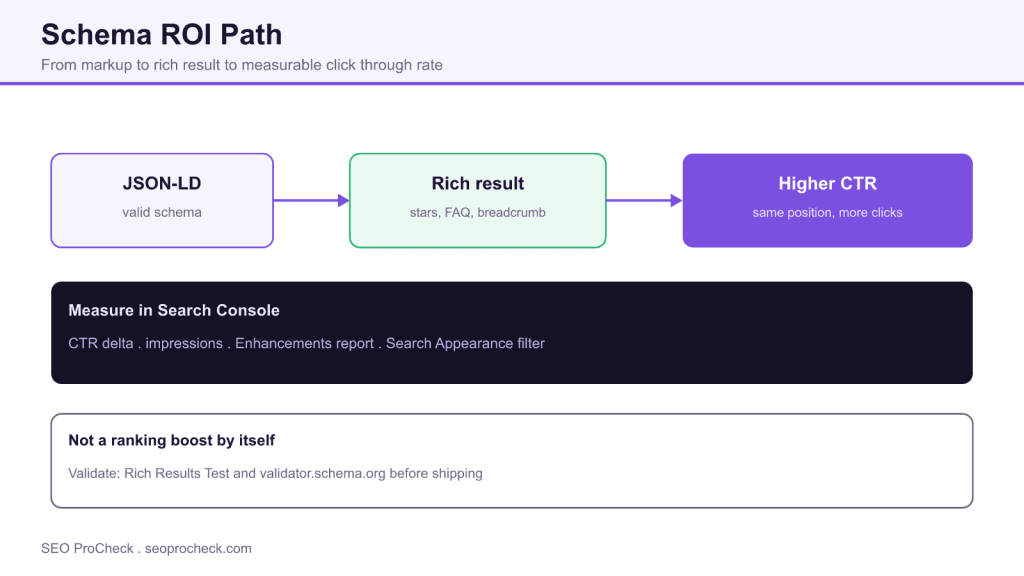
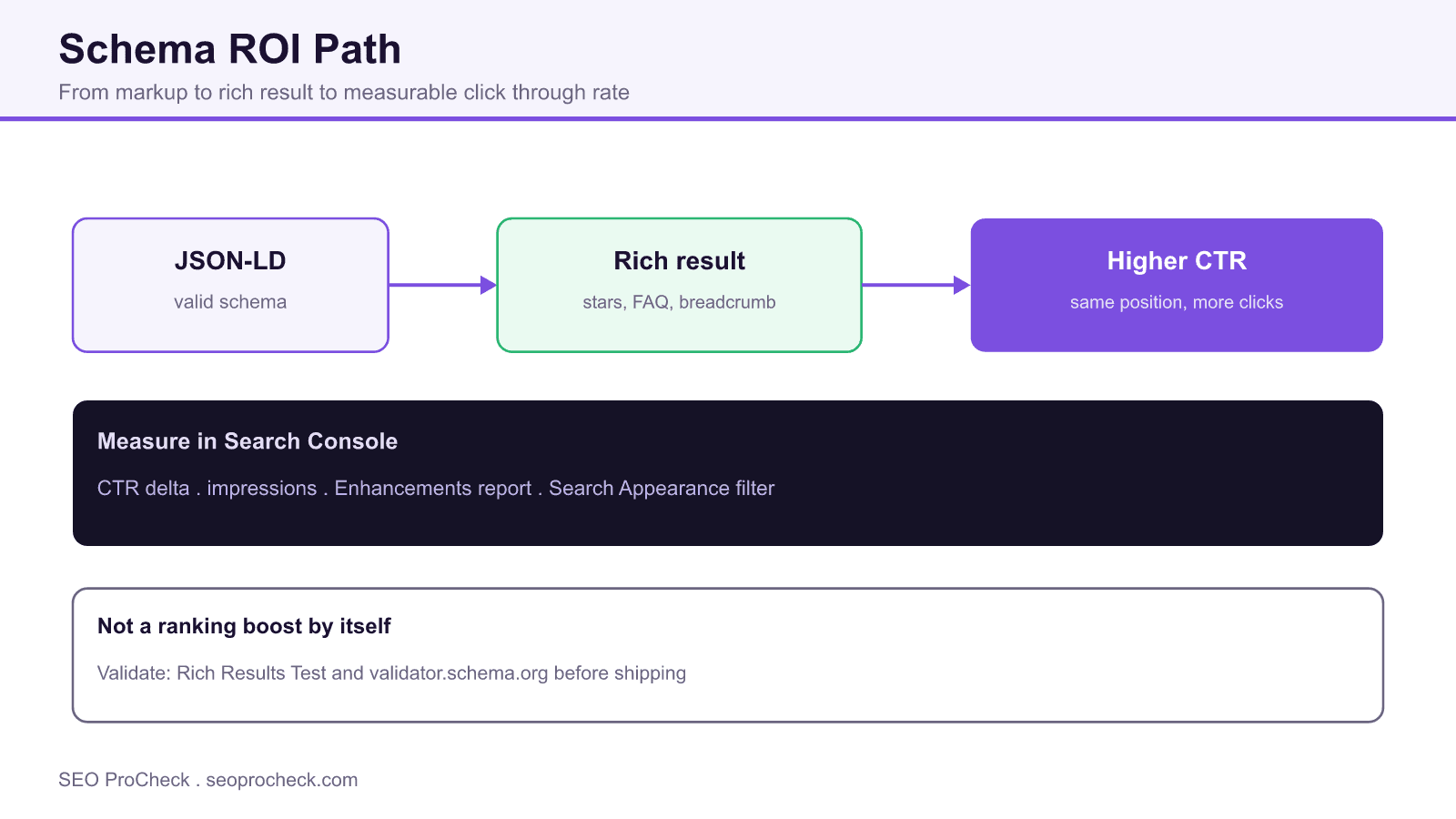
Schema markup rarely lifts rankings directly, so its return shows up as rich results, higher click through rate, and eligibility for features like FAQ, review stars, breadcrumbs and product snippets. You measure it by comparing click through rate and impressions for enhanced pages before and after in Search Console.
- Structured data earns rich results such as stars, breadcrumbs and product snippets, which lift click through rate.
- It is an eligibility signal, not a direct ranking factor.
- Measure return through Search Console click through rate, impressions and the Enhancements reports.
- Validate with the Rich Results Test and the Schema Markup Validator before shipping.
Understanding Structured Data
Structured Data represents a significant aspect of SEO strategy that practitioners need to understand thoroughly. As search algorithms evolve and user behavior changes, staying current with best practices in this area becomes increasingly important. This guide provides comprehensive coverage of the key concepts and actionable recommendations.
Strategic Importance
The role of structured data in overall SEO success cannot be understated. It influences multiple ranking factors and affects user experience. Sites that excel in this area typically see better organic performance across key metrics. Understanding the strategic implications helps prioritize efforts and allocate resources effectively.
Implementation Approach
Effective implementation requires a systematic approach. Begin with thorough assessment of your current state. Identify gaps and opportunities through analysis. Develop an action plan with clear priorities. Execute methodically while monitoring for issues. Iterate based on results and industry changes.
Best Practices
Industry best practices have evolved through collective experience and testing. Following established guidelines helps avoid common pitfalls and accelerates results. However, best practices should be adapted to your specific situation rather than applied blindly. Test and measure to confirm what works for your site.
Future Considerations
The landscape continues to evolve with new technologies and algorithm updates. Stay informed about developments that may affect your strategy. Build flexibility into your approach to accommodate changes. Focus on fundamentals that provide long-term value rather than short-term tactics that may become obsolete.
What schema actually returns
Structured data is an eligibility signal, not a ranking lever. Its return is qualifying a page for rich results, giving engines a clearer picture of the entities on the page, and feeding knowledge panels and AI answers. Because a rich result occupies more space and adds trust cues like star ratings, it can raise click through rate at the same ranking position, and that CTR lift is the core of schema return on investment.
High return schema types by page
Match the markup to the page purpose. The pairings below deliver the most visible return:
| Page type | Schema type | Possible rich result | Primary KPI |
|---|---|---|---|
| Product page | Product, Offer, AggregateRating | Price, availability, star rating | CTR, conversions |
| Informational | FAQPage, HowTo | Expandable Q and A, steps | CTR, impressions |
| Local business | LocalBusiness | Knowledge panel details | Calls, directions |
| Any page | BreadcrumbList | Breadcrumb trail in results | CTR |
| Article | Article | Top stories, richer listing | Impressions, CTR |
Implementation and validation workflow
Prefer JSON-LD, which Google recommends and which keeps markup separate from your visible HTML. Include the required properties for each type plus recommended ones, and make sure the markup matches what a user actually sees on the page. Validate before shipping with the Rich Results Test at search.google.com/test/rich-results and the Schema Markup Validator at validator.schema.org, then monitor the Enhancements section of Search Console for errors and valid items. A minimal FAQ block looks like this:
{
 "@context":"https://schema.org",
 "@type":"FAQPage",
 "mainEntity":[{
  "@type":"Question",
  "name":"Does schema boost rankings?",
  "acceptedAnswer":{"@type":"Answer","text":"Not directly. It earns rich results that lift CTR."}
 }]
}
Measuring return properly
Take a baseline of click through rate and impressions for the page set before you ship. After the markup is live and the pages are recrawled, compare the CTR delta and check whether the rich result now appears. In the Search Console Performance report, filter by Search Appearance to isolate impressions and clicks attributable to the enhancement. A rising CTR at a stable position is the clean signal that the schema is paying off.
Common mistakes that kill return
The biggest failure is markup that does not match visible content, which violates Google guidelines and can trigger a manual action. Other return killers are missing required properties, marking up content that is hidden from users, and duplicate or orphaned JSON-LD blocks. Note that Google narrowed FAQ rich results to authoritative government and health sites, so treat FAQ markup as an entity and AI clarity tool rather than a guaranteed rich result.
Frequently asked questions
Does schema markup improve rankings?
Not directly. Structured data is an eligibility signal for rich results, not a ranking factor. Its benefit is a higher click through rate from richer listings at the same position.
How do I measure schema ROI?
Baseline click through rate and impressions for the page set, ship the markup, then compare after recrawl. Use the Search Console Performance report filtered by Search Appearance and the Enhancements reports.
Which schema types give the best return?
It depends on the page: Product with AggregateRating for shops, FAQPage or HowTo for informational content, LocalBusiness for local, and BreadcrumbList sitewide. Match the type to what the page does.
What tools validate structured data?
Use the Rich Results Test at search.google.com/test/rich-results to check eligibility and the Schema Markup Validator at validator.schema.org for general validity. Then watch the Search Console Enhancements reports.
Why did my FAQ rich results disappear?
Google restricted FAQ rich results to authoritative government and health sites. The markup is still valuable for entity clarity and AI answers, but it will not always render as an expandable result.
Can incorrect schema hurt my site?
Yes. Markup that does not match visible content violates guidelines and can lead to a manual action, and invalid or hidden markup simply fails to earn rich results. Validate and keep markup honest.
Related coverage: topical authority, answer optimization, and robots and indexation.
Claude Vincent is a technical SEO consultant focused on crawlability, rendering, and AI-search visibility. He writes the field guides and case studies at SEO ProCheck, with a bias toward the durable, unglamorous work that decides whether search engines and AI answer engines can actually read and cite a site.
About SEO ProCheck
Technical SEO consulting and GEO strategy with 20 years of enterprise experience. Case studies, resources, and tools for search and AI visibility.
Work With Me
Technical SEO audits, GEO strategy, site migrations, and international SEO. Hourly consulting for teams who need hands-on support, not just reports.
Subscribe to our newsletter!







Recent Posts
- Can AI Crawlers Actually Read Your Site? I Measured 400 of the Biggest September 5, 2026
- The Pre-Publish Quality Gate for AI-Assisted Content August 6, 2026
- AGENTS.md vs llms.txt vs llms-full.txt: Which Agent File Does What July 18, 2026