

AI Summary
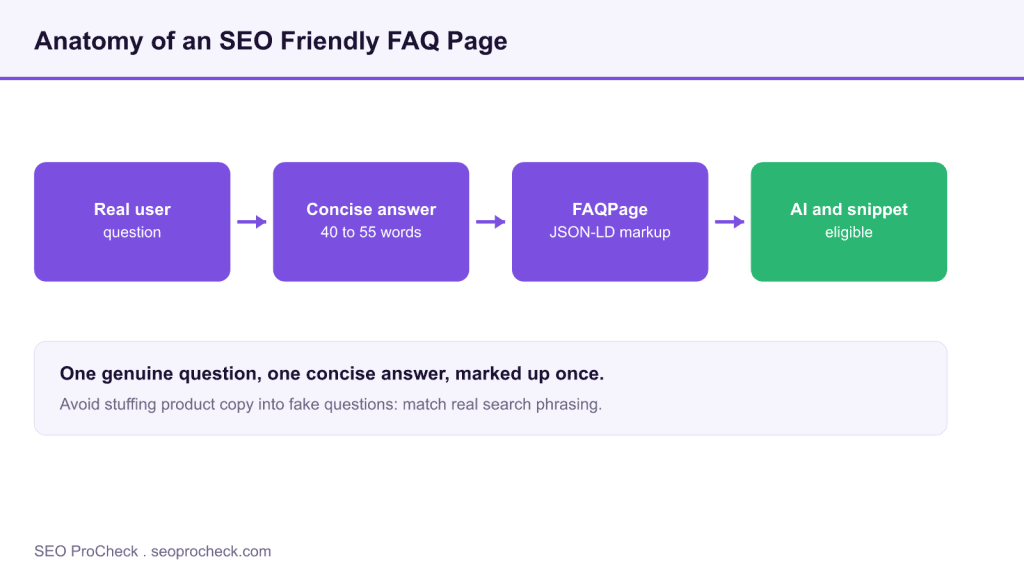
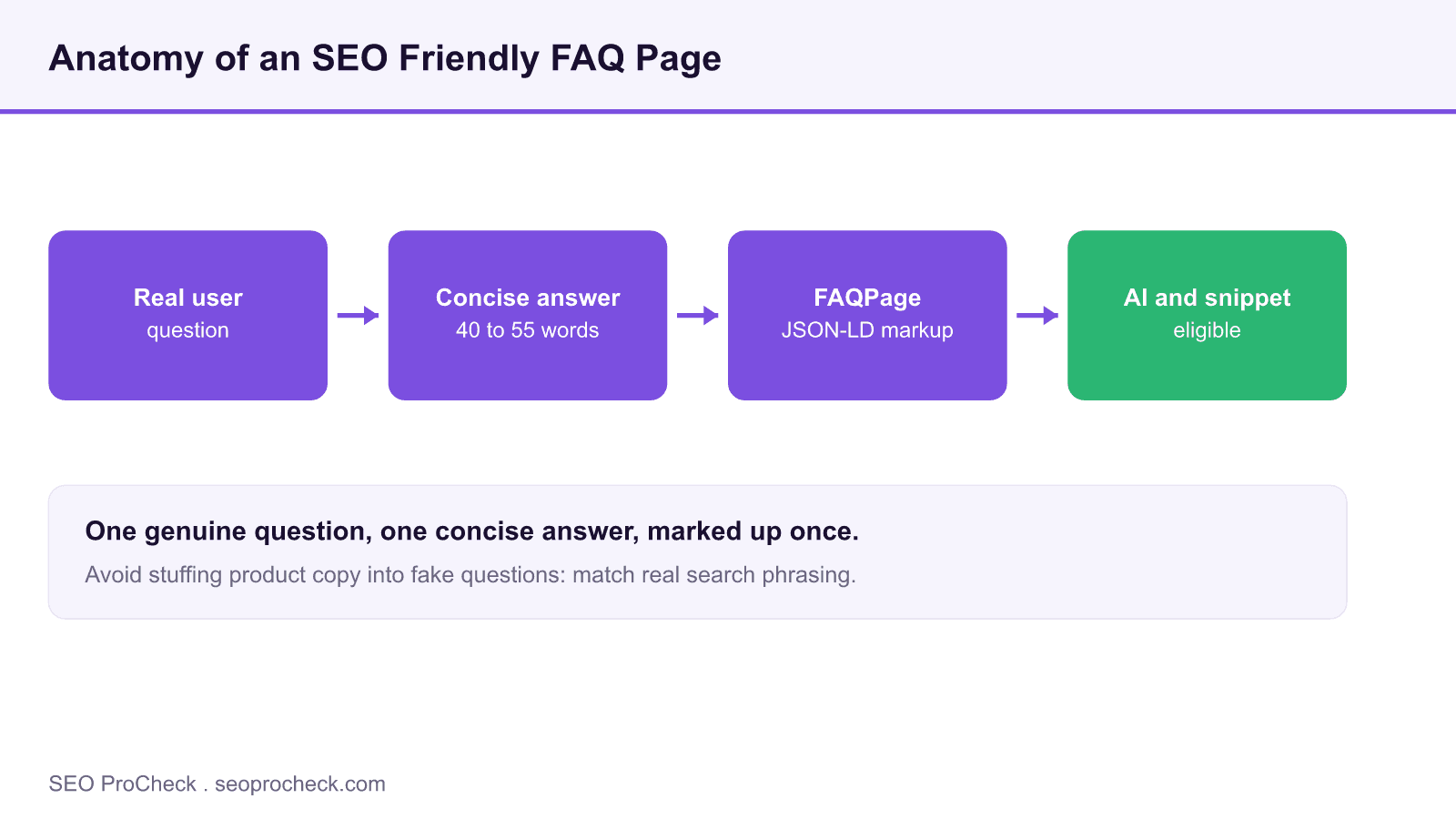
An SEO friendly FAQ page pairs the real questions people ask with short, self contained answers and marks them up with FAQPage JSON-LD. The goal is not a rich result badge, which Google now reserves for a narrow set of sites, but clean, quotable answers that both classic snippets and AI answer engines can lift.
- Write questions in the exact phrasing users search, not marketing spin.
- Keep each answer 40 to 55 words so it can stand alone in a snippet or AI response.
- Add FAQPage schema even though visible rich results are now rare: it still aids parsing.
- One question maps to one answer; never repeat the same answer across many fake questions.
Practitioner notes on FAQ pages that actually rank
The Seer Interactive piece is a solid starting point, so this section adds the field detail we lean on when we build or fix an FAQ section. The single biggest miss we see is teams inventing questions no one asks. Pull the real ones from Search Console query data, the People Also Ask box, sales and support tickets, and on site search logs. If a phrasing never appears in any of those, it is copywriting, not an FAQ.
Structure each answer to survive on its own. Lead with a direct one sentence answer, then one or two sentences of qualifier. That shape is what wins featured snippets and what AI answer engines quote, because the model can extract a clean, complete unit without dragging in surrounding fluff. If your good schema markup for SEO wraps a rambling three paragraph answer, nothing can lift it cleanly.
Where to put FAQs, and where not to
Put FAQs where they answer a genuine decision the visitor faces on that page: shipping and returns on a product template, eligibility on a service page, scope on a pricing page. Do not bolt a generic FAQ block onto every URL to pad word count. Duplicated FAQ blocks across a template create near duplicate content and dilute which page you actually want to rank. It is worth reading the case study on whether turning page content into FAQs benefits SEO before you restructure a whole section into question format.
What's changed since this resource was published
The most important shift is that Google sharply cut FAQ rich results in 2023, limiting the visual stars-and-dropdown treatment to a narrow set of authoritative government and health sites. Many teams read that as "FAQ schema is dead" and ripped it out. That is the wrong lesson. The markup still helps machines parse question and answer pairs, and those pairs now feed AI Overviews, Gemini, and ChatGPT style answers far more than they feed a blue link rich result. We treat FAQ schema today as structured input for answer engines, not as a play for a SERP badge. If you want the empirical angle, review the analysis of the removal of FAQ and HowTo snippets from Google results, and a controlled FAQ schema split test from SearchPilot for what the markup does and does not move.
| Do | Avoid | Why it matters |
|---|---|---|
| Source questions from real query data | Inventing questions to hit a keyword | Fake questions read as thin and rarely match search demand |
| Answer in 40 to 55 self contained words | Long, hedged multi paragraph answers | Concise answers are what snippets and AI engines can quote |
| One answer per unique question | Repeating one answer across many questions | Duplicate answers look manipulative and add no value |
| Keep FAQPage JSON-LD in sync with visible text | Marking up questions not on the page | Schema that does not match the page can be ignored or flagged |
| Place FAQs where a real decision happens | Bolting the same block onto every template URL | Duplicated blocks create near duplicates and split ranking signals |
Creating SEO-Friendly FAQ Pages | Seer Interactive provides valuable insights for SEO practitioners. This resource examines approaches and considerations that can improve organic search performance.
Key Concepts
Understanding the fundamental principles behind this topic helps inform strategic decisions. Whether optimizing for traditional search or emerging AI platforms, foundational concepts remain relevant. This resource covers the essential knowledge practitioners need.
Implementation Considerations
Moving from concept to execution requires understanding practical constraints and opportunities. Different situations call for different approaches. This resource provides guidance for applying concepts in real-world contexts.
Measuring Impact
SEO efforts require measurement to demonstrate value and guide optimization. Identifying appropriate metrics, establishing baselines, and tracking progress enables data-driven improvement. This resource addresses how to evaluate success.
This resource contributes to the knowledge base SEO practitioners need for effective optimization in an evolving search landscape.
Source: https://www.seerinteractive.com/insights/creating-seo-friendly-faq-pages
Frequently asked questions
Do FAQ pages still help SEO in 2026?
Yes, but the payoff moved. Visible FAQ rich results are now rare, so the value is in giving search engines and AI answer engines clean question and answer pairs they can quote. Well structured FAQs still win featured snippets and get cited in AI answers.
Should I keep FAQ schema after Google reduced rich results?
Keep it. FAQPage JSON-LD still helps machines parse your content even without the visual treatment, and those parsed pairs increasingly feed AI Overviews and chat assistants. Removing it loses that parsing benefit for no gain.
How long should an FAQ answer be?
Aim for 40 to 55 words: one direct sentence that fully answers the question, then a short qualifier. That length is long enough to be complete and short enough to be lifted cleanly into a snippet or AI response.
Where do I find the right questions to answer?
Use Search Console queries, the People Also Ask box, on site search logs, and your sales and support tickets. If a question never shows up in those sources, it is probably not worth an FAQ entry.
Can I reuse the same FAQ block on every page?
Avoid it. Duplicated FAQ blocks across a template create near duplicate content and blur which page should rank. Tailor questions to the specific decision a visitor makes on each page.
Does FAQ markup guarantee a rich result?
No. Google now shows FAQ rich results only for a small set of authoritative sites, mostly government and health. Treat the markup as structured input for parsing and AI answers, not as a guaranteed SERP feature.
Claude Vincent is a technical SEO consultant focused on crawlability, rendering, and AI-search visibility. He writes the field guides and case studies at SEO ProCheck, with a bias toward the durable, unglamorous work that decides whether search engines and AI answer engines can actually read and cite a site.
About SEO ProCheck
Technical SEO consulting and GEO strategy with 20 years of enterprise experience. Case studies, resources, and tools for search and AI visibility.
Work With Me
Technical SEO audits, GEO strategy, site migrations, and international SEO. Hourly consulting for teams who need hands-on support, not just reports.
Subscribe to our newsletter!







Recent Posts
- Can AI Crawlers Actually Read Your Site? I Measured 400 of the Biggest September 5, 2026
- The Pre-Publish Quality Gate for AI-Assisted Content August 6, 2026
- AGENTS.md vs llms.txt vs llms-full.txt: Which Agent File Does What July 18, 2026