

AI Summary
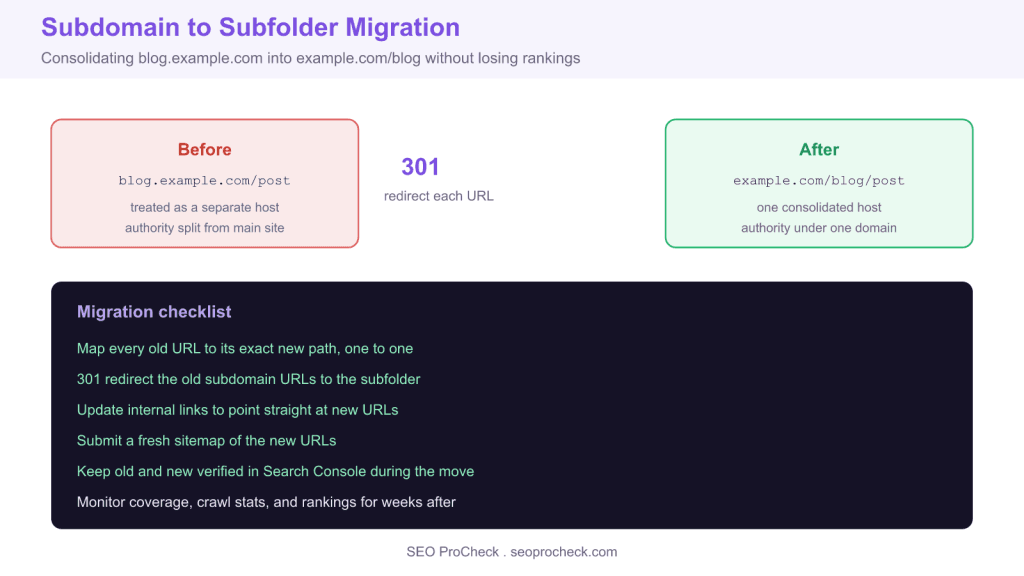
Migrating a subdomain like blog.example.com into a subfolder like example.com/blog can consolidate authority under one host, but only if you execute it cleanly. Build a one to one map, 301 redirect every old URL to its exact new path, update internal links, canonicals, and the sitemap, keep both properties verified in Search Console, and monitor coverage and rankings for several weeks.
- A subfolder clearly shares the parent domain authority, while a subdomain can be judged more separately.
- Redirect each old URL to its exact new path with a permanent 301, never a blanket redirect to the homepage.
- Update internal links and canonicals to the new URLs, and submit a fresh sitemap.
- The Change of Address tool is for full domain moves, so this scenario relies on clean 301s and monitoring.
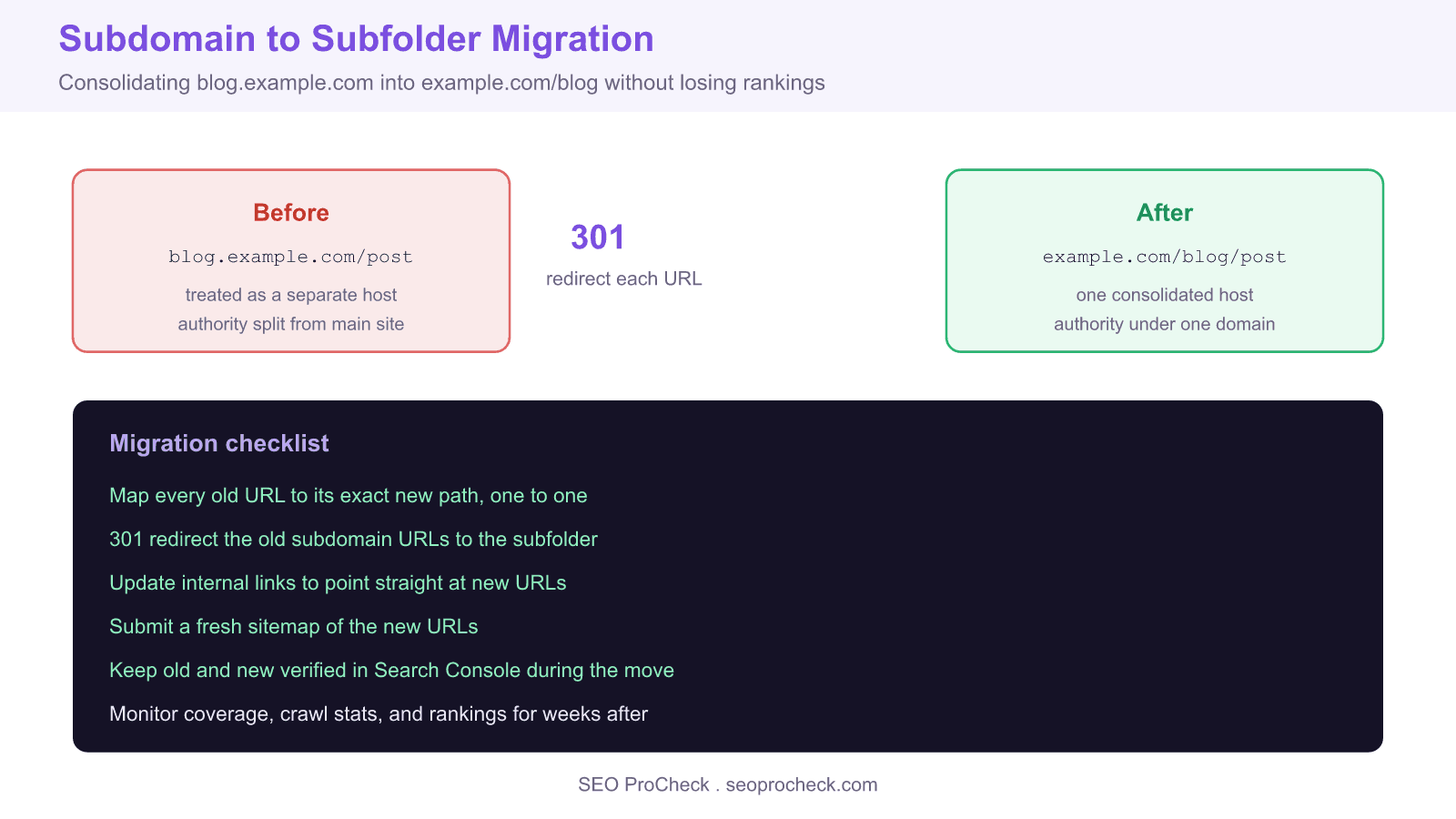
Moving content from a subdomain such as blog.example.com onto the main domain as example.com/blog is one of the most common consolidation projects in technical SEO. The source lays out the case and the mechanics; this page adds a practitioner runbook. Search engines can treat a subdomain as a partially separate site, so folding it into a subfolder can consolidate signals under one host, provided you execute the redirects and monitoring carefully. Done sloppily, the same move can shed rankings, so the details matter.
Why consolidate a subdomain into a subfolder
The practical argument is signal consolidation. Content on a subfolder clearly shares the authority and trust of the parent domain, while a subdomain can be evaluated with more independence. For most content and blog scenarios, bringing the pages under the main domain concentrates internal linking, topical relevance, and crawl attention in one place. It also simplifies analytics, cross linking, and site architecture. This is not a universal rule for every large organization, but for a blog or resource hub the subfolder approach is usually the cleaner long term structure.
Build a complete one to one redirect map
The heart of the migration is a URL map: every live URL on the subdomain paired with its exact destination on the subfolder. Export the full list from your CMS, your XML sitemap, a crawl, and your top pages in analytics and Search Console so nothing is missed. Each old URL should redirect with a permanent 301 to the single best matching new URL, preserving the path and slug wherever possible. Avoid chains and avoid dumping everything to the homepage, because a mass redirect to the root is treated as a soft error and passes little value.
# Apache, redirect the whole subdomain to the subfolder, path preserved
RewriteEngine On
RewriteCond %{HTTP_HOST} ^blog\.example\.com$ [NC]
RewriteRule ^(.*)$ https://example.com/blog/$1 [R=301,L]

# Nginx equivalent
server {
  server_name blog.example.com;
  return 301 https://example.com/blog$request_uri;
}
Test a sample of redirects with curl before and after launch to confirm each returns a single 301 hop to the right target, not a 302 and not a chain.
curl -sI https://blog.example.com/my-post/ | grep -i "^location\|HTTP"
# expect: HTTP/1.1 301 and Location: https://example.com/blog/my-post/
Update the pieces around the redirects
Redirects catch external links and bookmarks, but you should not rely on them internally. Update internal links, navigation, and canonical tags to point directly at the new subfolder URLs, so crawlers and users skip the redirect hop entirely. Set self referencing canonicals on the new URLs. Update the XML sitemap to list only the new URLs and submit it in Search Console. Refresh any hardcoded references in templates, feeds, and email footers. Leave the redirects in place permanently, since old external links keep arriving for years.
Search Console and monitoring
Because a subdomain and its root domain are separate properties, keep both verified in Google Search Console throughout the move. The Change of Address tool is designed for whole domain moves rather than a subdomain to subfolder consolidation on the same root, so for this scenario lean on clean 301s, the updated sitemap, and monitoring rather than that tool. Watch the coverage and crawl stats reports on both properties: indexed counts should fall on the old host and rise on the new path as Google reprocesses the redirects. Track rankings and organic traffic for several weeks, since consolidation often shows a brief dip before recovering.
What has changed since this was written
The mechanics of 301 redirects, canonical tags, and sitemaps have stayed remarkably stable, but the surrounding tooling has shifted. Google confirmed that 301 and 302 redirects both pass ranking signals and that PageRank is not diluted by redirects, which lowers the old fear of losing value through a hop, though a clean permanent 301 is still the correct choice for a move. Search Console replaced the old interface, and the Change of Address tool remains scoped to full domain migrations, so the subdomain to subfolder pattern still relies on solid redirects plus monitoring. The strategic debate about subdomain versus subfolder continues, but for a blog or resource section the consolidation case in this source holds up well.
Subdomain versus subfolder at a glance
| Factor | Subdomain (blog.example.com) | Subfolder (example.com/blog) |
|---|---|---|
| Authority sharing | Can be evaluated more separately | Clearly shares the parent domain |
| Internal linking | Cross host, less concentrated | Same host, concentrated |
| Search Console | Separate property | Same property as main site |
| Setup complexity | Separate host config | One host, simpler stack |
| Best fit | Distinct product or app | Blog and resource content |
Related reading
- Check your XML sitemaps for errors after a migration
- Browse technical SEO checks
- More SEO research and studies
Frequently asked questions
Is a subfolder better than a subdomain for SEO?
For blog and resource content, a subfolder usually consolidates authority and internal linking under one host, which is why many teams migrate. It is not an absolute rule, and large distinct products can justify a subdomain, but for content sections the subfolder is generally the cleaner structure.
Do I need to redirect every old subdomain URL?
Yes. Build a one to one map and 301 redirect each old URL to its exact new subfolder path, preserving the slug where possible. Skipping URLs or redirecting everything to the homepage loses rankings, because a blanket redirect to the root is treated as a soft error and passes little value.
Should I use the Change of Address tool for this move?
The Change of Address tool in Search Console is built for whole domain migrations, not a subdomain to subfolder consolidation on the same root domain. For this scenario, rely on clean 301 redirects, an updated sitemap, and careful monitoring rather than that tool.
Will I lose rankings when I consolidate?
A short term dip is common as Google reprocesses the redirects, and rankings usually recover if the migration is clean. Complete one to one 301s, updated internal links, self referencing canonicals, and a fresh sitemap are what protect the outcome. Monitor for several weeks before drawing conclusions.
How long should I keep the redirects in place?
Permanently. External links, bookmarks, and older references to the subdomain keep sending traffic for years, so the 301 redirects should stay live indefinitely to preserve that value and avoid broken links.
Do redirects lose PageRank?
Google has stated that 301 and 302 redirects pass ranking signals and that PageRank is not diluted by the redirect itself. A permanent 301 is still the right choice for a move because it clearly signals the change, but you should not fear losing value simply because a redirect hop exists.
Source: https://www.searchenginejournal.com/subdomain-site-migrations/436627/
Take this with you
The assistant links open with a question about this page already written. Nothing is sent until you press enter.
Claude Vincent is a technical SEO consultant focused on crawlability, rendering, and AI-search visibility. He writes the field guides and case studies at SEO ProCheck, with a bias toward the durable, unglamorous work that decides whether search engines and AI answer engines can actually read and cite a site.
About SEO ProCheck
Technical SEO consulting and GEO strategy with 20 years of enterprise experience. Case studies, resources, and tools for search and AI visibility.
Work With Me
Technical SEO audits, GEO strategy, site migrations, and international SEO. Hourly consulting for teams who need hands-on support, not just reports.
Subscribe to our newsletter!







Recent Posts
- Finding a Competitor's Sitemap, and Turning It Into a Change Log September 15, 2026
- AI Crawler User Agents: The Current Names, and Which Ones Sites Actually Block September 9, 2026
- Can AI Crawlers Actually Read Your Site? I Measured 400 of the Biggest September 5, 2026