


AI Summary
This case study documents two similar internal link tweaks that produced different outcomes when measured with controlled SEO tests: one lifted traffic above forecast, the other did not. The lesson is that internal linking is not an automatic win, because position, relevance, template, and target need decide the result, so each change should be tested rather than assumed.
- Similar internal link changes can win or stay flat depending on context.
- A controlled test compares changed pages against a forecast to separate real lift from noise.
- In-content, relevant links into under-linked pages have the best odds of winning.
- Verify each change against a baseline before rolling it out site wide.
Link acquisition remains a critical ranking factor. This case study documents effective approaches to earning links that improved domain authority and supported ranking growth.
Link Building Context
Every link building initiative operates within specific constraints: industry, resources, existing authority, and competitive landscape. This case study establishes the context that shaped link building strategy and tactics.
Strategy and Tactics
Sustainable link building requires approaches that earn editorial links rather than manufacture artificial signals. This case study details the specific tactics employed: content-driven outreach, digital PR, resource creation, or relationship building.
Outreach and Execution
Link building requires efficient outreach processes and compelling value propositions. This case study documents outreach methodology, response rates, and relationship development approaches that yielded results.
Impact Assessment
Link building value manifests in domain authority growth, ranking improvements for target keywords, and referral traffic from acquired links. This case study quantifies the impact of link building efforts and their contribution to overall SEO success.
Link building case studies help practitioners understand effective approaches in an increasingly sophisticated link landscape.
Source: https://searchengineland.com/case-study-the-tale-of-two-internal-link-tweaks-304453
The lesson behind the tale of two tweaks
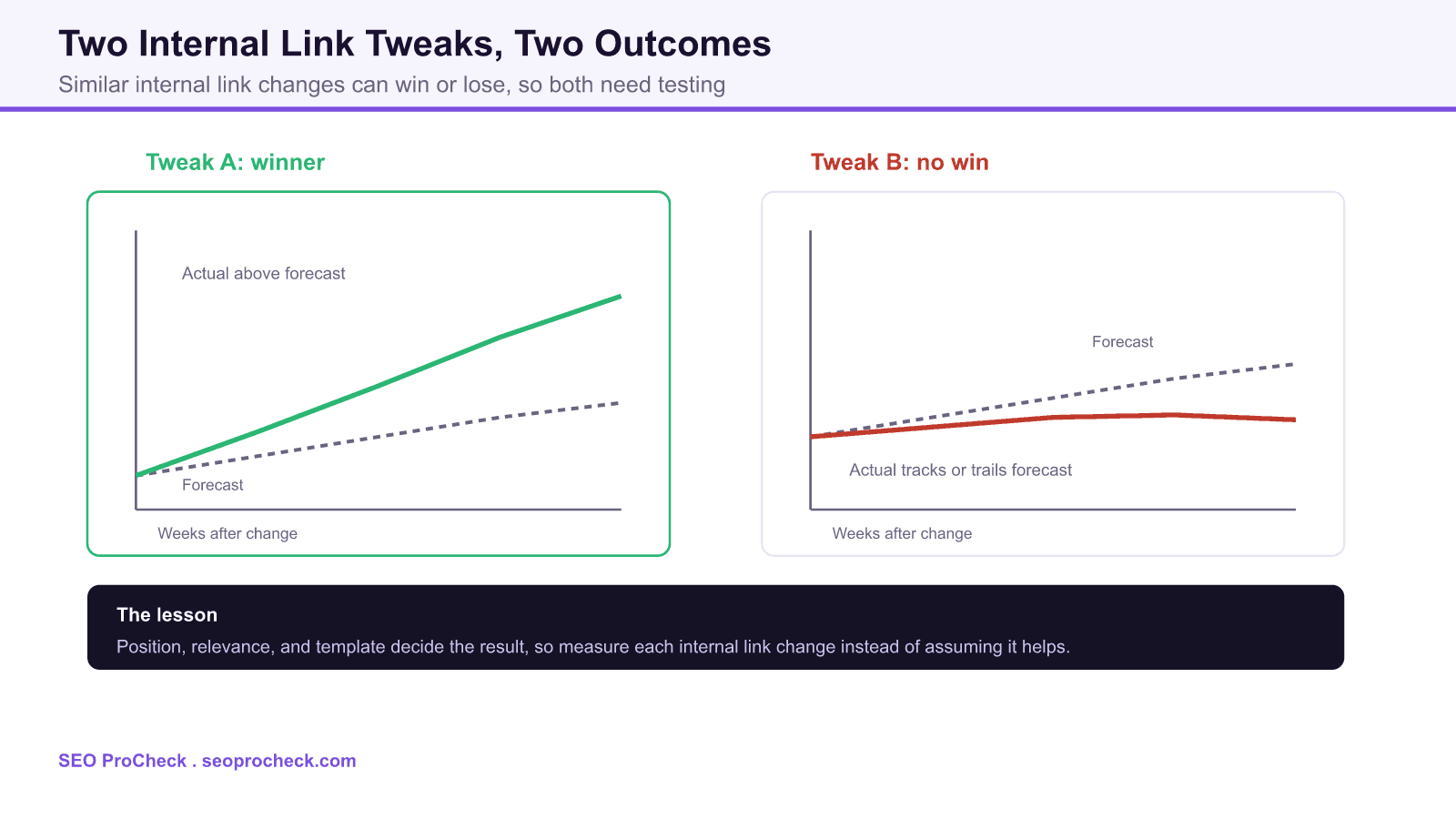
The value of this case study is that it refuses to give internal linking a simple thumbs up or thumbs down. It documents two internal link changes that look similar on paper yet produce different outcomes when measured with a controlled SEO test. One tweak lifts organic traffic clearly above the forecast, so it is a genuine winner worth rolling out. The other tracks or trails its forecast, meaning the change added effort and code without moving the metric. Same broad tactic, opposite verdicts. That contrast is the whole point: internal linking is not a lever that only ever pushes traffic up.
Why would two comparable changes diverge? The result depends on where the links sit, how relevant they are, which template they touch, and whether the target pages actually needed more internal authority in the first place. A related links module added to a page type that was already well linked may do nothing, while the same module on an under-linked template can unlock real gains. Because these variables interact, prediction is unreliable and measurement is essential.
How a controlled test tells a winner from a dud
Both tweaks are evaluated the same way. A group of pages receives the change, a comparable group does not, and a statistical model forecasts what the changed group would have earned had nothing happened. The winner shows actual organic traffic pulling clearly above the forecast band and staying there. The non-winner shows actual traffic sitting on or below the forecast, which means the change cannot be credited with any lift. Reading the forecast band rather than the raw traffic line is what separates a real effect from ordinary week to week movement, seasonality, or an unrelated algorithm update.
How to apply this discipline without a testing platform
You can capture most of the benefit by refusing to assume. Before you push an internal linking change site wide, roll it out to one clearly defined set of pages and leave a comparable set unchanged as a rough baseline. Record the date and the exact change: which template, which module, how many links, and what anchors. Then compare impressions and clicks for the two groups in Google Search Console over several weeks. If the changed group clearly outpaces the steady group, roll it out. If it does not, you have avoided baking a useless change into every page and adding maintenance for no return.
| Factor | Pushes a tweak toward winning | Pushes a tweak toward flat |
|---|---|---|
| Link position | In-content, near relevant text | Footer or sidebar boilerplate |
| Relevance | Strong topical match to the target | Loosely related or generic |
| Target need | Target was under-linked before | Target was already well linked |
| Anchor text | Descriptive and topic naming | Vague, like read more |
The takeaway for your internal linking roadmap
Treat internal linking as a portfolio of hypotheses, not a checklist of guaranteed wins. Prioritize changes that put relevant, in-content links into under-linked pages, since those have the best odds, but still verify each one against a baseline before you scale it. The habit of measuring is what turns internal linking from folklore into a repeatable, evidence-based practice. For the fundamentals, see our internal linking complete guide and the practical rules in 15 internal linking best practices. For related controlled tests, compare increasing the number of related article links and this wider site architecture and internal linking case study.
Frequently Asked Questions
Why did two similar internal link tweaks give different results?
Because the outcome of an internal link change depends on link position, topical relevance, the template it touches, and whether the target pages needed more internal authority. When those variables differ, two changes that look alike on paper can produce opposite results, which is why each needs its own test.
Does adding internal links ever fail to help?
Yes. A related links module added to pages that are already well linked, or links that are loosely relevant or buried in a footer, can produce no measurable lift. Internal linking is a powerful lever but not an automatic win, so it should be measured rather than assumed.
How does an SEO test decide if an internal link tweak worked?
It compares a group of changed pages against a comparable unchanged group and forecasts what the changed group would have earned without the tweak. If actual organic traffic pulls clearly above that forecast band and stays there, the tweak is a genuine winner; if it tracks or trails the forecast, it is not.
What makes an internal link tweak more likely to win?
In-content placement near relevant text, strong topical relevance, descriptive anchor text, and targeting pages that were previously under-linked. Those conditions give the link a real chance to pass authority and reinforce relevance.
Should I roll out an internal linking change site wide right away?
No. Roll it out to one bounded set of pages first, hold a comparable set as a baseline, and compare impressions and clicks over several weeks. Scale it only if the changed group clearly outperforms, so you avoid baking a useless change into every page.
How long should I wait before judging an internal link change?
Give it several weeks so the effect can separate from normal week to week variation, seasonality, and unrelated algorithm updates. Judging too early risks reading random noise as a win or a loss.
Take this with you
The assistant links open with a question about this page already written. Nothing is sent until you press enter.
Claude Vincent is a technical SEO consultant focused on crawlability, rendering, and AI-search visibility. He writes the field guides and case studies at SEO ProCheck, with a bias toward the durable, unglamorous work that decides whether search engines and AI answer engines can actually read and cite a site.
About SEO ProCheck
Technical SEO consulting and GEO strategy with 20 years of enterprise experience. Case studies, resources, and tools for search and AI visibility.
Work With Me
Technical SEO audits, GEO strategy, site migrations, and international SEO. Hourly consulting for teams who need hands-on support, not just reports.
Subscribe to our newsletter!







Recent Posts
- Finding a Competitor's Sitemap, and Turning It Into a Change Log September 15, 2026
- AI Crawler User Agents: The Current Names, and Which Ones Sites Actually Block September 9, 2026
- Can AI Crawlers Actually Read Your Site? I Measured 400 of the Biggest September 5, 2026