

AI Overviews Strategy: Optimizing for Google's AI Search Experience
- October 5, 2024
- AI Overviews and SGE, AI and Search
AI Summary
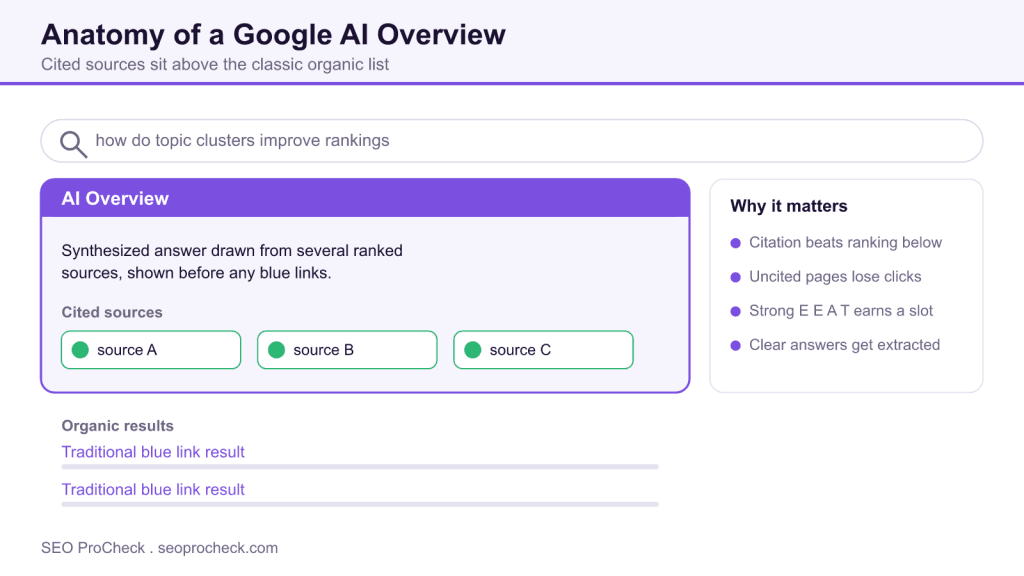
Google AI Overviews synthesise an answer from several ranked sources and place it above the classic blue links, so being cited inside the Overview now matters more than ranking just beneath it. You earn a citation with comprehensive topical coverage, clear question and answer structure, and the same authority signals that drive strong organic rankings.
- AI Overviews combine multiple sources, unlike featured snippets which pull from one.
- Cited brands can see materially higher click through than uncited pages on the same query.
- No special markup earns a slot; strong rankings, depth, and clarity do.
- Add AI Overview optimisation to traditional SEO rather than replacing it.
Google AI Overviews (formerly Search Generative Experience) represents Google's integration of AI-generated answers directly into search results. Understanding how to appear in and be cited by AI Overviews has become a critical SEO consideration as these features expand across more queries.
Understanding AI Overviews
AI Overviews appear at the top of search results for many informational queries, synthesizing information from multiple sources into a comprehensive answer. Unlike featured snippets which pull from a single source, AI Overviews combine information and provide citations to the sources used.
Current data shows AI Overviews appearing for approximately 13-16% of queries, with higher prevalence in informational and how-to categories. Industries seeing highest AI Overview presence include healthcare (63%), B2B technology (32%), and educational content. E-commerce and transactional queries show lower AI Overview rates.
Impact on Click-Through Rates
Research shows AI Overviews reduce click-through rates to underlying sources. Studies document 15-35% CTR declines for queries triggering AI Overviews compared to traditional results. However, being cited within an AI Overview provides competitive advantage; brands cited show 35% higher CTR than those not cited.
The strategic implication: appearing in AI Overviews matters more than appearing below them. Content not cited in the Overview may see significant traffic decline as users get answers without clicking through. This makes AI Overview optimization increasingly important for maintaining organic visibility.
Factors Affecting AI Overview Inclusion
Google states that standard SEO best practices apply to AI Overviews, with no special optimization required. However, analysis of AI Overview citations reveals patterns. Sources cited tend to have strong traditional rankings, comprehensive topical coverage, clear content structure, and established E-E-A-T signals.
Content format matters. How-to content, definitions, comparison information, and factual explanations appear frequently in AI Overviews. Content that directly answers specific questions in clear, structured ways gets cited more often than content requiring significant interpretation.
Optimization Strategies
Focus on comprehensive topic coverage. AI Overviews synthesize from multiple sources; having the most complete, accurate information on a topic increases citation likelihood. Build content depth through topic clusters and pillar pages that establish topical authority.
Structure content for AI extraction. Use clear question-based headings followed by direct answers. Provide supporting detail after the direct answer. Include relevant statistics and cite sources. Make it easy for AI to identify and extract the most relevant passages.
Monitor your AI Overview presence using tools that track these placements. Identify queries where competitors are cited and you're not. Analyze what their content provides that yours doesn't. Update content to fill gaps and match the comprehensiveness of cited sources.
The Relationship to Traditional SEO
AI Overview optimization builds on traditional SEO foundations. Sites with strong domain authority, quality backlinks, and established rankings are more likely to be cited. Don't abandon traditional SEO for AI Overview optimization; instead, add AI-specific considerations to your existing strategy.
Why Citation Beats Position
The strategic change AI Overviews introduce is that the top of the page is no longer a ranked list you can climb into predictably. It is a synthesised answer that names a handful of sources. If your page is one of those cited sources, you sit above every organic result and capture attention even from users who never scroll. If it is not, you can rank first in the blue links and still lose the click, because the Overview answered the question before the user got there. That is why the goal shifts from position to citation.
Practically, this means auditing the queries that matter to you and recording which ones trigger an Overview and who gets cited. Where a competitor is cited and you are not, read their cited passage closely. You are reverse engineering the specific sentence Google chose to synthesise, which tells you the depth, structure, and framing the model rewarded for that question.
| Signal | Featured Snippet | AI Overview |
|---|---|---|
| Number of sources | One | Several combined |
| Position on page | Top of organic | Above organic results |
| What wins it | Best single passage | Comprehensive, corroborated coverage |
| Best content shape | One tight answer block | Depth plus clear extractable sections |
How to Earn a Slot
Google says standard best practices apply, and the observable pattern supports that: cited sources tend to rank well already, cover the topic comprehensively, structure content clearly, and carry visible experience and expertise. So the work is familiar but sharper. Give each important question its own clearly headed section with a direct answer in the opening line, then supporting detail, statistics, and sources beneath. Build depth through topic clusters and pillar pages so your site demonstrates end to end coverage of a subject rather than a single shallow page. The deeper source pool for a topic is what a synthesising model draws from.
Fitting AI Overviews Into a Wider AI Search Program
AI Overview optimisation does not stand alone. The same passage level clarity that earns a Google citation also helps you get cited in ChatGPT conversations, so plan for both answer surfaces together. Keep leaning on the fundamentals that the AI Overviews citation research keeps confirming: authority, quality links, and established rankings still gate whether you are eligible to be cited at all. Do not abandon traditional SEO for AI features; layer AI specific structure and monitoring on top of a healthy technical and content foundation, and revisit your target queries regularly because Overview coverage keeps expanding into new categories.
Frequently Asked Questions
What is the difference between an AI Overview and a featured snippet?
A featured snippet pulls a single passage from one source. An AI Overview synthesises information from several ranked sources into one answer and cites them, and it sits above the organic results rather than within them.
Can I opt out of AI Overviews?
There is no reliable citation focused opt out that also keeps your organic visibility. Blocking the content that feeds Overviews would also remove you from the citations, so the practical strategy is to compete for the citation rather than avoid the feature.
Does being cited in an AI Overview send traffic?
It can. Cited sources generally see stronger click through than uncited pages on the same query, because the citation sits in the most prominent position on the page. Uncited pages on Overview queries often lose clicks.
What content is most likely to be cited?
How to steps, definitions, comparisons, and factual explanations that answer a specific question directly and clearly are cited most often. Content that requires heavy interpretation is cited less.
Do I need special schema to appear in AI Overviews?
No specific markup guarantees inclusion. Google states standard best practices apply, so strong rankings, comprehensive coverage, clear structure, and visible expertise are what raise your odds.
How do I find which of my queries trigger AI Overviews?
Track your priority queries with a rank tracker that flags AI Overview presence, or check them manually. Note where competitors are cited and you are not, then compare their cited passage against your content to find the gap.
Take this with you
The assistant links open with a question about this page already written. Nothing is sent until you press enter.
Claude Vincent is a technical SEO consultant focused on crawlability, rendering, and AI-search visibility. He writes the field guides and case studies at SEO ProCheck, with a bias toward the durable, unglamorous work that decides whether search engines and AI answer engines can actually read and cite a site.
About SEO ProCheck
Technical SEO consulting and GEO strategy with 20 years of enterprise experience. Case studies, resources, and tools for search and AI visibility.
Work With Me
Technical SEO audits, GEO strategy, site migrations, and international SEO. Hourly consulting for teams who need hands-on support, not just reports.
Subscribe to our newsletter!







Recent Posts
- Finding a Competitor's Sitemap, and Turning It Into a Change Log September 15, 2026
- AI Crawler User Agents: The Current Names, and Which Ones Sites Actually Block September 9, 2026
- Can AI Crawlers Actually Read Your Site? I Measured 400 of the Biggest September 5, 2026