AI Summary
Building an SEO API with Python means wrapping your data sources, such as Search Console, a SERP provider, and your own scrapers, behind clean HTTP endpoints so any tool can request SEO data on demand. FastAPI is the practical choice: it gives you typed routes, automatic validation, and interactive docs, so a dashboard or a teammate can call GET /rankings instead of rerunning a script.
- Use FastAPI for typed endpoints, request validation, and automatic docs at
/docs. - Put a caching layer between your API and slow upstreams so repeat calls are fast and stay within quota.
- Protect every route with an API key, and rate limit callers so one client cannot exhaust your quota.
- Return clean, consistent JSON with correct status codes so the API is predictable for whoever consumes it.
Once you have written a few SEO scripts, you hit a wall: every report is a file someone has to run, and the data lives in whoever ran it last. An API solves that. Instead of a script you execute, you build a small web service that returns SEO data over HTTP, so a dashboard, a spreadsheet, a chatbot, or a colleague can request it whenever they need it. This guide shows how to build that service in Python with FastAPI, how to structure it in layers, and the production habits that keep it reliable.
Why FastAPI for an SEO API
Flask still works, but FastAPI has become the default for new Python APIs, and for good reasons that matter here. It uses standard Python type hints to validate incoming requests automatically, so a route that expects a domain string rejects bad input before your code runs. It is built on ASGI, so it handles the concurrent, network bound calls that SEO APIs make to upstream providers efficiently. And it generates interactive documentation at /docs from your code with no extra work, which means anyone can explore your endpoints in a browser. For a data service that mostly waits on other APIs, that combination is hard to beat.
Structure it in three layers
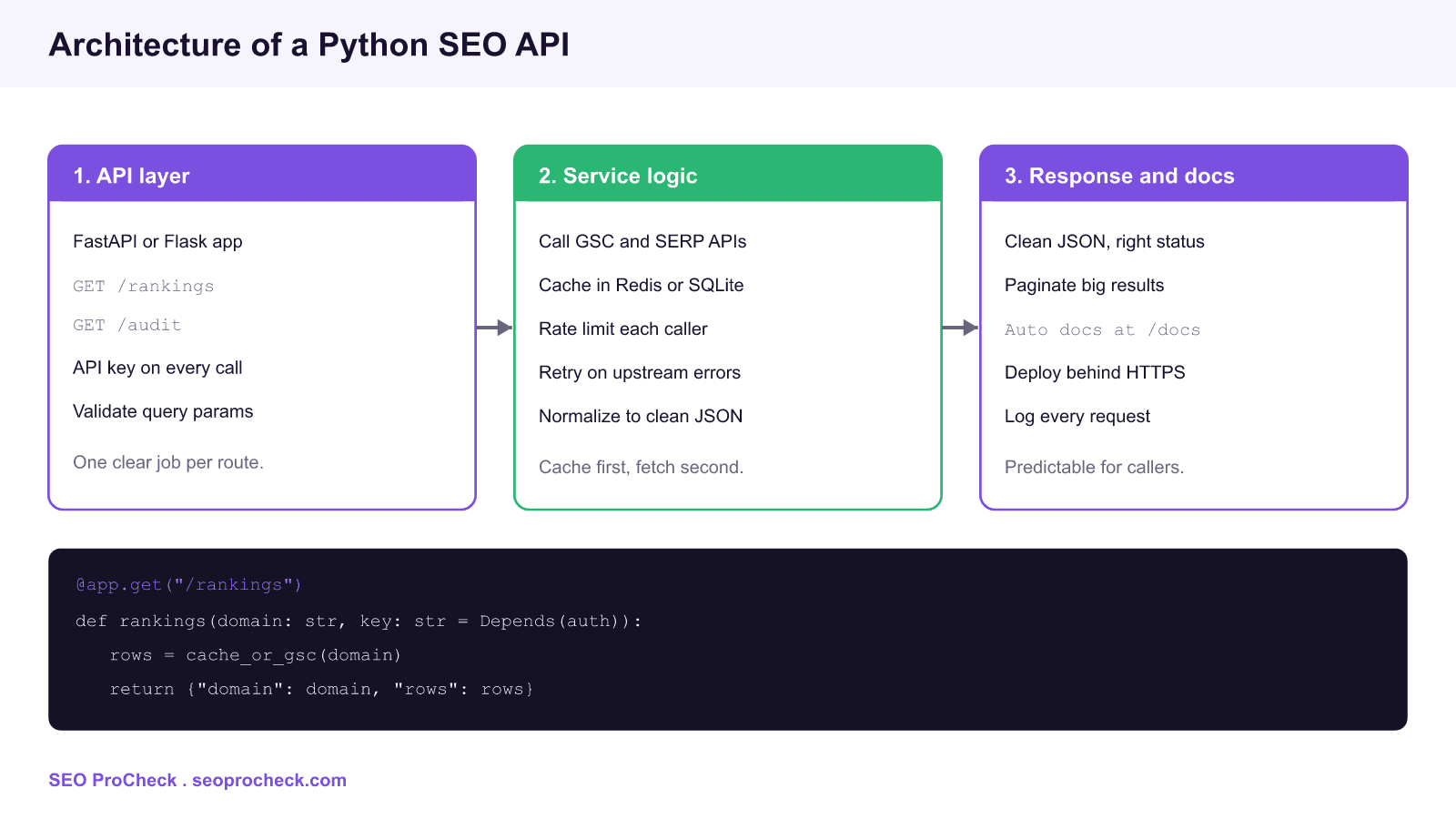
Keep the design simple and separated. The API layer defines the routes and handles authentication and validation. The service layer holds the real logic: it calls upstream sources, applies caching, and normalizes the results. The response layer returns clean JSON with the right status code. A minimal endpoint reads @app.get("/rankings") above a function like def rankings(domain: str, key: str = Depends(auth)): that fetches data through the service layer and returns a dictionary FastAPI serializes to JSON. Keeping routes thin and logic in the service layer makes the whole thing testable and easy to extend with new endpoints.
Caching is not optional
Your endpoints call slow, rate limited upstreams like the Search Console API and paid SERP providers. Without caching, ten dashboard refreshes mean ten upstream calls, which is slow and burns quota you pay for. Put a cache between your service layer and the upstream: check the cache first, and only call the provider on a miss, then store the result with a sensible time to live. Redis is ideal for a shared, multi user API, while SQLite or even an in memory dictionary is fine for a single user tool. This is the same principle behind an automated Search Console report, which stores pulled data so you never refetch the same window twice.
Endpoints worth exposing
Design routes around the questions people actually ask, one clear job per route. The table lists a practical starting set for an in house SEO API.
| Endpoint | Returns | Backed by |
|---|---|---|
GET /rankings | Clicks, impressions, position by query | Search Console API |
GET /audit | Title, meta, headings, canonical for a URL | Your own scraper |
GET /keywords | Volume and difficulty for a term | SERP or keyword provider |
GET /serp | Top results and features for a query | Licensed SERP API |
Secure and rate limit every route
An internal API is still exposed the moment it is deployed. Require an API key on every request through a dependency like Depends(auth), and reject calls without a valid key with a 401. Rate limit each caller so one runaway client or loop cannot exhaust the quota you share with the upstream provider. Never hardcode your Search Console or SERP credentials in the code: load them from environment variables or a secrets manager. These are small additions that separate a weekend script from something a team can rely on.
Deploy and observe it
Run the app with an ASGI server such as Uvicorn, behind a reverse proxy that terminates HTTPS. Containerize it with Docker so the environment is reproducible, and log every request with its endpoint, caller, and response time so you can see usage and spot errors. Return correct HTTP status codes, a 200 on success, a 400 on bad input, a 429 when rate limited, so clients can handle responses programmatically. Once it is live, this API becomes the backbone that feeds a custom GA4 dashboard, powers reliable SEO forecasting, and gives every tool in your stack one consistent source of SEO data.
Frequently asked questions
Should I use FastAPI or Flask for an SEO API?
FastAPI is the better default for a new SEO API. It validates requests from type hints, handles concurrent upstream calls efficiently, and generates interactive docs automatically. Flask is fine for a tiny service, but you will add by hand what FastAPI gives you for free.
Why does my SEO API keep hitting rate limits?
Usually because it has no cache and calls the upstream on every request. Add a caching layer that serves repeat requests from storage and only calls the provider on a miss, and rate limit your own callers so no single client drains the shared quota.
How do I secure an internal SEO API?
Require an API key on every route through a dependency, reject missing keys with a 401, and rate limit callers. Load provider credentials from environment variables or a secrets manager, and serve the API only over HTTPS.
What data sources can a Python SEO API wrap?
Common ones are the Search Console API for performance data, licensed SERP and keyword APIs for rankings and volume, and your own scrapers for on page audits. The API presents all of them through one consistent JSON interface.
How do I deploy a FastAPI SEO API?
Run it with an ASGI server like Uvicorn behind a reverse proxy that handles HTTPS, and package it in Docker for a reproducible environment. Log each request and return correct status codes so clients can respond to errors programmatically.
Claude Vincent is a technical SEO consultant focused on crawlability, rendering, and AI-search visibility. He writes the field guides and case studies at SEO ProCheck, with a bias toward the durable, unglamorous work that decides whether search engines and AI answer engines can actually read and cite a site.
About SEO ProCheck
Technical SEO consulting and GEO strategy with 20 years of enterprise experience. Case studies, resources, and tools for search and AI visibility.
Work With Me
Technical SEO audits, GEO strategy, site migrations, and international SEO. Hourly consulting for teams who need hands-on support, not just reports.
Subscribe to our newsletter!