

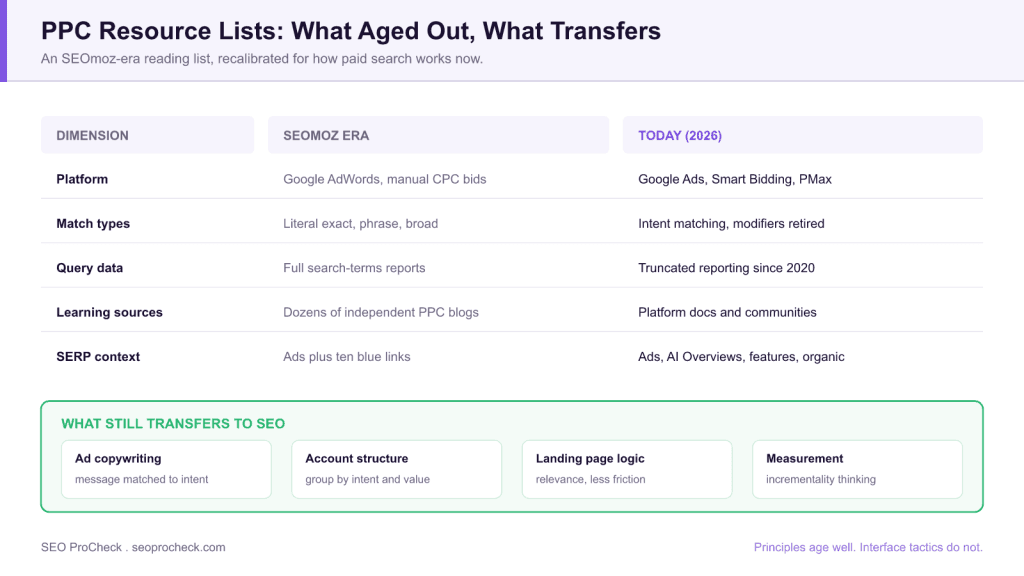
AI Summary
The SEOmoz Big List of PPC Resources was a curated roundup of paid-search articles and blogs from before the company rebranded to Moz in 2013. Most of the individual links have aged out, but the underlying question, how SEOs should learn and use paid search, is still worth answering, which is what this page now does.
- Interface-level tactics from that era are obsolete: Smart Bidding and Performance Max replaced most manual levers.
- Principles survived: ad copywriting, account structure logic, landing-page relevance, and measurement discipline all transfer to SEO.
- Paid search is the fastest feedback loop available for organic decisions, from title testing to keyword validation.
- Running Google Ads does not improve organic rankings: the benefit is informational and strategic, not algorithmic.
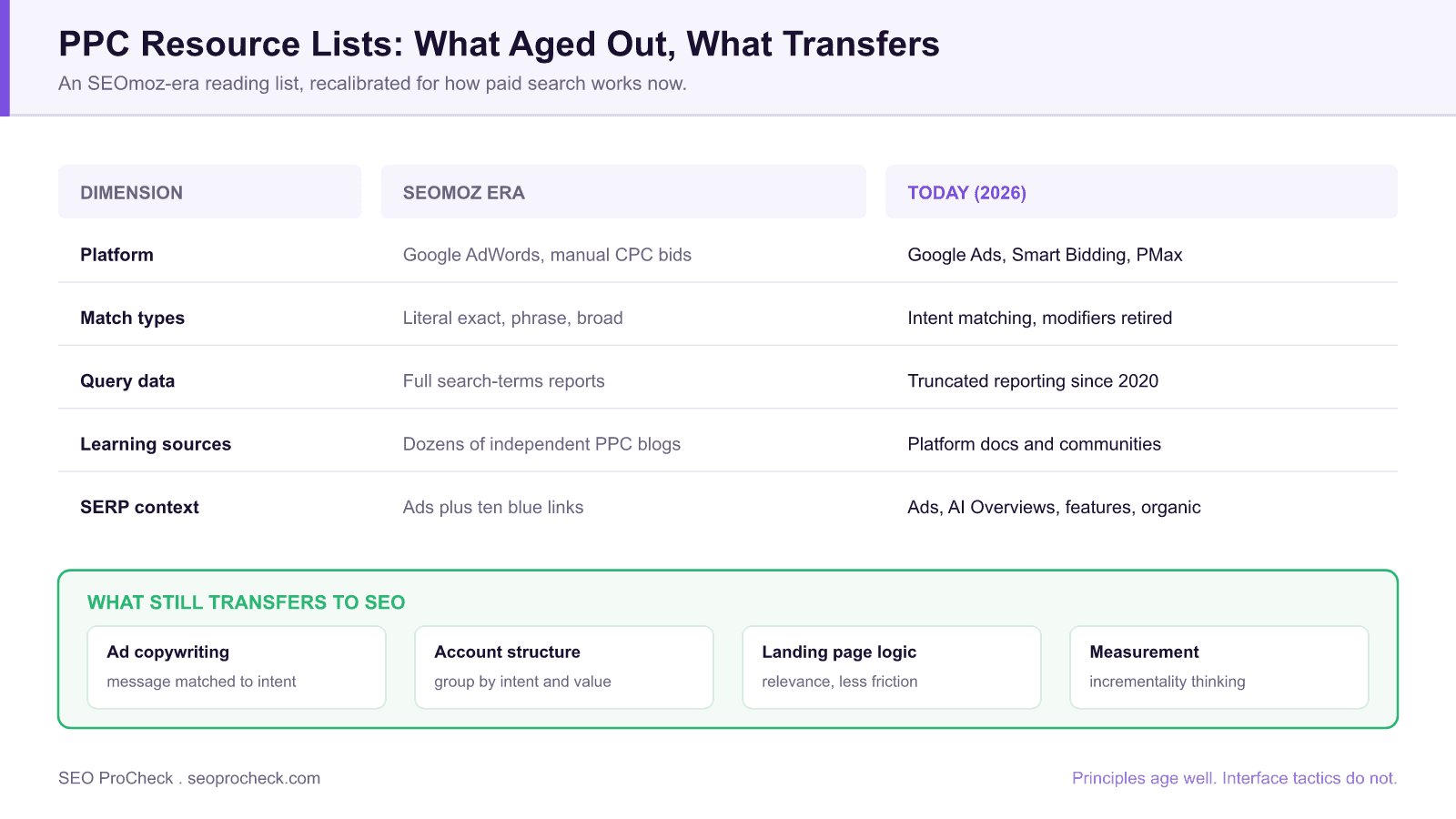
What was the SEOmoz Big List of PPC Resources? It was a curated roundup of paid-search articles, guides, and blogs published in the SEOmoz era (before the company rebranded to Moz in 2013), collecting the PPC learning material practitioners of that period relied on. Most of the specific links have aged out, but the resource-list format, and the underlying question of how SEOs should learn and use PPC, remains relevant, which is what this page now addresses.
Key Concepts
Paid and organic search share one unit of analysis: the query. Everything useful about the SEO and PPC relationship follows from that. Both channels are attempts to satisfy the same intent on the same result page, which is why insight moves between them freely even though the ranking mechanisms are completely separate.
The mechanisms differ in one decisive way: feedback speed. A paid test returns readable data in days because you control impressions directly through budget. An organic change waits on recrawl, reprocessing, and ranking movement, so the same question takes weeks or months to answer. That asymmetry is the entire argument for SEOs learning PPC, and it is why old resource lists retain value where they teach reasoning rather than button locations.
It is also worth being precise about what does not transfer. Quality Score is a paid-auction concept with no organic equivalent, and treating it as an SEO signal is a category error that old blog posts encouraged. Similarly, bid strategy has no organic analogue. The transferable material is the thinking about queries, messaging, landing pages, and measurement, not the auction machinery around it.
Implementation Considerations
Reading old PPC material productively means filtering it before you apply it. A practical test: if an article's advice depends on a screen, a setting, or a match-type behaviour, verify it against current platform documentation before acting. If it depends on how buyers read an ad or how a landing page converts, it is probably still sound.
- Check the publication date first, and the platform second. Anything written before 2018 predates the Google Ads rename and the automation shift. Anything before 2020 predates search-terms truncation, which invalidates a large body of query-mining advice.
- Distinguish deprecated from renamed. Average position was retired outright and replaced by impression-share metrics; broad match modifier was folded into phrase match. Older articles referencing these are not merely using old names, they are describing behaviour that no longer exists.
- Rebuild query mining around what you can still see. With search-terms reporting truncated, the practical substitutes are Search Console query data for organic, the paid search-terms report for what remains visible, and site-search logs, which nobody truncates and almost nobody uses.
- Treat automation as an input problem. Where an old article taught manual optimisation, the modern equivalent is usually a data-quality question: clean conversion tracking, sensible conversion values, accurate negatives, and good creative assets. That is where the practitioner's leverage moved.
Measuring Impact
If you use PPC to inform SEO, measure the transfer explicitly rather than assuming it. Three measurements make the loop honest:
- Title and messaging tests. Record the winning ad-copy angle, then apply it to organic titles and meta descriptions on a defined page set and watch Search Console CTR at constant average position. Holding position constant is what separates a genuine CTR effect from a ranking change.
- Keyword validation before content spend. Track conversion rate and cost per conversion for a query cluster in paid before committing content resources to it. The metric that matters is not volume but whether the intent converts at all.
- Coverage and cannibalisation. For queries where you already rank first organically, incremental paid clicks may be partly cannibalised. The only honest read comes from pausing paid on a matched query subset and comparing total clicks, not paid clicks.
All three are variations on the same discipline: define a control, change one thing, and attribute carefully. That is exactly the methodology set out in our guide to SEO A/B split testing, and applying it to cross-channel questions is where most teams find their fastest wins.
What's Changed Since the SEOmoz Era
A PPC resource list from the SEOmoz years describes a different industry. If you land here looking for current paid-search knowledge, calibrate for these shifts:
- The platform itself was renamed and rebuilt. Google AdWords became Google Ads in 2018. Exact match no longer means exact, broad match is now driven by machine-learning intent matching, and average position was retired as a metric in favor of impression-share metrics.
- Automation replaced manual levers. The craft that era's articles taught (granular bid management, single-keyword ad groups, exhaustive match-type sculpting) has largely been absorbed by Smart Bidding, responsive search ads, and Performance Max campaigns, where the practitioner's job is feeding the machine good inputs (conversion data, assets, exclusions) rather than pulling manual levers.
- Keyword-level visibility shrank. Search-terms reporting was heavily truncated in 2020, so the detailed query mining those resources described is only partially possible today.
- The blog ecosystem consolidated. Many of the independent PPC blogs that dominated such lists went dormant or were acquired. Durable learning sources today cluster around official platform documentation, a handful of large industry publications, and practitioner communities rather than dozens of individual blogs.
- AI answers now sit above the ads. AI Overviews and answer engines change the economics of both paid and organic clicks, making holistic search visibility, not channel-siloed tactics, the planning unit.
What From That Resource Class Still Matters
Not everything on an old PPC list is obsolete. The material that has held its value shares a trait: it teaches principles rather than interface mechanics.
- Ad copywriting fundamentals: matching message to query intent, benefit-led headlines, and testing discipline transfer directly to responsive search ads and even to writing titles and meta descriptions for organic listings.
- Account structure logic: the principle of grouping by intent and economics (not the specific SKAG tactics) still governs how you structure campaigns and, by analogy, site architecture.
- Landing-page and conversion thinking: relevance, clarity, and friction reduction are platform-independent and as important for organic landing pages as paid ones.
- Measurement discipline: incrementality questions ("would this conversion have happened anyway?") were sharpened in PPC long before they reached SEO reporting.
How SEOs Should Use PPC Today
The most productive way to read a PPC resource list as an SEO is as a menu of synergies. Paid search is the fastest feedback loop available for organic decisions:
- Test titles before you commit. Run ad-copy variants against a query set and use the CTR winners to inform organic title tags: days of data instead of months.
- Validate keywords before building content. A small paid test tells you whether a query converts before you invest in a page targeting it. This is especially efficient for deciding which long-tail keyword clusters deserve dedicated content.
- Mine search-terms reports for content gaps. Queries that convert in paid but have no matching organic page are a prioritized content roadmap.
- Coordinate SERP coverage. Decide deliberately where to pay and where organic already carries you: brand terms, striking-distance queries, and SERP features like People Also Ask all change that calculus.
Then vs. Now: The PPC Knowledge Landscape
| Dimension | SEOmoz era | Today (2026) |
|---|---|---|
| Platform | Google AdWords, manual CPC bidding | Google Ads, Smart Bidding / Performance Max |
| Match types | Literal exact/phrase/broad + modifiers | Intent-based matching; modifiers retired |
| Ad formats | Static text ads, manual A/B testing | Responsive search ads, asset-based, AI-assembled |
| Query data | Full search-terms reports | Truncated reporting since 2020 |
| Learning sources | Dozens of independent PPC blogs | Platform docs, major publications, communities |
| SERP context | Ads + ten blue links | Ads + AI Overviews + features + organic |
| Practitioner's core skill | Manual optimization mechanics | Feeding automation good data and constraints |
Reading an Old PPC Article: A Triage Table
| If the article covers | Verdict | What to do instead |
|---|---|---|
| Manual bid adjustments by device, hour, or location | Largely obsolete | Feed Smart Bidding accurate conversion values and let it set modifiers |
| Single keyword ad groups (SKAGs) | Obsolete as a tactic | Keep the underlying idea: group by intent so messaging can stay specific |
| Broad match modifier sculpting | Removed from the platform | Use phrase match plus disciplined negative keyword lists |
| Average position optimisation | Metric retired | Work with impression share and top-of-page rate |
| Ad copy testing method and messaging theory | Still valid | Apply to responsive search ad assets and to organic title tags |
| Landing page relevance and conversion design | Still valid | Apply directly to organic landing pages |
| Attribution and incrementality reasoning | More relevant than ever | Carry it into organic reporting, where it is still underused |
Frequently Asked Questions
SEOmoz rebranded to Moz in 2013, narrowing its focus to organic search software. Old SEOmoz blog URLs, including resource roundups like this one, redirect to moz.com.
Selectively. Interface walkthroughs and bid-management tactics are obsolete, but pieces on ad copywriting, account-structure logic, landing-page relevance, and measurement thinking still teach transferable principles.
Yes, at least to working literacy. Paid search provides the fastest testing loop for messaging and keyword-value questions, shares its core unit (the query) with SEO, and increasingly shares budget conversations too. You do not need to run large accounts, but you should be able to read one.
No. Google has been consistent that paid spend does not influence organic rankings. The synergy is informational, meaning paid data improving organic decisions, and strategic, via coordinated SERP coverage, not algorithmic.
Start with the platforms' own certification material (Google Skillshop, Microsoft Advertising learning lab) for mechanics, then layer practitioner perspective from major search publications and PPC communities. Principles-first books and courses age far better than tactic roundups.
The highest-value exchanges are: search-terms reports flowing to the content team, organic ranking data informing paid bid decisions on covered queries, shared conversion definitions so both channels report against the same outcomes, and joint SERP-level planning for high-value queries.
This resource contributes to the knowledge base SEO practitioners need for effective optimization in an evolving search landscape.
Source: https://moz.com/blog/the-big-list-of-ppc-resources-articles
Claude Vincent is a technical SEO consultant focused on crawlability, rendering, and AI-search visibility. He writes the field guides and case studies at SEO ProCheck, with a bias toward the durable, unglamorous work that decides whether search engines and AI answer engines can actually read and cite a site.
About SEO ProCheck
Technical SEO consulting and GEO strategy with 20 years of enterprise experience. Case studies, resources, and tools for search and AI visibility.
Work With Me
Technical SEO audits, GEO strategy, site migrations, and international SEO. Hourly consulting for teams who need hands-on support, not just reports.
Subscribe to our newsletter!







Recent Posts
- Can AI Crawlers Actually Read Your Site? I Measured 400 of the Biggest September 5, 2026
- The Pre-Publish Quality Gate for AI-Assisted Content August 6, 2026
- AGENTS.md vs llms.txt vs llms-full.txt: Which Agent File Does What July 18, 2026