

AI Summary
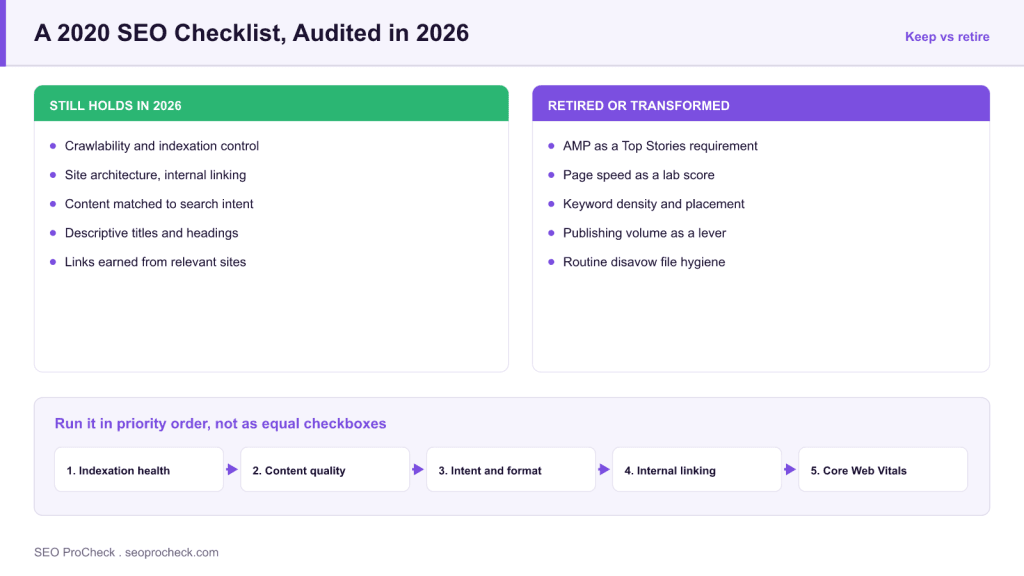
Is a 2020 SEO checklist still useful? Mostly yes. The durable classes of work in checklists like Semrush’s 41 best practices (crawlability, indexation control, site architecture, intent-matched content, descriptive titles, internal linking, earned links) are still the core of SEO in 2026. What has expired are the era-specific tactics around them: AMP for rankings, keyword-density thinking, disavowing by default, and treating page speed as a score rather than field-measured Core Web Vitals. Use old checklists for their categories, not their specifics.
- The durable half of a 2020 checklist is its category structure: crawlability, architecture, intent matched content, internal links, earned links.
- The expired half is mechanism specific: AMP for Top Stories, keyword density, lab page speed scores, routine disavow hygiene.
- Publishing volume aged worst of all. Scaled thin pages now suppress the rest of a site rather than adding to it.
- Run any checklist in dependency order, indexation first, because an early failure invalidates every measurement after it.
The Only SEO Checklist You Will Need in 2020: 41 Best Practices provides valuable insights for SEO practitioners. This resource examines approaches and considerations that can improve organic search performance.
Key Concepts
Understanding the fundamental principles behind this topic helps inform strategic decisions. Whether optimizing for traditional search or emerging AI platforms, foundational concepts remain relevant. This resource covers the essential knowledge practitioners need.
The genuinely useful skill an old checklist teaches is telling a durable practice apart from a dated tactic, and there is a reliable test for it. Ask what the item is a proxy for. Items that describe an outcome for a user or a crawler (the page can be found, the page answers the question, the page loads quickly) survive algorithm changes, because the outcome is what the engine is trying to measure in the first place. Items that describe a mechanism (a specific tag, a specific framework, a specific ratio) expire as soon as the mechanism is replaced.
Applied to the 2020 list, the sorting does most of itself. "Make important pages crawlable" is an outcome, and it still holds. "Use AMP" was a mechanism, and it lost its reason to exist the moment the Top Stories requirement was withdrawn. "Hit your keyword in the first hundred words" was a proxy for relevance that stopped correlating with relevance once retrieval became semantic.
| 2020 checklist item | Status in 2026 | What it became |
|---|---|---|
| Implement AMP for Top Stories | Retired | Any fast, policy-compliant page is eligible |
| Target a keyword density | Retired | Topic coverage and passage-level relevance |
| Maintain a disavow file as hygiene | Narrowed | A targeted tool for manual-action cases only |
| Optimize your PageSpeed score | Transformed | Field-measured Core Web Vitals from real-user CrUX data |
| Publish consistently | Transformed | Maintain and enrich what exists; publish only what you can do properly |
| Submit an XML sitemap | Unchanged | Still standard practice |
| Fix crawl errors and broken links | Unchanged | Still the first checkpoint of any audit |
Implementation Considerations
Moving from concept to execution requires understanding practical constraints and opportunities. Different situations call for different approaches. This resource provides guidance for applying concepts in real-world contexts.
Run the list in dependency order rather than in list order, because a failure early on invalidates everything you measure afterwards:
- Indexation first. There is no point evaluating a page that is not indexed. Start in Search Console's Pages report, and resolve the exclusion reasons before touching any content.
- Then intent and format. Look at what actually ranks for the target query. If the results are all comparison tables and calculators and your page is a narrative essay, no amount of on-page work will close that gap.
- Then depth and coverage, on the pages that survived the first two filters. This is where enrichment work pays for itself, and where it is wasted if you skipped the earlier steps.
- Then technical performance and markup, which act as multipliers on pages that are already relevant rather than as substitutes for relevance.
The sequencing matters more than the completeness of the list. A site with an indexation problem and a perfect on-page score is still invisible.
Measuring Impact
SEO efforts require measurement to demonstrate value and guide optimization. Identifying appropriate metrics, establishing baselines, and tracking progress enables data-driven improvement. This resource addresses how to evaluate success.
Checklist completion is not a metric. Three numbers are worth tracking after a checklist-driven sprint:
- Indexed pages against intended pages. The size of the gap, and the direction it moves over time, is the single most diagnostic figure on most sites.
- Share of indexed pages earning any impressions. Pages that are indexed but have never had an impression are exactly the population a site-level quality evaluation notices. That set should be shrinking.
- Movement by page group rather than sitewide averages. A sitewide total hides the thing you actually want to know, which is whether the pages you worked on moved.
Set the baseline before the work starts, not after. Retrofitting a baseline from memory is how checklist projects end up unfalsifiable.
This resource contributes to the knowledge base SEO practitioners need for effective optimization in an evolving search landscape.
What’s Changed Since 2020
This summary points at Semrush’s 2020-era checklist of 41 best practices, and reading a checklist from that year is a useful exercise precisely because it shows which parts of SEO are structural and which are fashion. The structural layer aged well. The tactical layer did not. Here is the honest split, by practice class rather than by individual line item:
Still holds: the durable practice classes
- Crawlability and indexation control. Clean robots.txt, XML sitemaps, sensible canonicals, and no accidental noindex remain the foundation of everything else. Our technical SEO audit checklist covers the current version of this layer.
- Site architecture and internal linking. Flat, logical structures that concentrate link equity on pages that deserve it were right in 2020 and are right now, arguably more so, since AI crawlers lean heavily on discoverable, well-linked HTML.
- Search-intent-matched content. The 2020 advice to match content format to what actually ranks for a query is still the single highest-leverage content practice.
- Titles, headings, and descriptive URLs. Still table stakes, with one modern caveat: Google now rewrites a large share of title tags, so treat the title as a candidate Google may edit, not a guaranteed SERP string.
- Earning links from relevant sites. The methods have shifted toward digital PR and genuinely citable assets, but the principle is unchanged.
Retired or transformed since 2020
- AMP as a checklist item. In 2020, AMP was a prerequisite for the Top Stories carousel. That requirement ended with the page experience update in 2021, and the ecosystem has since retreated from AMP almost entirely. Nobody should be adding AMP for SEO in 2026.
- “Page speed” as a lab score. The 2020 framing of speed as a PageSpeed number was replaced by field-measured Core Web Vitals: LCP, CLS, and (since 2024) INP replacing FID, assessed from real-user CrUX data, not lab runs.
- Keyword placement mechanics. Checklist items about hitting the keyword in the first 100 words or at a target density were already fading in 2020; passage indexing and semantic retrieval finished them off. Cover the topic; stop counting occurrences.
- Publishing volume as a growth lever. The “publish consistently” item aged worst of all. Since the 2022 to 2024 helpful content and core updates folded site-wide quality signals into core ranking, thin pages published for cadence actively suppress the rest of the site. The modern equivalent is a content audit and enrichment program: fewer, deeper, maintained pages.
- Disavowing as hygiene. Routine disavow work has been explicitly deprioritized by Google; it is now a targeted tool for manual-action cases, not a checklist line.
- What 2020 checklists didn’t have at all: AI Overviews and answer-engine visibility, E-E-A-T-driven author and entity signals, and the reality that a growing share of discovery happens via LLM crawlers reading your server-rendered HTML.
The Current-Priority Checklist, Condensed
If you were rebuilding the 41 items today, the priority order looks like this:
| Priority | Practice area | 2026 checkpoint |
|---|---|---|
| 1 | Indexation health | Every important page indexable and indexed; no orphaned money pages; GSC “Crawled - currently not indexed” investigated as a quality signal |
| 2 | Content quality & coverage | Each page answers a real query better than what ranks; thin pages enriched or consolidated; regular content audits |
| 3 | Search intent & format match | Page type (guide, tool, comparison, product) matches what the SERP rewards for the query |
| 4 | Internal linking & architecture | Priority pages within 3 clicks; descriptive anchors; hubs link down, supporting pages link up |
| 5 | Core Web Vitals | Green field data (LCP ≤ 2.5s, INP ≤ 200ms, CLS ≤ 0.1) on real-user CrUX, not lab scores |
| 6 | Structured data | Schema for the rich results and AI surfaces you are eligible for; validated, not just present |
| 7 | E-E-A-T & entity signals | Clear authorship, about/contact pages, consistent organization markup, first-hand experience visible in content |
| 8 | Links & digital PR | Citable assets that earn relevant links; no scaled link buying |
| 9 | AI/answer-engine readiness | Server-rendered content, quotable direct answers, crawlable by the AI bots you choose to allow |
How to Actually Use a Checklist
The failure mode of every SEO checklist (2020’s or 2026’s) is treating it as a to-do list where every box weighs the same. In practice, one unresolved indexation problem outweighs twenty completed on-page tweaks. Run the checklist as a diagnostic sweep, then rank findings by expected impact and effort before touching anything. For a fuller treatment of sequencing an audit, see our SEO audit FAQ.
Frequently Asked Questions
Are old SEO checklists from 2020 still worth reading?
Yes, selectively. The category structure (technical foundation, on-page, content, links) is timeless, and most fundamentals items remain valid. Skip anything tactic-specific (AMP, keyword density, disavow hygiene) and cross-check speed advice against current Core Web Vitals definitions.
What is the biggest difference between SEO in 2020 and now?
Site-level quality evaluation and AI-mediated discovery. In 2020 you could rank thin pages on a strong domain; today scaled thin content suppresses whole sites, and a growing slice of visibility happens inside AI Overviews and LLM answers rather than blue links.
Does AMP still matter for SEO?
No. AMP lost its Top Stories requirement in 2021, and the ecosystem has largely abandoned it. If you still serve AMP pages, the relevant checklist item today is retiring them cleanly (correct canonicals and redirects) so they don’t create AMP canonical conflicts.
Is keyword density still a thing?
No. Modern retrieval is semantic; Google matches passages and concepts, not term frequency. Use the query language naturally in titles and headings because it helps users and click-through, not to satisfy a ratio.
How often should an SEO checklist be re-run on a site?
Continuous monitoring for indexation and Core Web Vitals; a structured technical re-audit quarterly or after any major release; and a content audit once or twice a year. Checklists decay fastest at the tactic level, so refresh your own checklist annually against current documentation.
What should replace “publish more content” on a modern checklist?
“Make every indexed page earn its place.” Audit what you have, enrich or consolidate thin pages, and only add net-new pages that target real queries you can answer with genuine depth or first-hand experience.
Take this with you
The assistant links open with a question about this page already written. Nothing is sent until you press enter.
Claude Vincent is a technical SEO consultant focused on crawlability, rendering, and AI-search visibility. He writes the field guides and case studies at SEO ProCheck, with a bias toward the durable, unglamorous work that decides whether search engines and AI answer engines can actually read and cite a site.
About SEO ProCheck
Technical SEO consulting and GEO strategy with 20 years of enterprise experience. Case studies, resources, and tools for search and AI visibility.
Work With Me
Technical SEO audits, GEO strategy, site migrations, and international SEO. Hourly consulting for teams who need hands-on support, not just reports.
Subscribe to our newsletter!





Recent Posts
- Finding a Competitor's Sitemap, and Turning It Into a Change Log September 15, 2026
- AI Crawler User Agents: The Current Names, and Which Ones Sites Actually Block September 9, 2026
- Can AI Crawlers Actually Read Your Site? I Measured 400 of the Biggest September 5, 2026