

Are Google’s Search Quality Evaluator Guidelines A Ranking Factor?
- November 10, 2022
- General
AI Summary
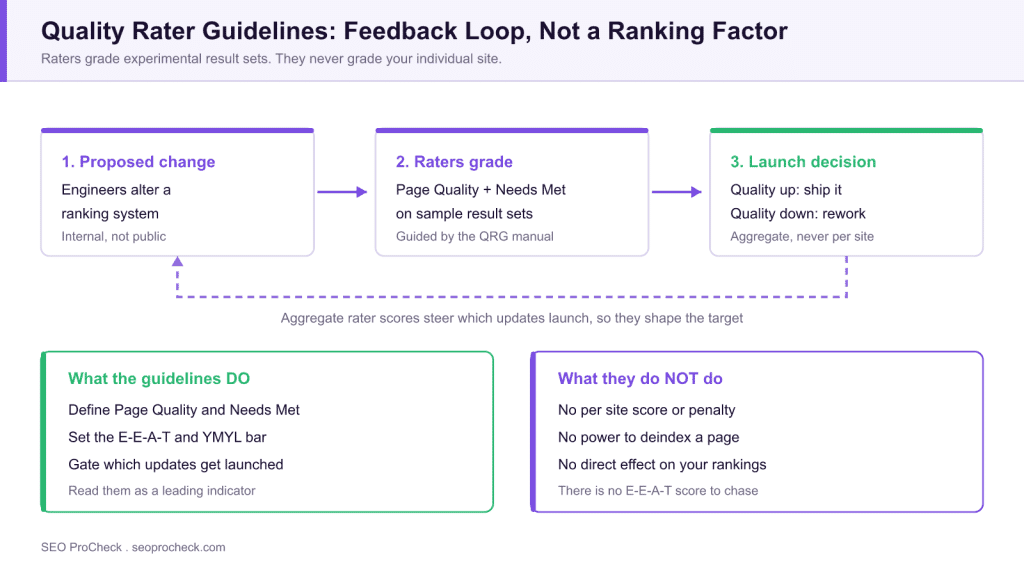
Google's Search Quality Evaluator Guidelines are not a ranking factor. The document trains contracted human raters who grade sample search result sets in controlled experiments, and those grades are used to judge whether an algorithm change improved results, never to raise or lower an individual site.
- Raters cannot penalise, demote, or deindex your site: they have no mechanism to act on a specific URL.
- The guidelines still matter because they describe, in plain language, what Google is tuning its systems to reward.
- E-E-A-T is a quality framework approximated by many signals, not a single score in the ranking systems.
- YMYL topics (health, finance, safety, civic) are held to the strictest quality and trust bar.
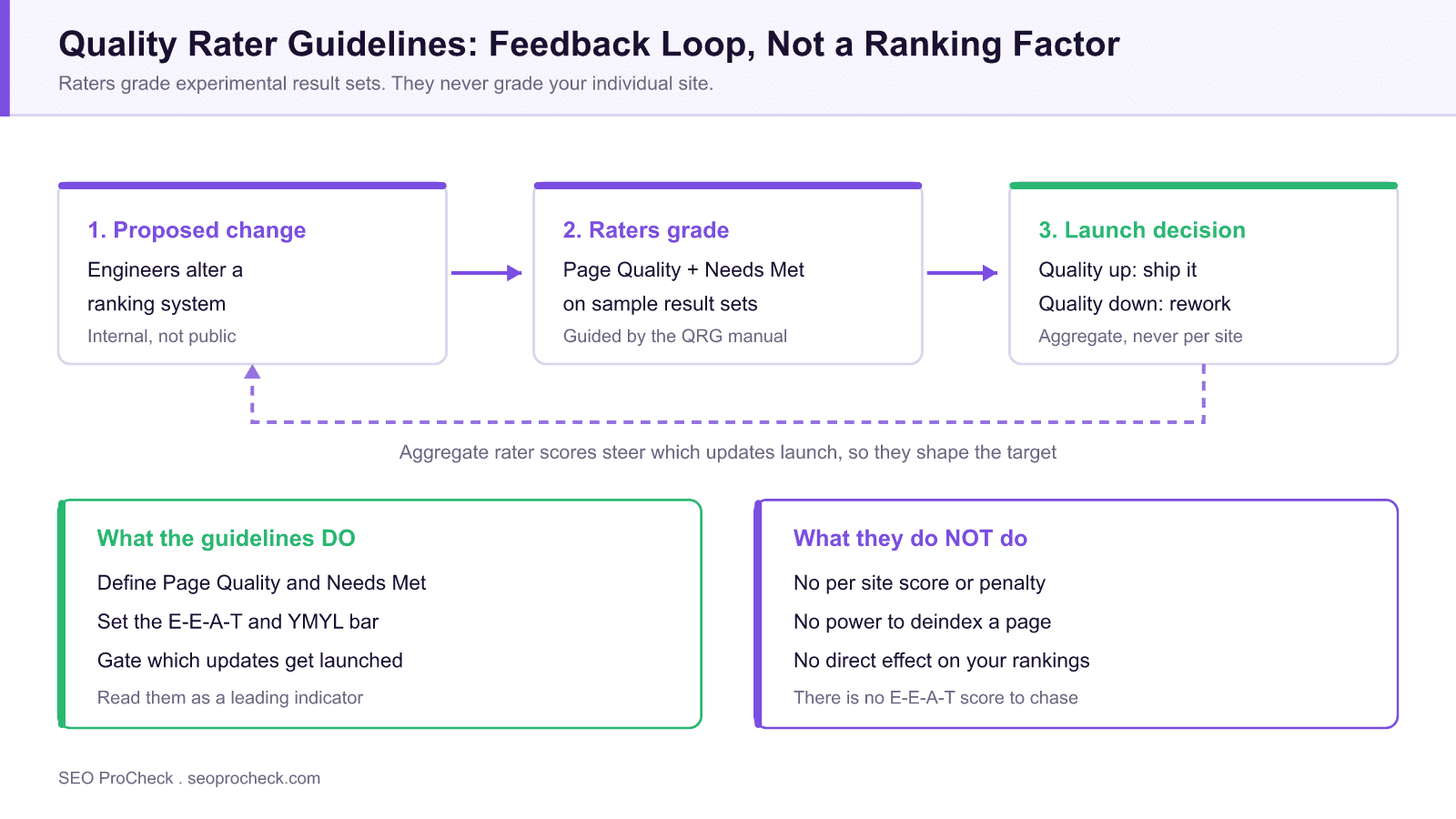
Quick answer: No, Google's Search Quality Evaluator Guidelines are not a ranking factor. The document instructs thousands of contracted human raters who score search results in controlled experiments; those ratings never directly raise or lower any individual site. Their real function is as a benchmark: rater scores tell Google whether an algorithm change made results better or worse. The guidelines still matter enormously to SEO for a different reason: they are the most explicit public description of what Google's ranking systems are being tuned to reward.
What the Guidelines Actually Are
The Search Quality Evaluator Guidelines (often "Quality Rater Guidelines" or QRG) are a book-length manual Google first published officially in 2015 and has revised regularly since. External quality raters use it to grade sample search results on two main axes: Page Quality (is this page trustworthy and well-made for its purpose?) and Needs Met (does this result satisfy this query?). The concepts SEO has absorbed into daily vocabulary come from this document: E-A-T, expanded to E-E-A-T with "Experience" in the December 2022 revision, and YMYL ("Your Money or Your Life") for topics where bad information causes real harm. The source article below, from Search Engine Journal's ranking-factors series, examines the ranking-factor question head-on and lands where the evidence points: the guidelines shape evaluation, not live scoring.
The Feedback Loop: How Raters Influence Rankings Without Rating You
The mechanism is worth being precise about, because it is qualitative and aggregate, not per-site:
- Google engineers propose a change to a ranking system.
- Raters compare before/after result sets for sample queries, scoring them per the guidelines.
- If rated quality improves, the change is a launch candidate; if not, it is reworked.
So a rater giving your page a "Low" rating does nothing to your page. But if pages like yours consistently rate poorly, future algorithm updates get tuned in directions that demote that pattern. That is why the guidelines are best read as a leading indicator: they describe the target the algorithms are being steered toward, usually a step ahead of what the algorithms can measure. There is no "E-E-A-T score" in the ranking systems: Google's systems use many separate signals that approximate those human judgments (link patterns, mentions, content characteristics, user behavior in aggregate).
Reading the QRG as an SEO: Concept to Action
| QRG concept | What raters use it for | What you should do with it |
|---|---|---|
| Page Quality rating (Lowest to Highest) | Grading a page's trustworthiness and effort for its purpose | Audit your money pages against the "Highest" descriptions: clear purpose, evident effort, accountability |
| E-E-A-T | Lens for judging quality, with Trust as the anchor | Make experience and credentials visible and verifiable, see our complete E-E-A-T guide |
| YMYL classification | Raising the quality bar for health, finance, safety, civic topics | On YMYL topics, expect the strictest scrutiny: citations, author qualifications, editorial standards |
| Needs Met rating | Grading how fully a result satisfies the query | Match format and depth to intent: a "Fully Meets" answer for the query, not your preferred content type |
| Lowest-quality characteristics | Flagging deception, harm, effort-free content | Treat these as a do-not list: unattributed scaled content, fake authorship, hidden ownership, clickbait mismatch |
The practical exercise we recommend: pick your three most important pages and rate them yourself, honestly, using the guideline definitions. Most sites discover the gap is not "add E-E-A-T signals" but structural: no identifiable author, no evidence of first-hand experience, no way for a stranger to verify the site is accountable. Smaller sites have real, concrete options here; see demonstrating E-E-A-T as a small site.
Run the Rating Exercise Yourself: A Repeatable Audit Pass
Self-rating only works if you copy the raters' discipline rather than skimming your own page and declaring it good. Raters are told to identify the page's purpose first, then judge everything else against that purpose. Work one page at a time in this order, and write the answer down before moving on:
- State the beneficial purpose in one sentence. If you cannot, the page rates Lowest regardless of how polished it looks. Pages that exist only to hold ads or internal links have no beneficial purpose by definition.
- Identify who is responsible. Find the author, the organisation behind the site, and a way to contact them. If a stranger cannot do this in thirty seconds, the accountability signal raters look for is missing.
- Look for evidence of effort, originality, and skill. Ask what this page contains that a competitor could not produce in ten minutes: original data, first-hand testing, worked examples, proprietary screenshots, genuine expertise.
- Judge reputation independently of the site. Raters research reputation off-site. Search your brand and your author names and read what other people say, not what your About page says.
- Score Needs Met against the actual query. Pull the top queries the page ranks for from Search Console, then ask whether the page fully meets each one or merely mentions the topic.
The output is a short, blunt list of structural fixes. In our experience the recurring findings are the same three every time: anonymous content, no first-hand evidence, and format mismatch with intent.
Page Quality Ratings and the Fix They Imply
| Page Quality band | What raters see | Typical cause on real sites | Practical fix |
|---|---|---|---|
| Lowest | Harmful, deceptive, or no beneficial purpose | Fake authorship, hidden ownership, scaled content with no oversight | Remove the deception, or rebuild the page with real accountability |
| Low | Purpose exists but effort, expertise, or trust falls short | Unattributed rewrites of competitor content, no author, thin coverage | Add first-hand experience, named authorship, and depth that answers follow-up questions |
| Medium | Meets its purpose but nothing distinguishes it | Competent but generic content on a site with an unremarkable reputation | Add original material: data, testing, examples, or a point of view |
| High | Satisfying amount of quality content, good reputation, clear accountability | Solid editorial process already in place | Keep it current and deepen topical coverage around it |
| Highest | Very high effort, originality, talent, or skill for the topic | Recognised authority with a track record on the subject | Protect it: refresh, keep authorship visible, and link related pages into it |
Two ratings deserve extra care. On YMYL topics the bar rises across every band, so content that would rate High in a hobby niche can rate Low when money or health is at stake. And the Lowest band is not a spectrum: a single deceptive element, such as a fabricated author or concealed site ownership, drops the page there on its own, which is why undisclosed AI bylines are a disproportionate risk relative to the effort they save.
What's Changed Since the Ranking-Factor Debate
Three developments sharpened the picture. First, the December 2022 revision added Experience as the first E and made explicit that Trust is the most important member of the family: the others exist to support it. Second, later revisions caught up with the AI-content era: current guidance directs raters to rate content on quality, effort, and accuracy rather than on how it was produced, while flagging scaled, low-effort content (however generated) among the lowest quality, mirroring Google's 2024 spam-policy turn against scaled content abuse. Third, the "not a ranking factor" answer got its strongest confirmation from Google's own 2023 messaging that E-E-A-T itself is not a direct ranking signal but a concept its systems approximate. The takeaway has not moved in a decade: you cannot optimize for raters, and you cannot ignore what they are told to reward. Definitions in brief live in our E-E-A-T lexicon entry, and if you want to prove a quality change actually moved the needle, the page-bucket method in our guide to SEO A/B split testing is the honest way to measure it.
FAQ
No. Raters score experimental result sets to evaluate algorithm changes; their ratings never directly affect a specific site's rankings. The guidelines influence rankings only indirectly, by steering what future updates reward.
No. Raters have no mechanism to act on individual sites. Manual penalties come from Google's webspam team, and algorithmic demotions come from ranking systems, not from raters.
Not as a single measurable signal. Google has said its systems use a mix of signals that approximate E-E-A-T, especially on YMYL topics. It is a quality framework to satisfy, not a score to chase.
"Your Money or Your Life" covers topics where inaccurate or deceptive content could significantly harm a person's health, finances, safety, or welfare. YMYL pages are held to the guidelines' highest quality and trust standards.
Irregularly but repeatedly, typically at least once a year since the first official 2015 publication. Major revisions (like December 2022's addition of Experience) are worth reading in full because they preview Google's direction.
Yes, at minimum the Page Quality sections on Lowest and Highest ratings and the YMYL definitions. It is the closest thing to Google documenting, in plain language, what its ranking systems are being tuned to prefer.
This resource contributes to the knowledge base SEO practitioners need for effective optimization in an evolving search landscape.
Source: https://www.searchenginejournal.com/ranking-factors/search-quality-rater-guidelines/
Take this with you
The assistant links open with a question about this page already written. Nothing is sent until you press enter.
Claude Vincent is a technical SEO consultant focused on crawlability, rendering, and AI-search visibility. He writes the field guides and case studies at SEO ProCheck, with a bias toward the durable, unglamorous work that decides whether search engines and AI answer engines can actually read and cite a site.
About SEO ProCheck
Technical SEO consulting and GEO strategy with 20 years of enterprise experience. Case studies, resources, and tools for search and AI visibility.
Work With Me
Technical SEO audits, GEO strategy, site migrations, and international SEO. Hourly consulting for teams who need hands-on support, not just reports.
Subscribe to our newsletter!






Recent Posts
- Finding a Competitor's Sitemap, and Turning It Into a Change Log September 15, 2026
- AI Crawler User Agents: The Current Names, and Which Ones Sites Actually Block September 9, 2026
- Can AI Crawlers Actually Read Your Site? I Measured 400 of the Biggest September 5, 2026