

Is Content Pruning Good for SEO? Case Studies + Experts' Opinions
- February 20, 2018
- Content
AI Summary
Content pruning is the deliberate review and removal or consolidation of low value pages so a site is judged on its strongest material. Done with a decision framework rather than a delete key, it can lift overall visibility, but the right action is usually improve or consolidate, not delete.
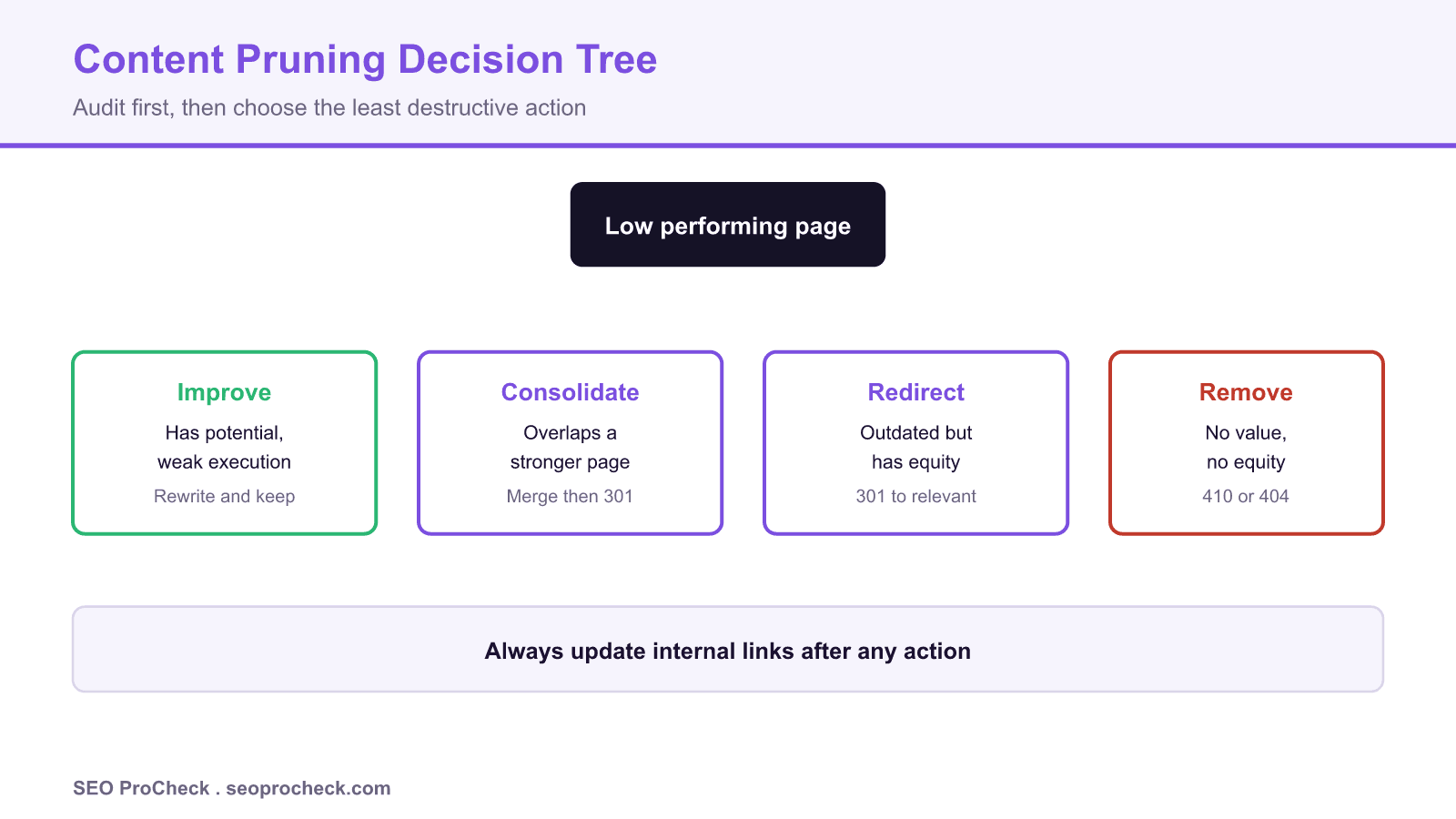
- Pruning means audit first, then improve, consolidate, redirect, or remove, in that order of preference.
- Never bulk delete on a traffic threshold alone, check backlinks, rankings, conversions, and strategic value first.
- Consolidating thin pages into one strong page with a 301 usually beats outright removal.
- Redirect removed URLs, or return 410 for genuine dead weight, and update internal links.
Is content pruning good for SEO? The short answer is yes, when it is done as a careful audit rather than a mass delete. Pruning is the deliberate process of reviewing a site page by page and deciding what to improve, merge, redirect, or remove, so search engines judge the site on its strongest material instead of being dragged down by neglected pages. The case studies that show large gains from pruning almost always pair removal with consolidation and internal-link cleanup, which is the part that gets lost when the idea is reduced to deleting low-traffic URLs.
Why pruning can help
Search engines assess quality at the site level as well as the page level. A large body of thin, outdated, or redundant pages can dilute how a site is perceived and can spread crawl attention across URLs that will never earn traffic. Removing or consolidating that dead weight concentrates authority and can lift the pages you actually care about. The mechanism is not magic, it is focus: fewer, stronger pages, better internal links, and a cleaner topical footprint. Our content pruning glossary entry defines the terms, and the content pruning impact study looks at how results tend to play out over time.
The decision framework, not the delete key
The dangerous version of pruning is sorting a report by sessions and deleting everything below a line. That throws away pages with valuable backlinks, seasonal pages that only earn traffic part of the year, and pages that convert quietly without much volume. A safe process evaluates each candidate against several signals before acting: organic traffic trend, keyword rankings, referring domains, conversions or assisted conversions, and strategic value such as supporting a cluster or serving an important audience. Only after that review do you pick the least destructive action that fits.
| Signal to check | Question it answers | Weighs toward |
|---|---|---|
| Traffic trend | Is anyone finding this page? | Improve or remove |
| Backlinks | Does it hold external equity? | Redirect, never delete |
| Rankings | Is it close to page one? | Improve |
| Conversions | Does it earn quietly? | Keep |
| Overlap | Does a stronger page cover this? | Consolidate |
| Strategic role | Does a cluster need it? | Keep or improve |
Prefer improve and consolidate over delete
For most low performers, the best action is not removal. If a page has potential but weak execution, rewrite and expand it. If it overlaps a stronger page, consolidate the useful parts into that page and point the old URL there with a 301 redirect, which preserves any accumulated equity and sends the searcher somewhere useful. Consolidation is often the quiet winner in pruning case studies because it removes redundancy while keeping value in play. Our strategic guide to removing low value pages walks through how to run this at scale without breaking things.
When removal is right, do it cleanly
Some pages genuinely have no value and no equity, and removing them is correct. When you do, choose the status code deliberately. A 301 redirect to a relevant page is right when the URL holds links or lingering traffic. A 410 Gone tells search engines the page is intentionally removed and speeds deindexing when there is nothing worth redirecting to, while a plain 404 is acceptable for true dead ends. Whatever you choose, update the internal links that pointed at the removed URL so you are not leaving readers and crawlers hitting redirects or errors.
Measure, and give it time
Pruning is not instant. Search engines need to recrawl and reassess, so expect changes over weeks, not days, and track the pages you kept as much as the ones you removed. The goal is a healthier overall site, so the success metric is the trend across your retained pages and clusters, not the raw page count. Reviewed this way, pruning is one of the higher-leverage maintenance tasks in SEO, precisely because it is a scalpel and not a hatchet.
A quick pruning checklist
Before you touch anything, export a full inventory of URLs with organic clicks, impressions, referring domains, and conversions attached, ideally over a twelve month window so seasonal pages are visible. Flag candidates, then for each one ask in order: does it earn or assist conversions, does it hold backlinks, is it ranking close to page one, and does a cluster depend on it. A yes to any of those pulls the page out of the delete pile and into improve, keep, or consolidate. Only pages that fail every test belong in the removal group, and even then you redirect anything with lingering equity. Work in small batches rather than one mass action, record what you changed and when, and give each batch several weeks before you judge it. This paced, documented approach is what separates a pruning project that lifts a site from one that quietly amputates traffic the owner never gets back.
Source: https://cognitiveseo.com/blog/17548/content-pruning-for-seo/
Frequently asked questions
Is content pruning good for SEO?
Yes, when done as a careful audit. Removing or consolidating thin, outdated, or redundant pages helps search engines judge a site on its strongest material, but bulk deleting by traffic alone is risky.
Should I delete pages with low traffic?
Not automatically. Check backlinks, rankings, conversions, and strategic value first. A low-traffic page may hold valuable links or serve a seasonal or conversion role that raw sessions hide.
What is the difference between pruning and deleting?
Pruning is a decision process that can end in improve, consolidate, redirect, or remove. Deleting is only one of those outcomes and usually the last resort.
Should I use a 301 or a 410 when removing a page?
Use a 301 redirect when the URL holds links or traffic and a relevant target exists. Use 410 Gone for genuine dead weight with nothing worth redirecting to, which speeds deindexing.
How long until pruning shows results?
Expect weeks rather than days, because search engines must recrawl and reassess. Track the trend across the pages you kept, not just the reduced page count.
Does consolidating pages help more than deleting them?
Often yes. Merging overlapping thin pages into one strong page and redirecting the old URLs removes redundancy while preserving equity, which is why consolidation drives many pruning wins.
Claude Vincent is a technical SEO consultant focused on crawlability, rendering, and AI-search visibility. He writes the field guides and case studies at SEO ProCheck, with a bias toward the durable, unglamorous work that decides whether search engines and AI answer engines can actually read and cite a site.
About SEO ProCheck
Technical SEO consulting and GEO strategy with 20 years of enterprise experience. Case studies, resources, and tools for search and AI visibility.
Work With Me
Technical SEO audits, GEO strategy, site migrations, and international SEO. Hourly consulting for teams who need hands-on support, not just reports.
Subscribe to our newsletter!







Recent Posts
- Can AI Crawlers Actually Read Your Site? I Measured 400 of the Biggest September 5, 2026
- The Pre-Publish Quality Gate for AI-Assisted Content August 6, 2026
- AGENTS.md vs llms.txt vs llms-full.txt: Which Agent File Does What July 18, 2026