

AI Summary
Analyzing a link building campaign means measuring the links you earned against effort and, more importantly, their effect on rankings, referral traffic and authority, not just counting total links. Quality, relevance and placement matter far more than raw volume.
- Judge links by quality: referring domain authority, relevance, dofollow status and placement.
- Tie link acquisition to ranking movement on target pages and to referral sessions.
- Measure efficiency: links earned per outreach sent and cost per earned link.
- Flag clearly manipulative links and disavow only when they are genuinely spammy.
Understanding Link Building
Link Building represents a significant aspect of SEO strategy that practitioners need to understand thoroughly. As search algorithms evolve and user behavior changes, staying current with best practices in this area becomes increasingly important. This guide provides comprehensive coverage of the key concepts and actionable recommendations.
Strategic Importance
The role of link building in overall SEO success cannot be understated. It influences multiple ranking factors and affects user experience. Sites that excel in this area typically see better organic performance across key metrics. Understanding the strategic implications helps prioritize efforts and allocate resources effectively.
Implementation Approach
Effective implementation requires a systematic approach. Begin with thorough assessment of your current state. Identify gaps and opportunities through analysis. Develop an action plan with clear priorities. Execute methodically while monitoring for issues. Iterate based on results and industry changes.
Best Practices
Industry best practices have evolved through collective experience and testing. Following established guidelines helps avoid common pitfalls and accelerates results. However, best practices should be adapted to your specific situation rather than applied blindly. Test and measure to confirm what works for your site.
Future Considerations
The landscape continues to evolve with new technologies and algorithm updates. Stay informed about developments that may affect your strategy. Build flexibility into your approach to accommodate changes. Focus on fundamentals that provide long-term value rather than short-term tactics that may become obsolete.
The metrics that matter
Start by counting referring domains rather than total backlinks, because ten links from one site are worth far less than links from ten relevant sites. Then look at the distribution of domain rating or authority, topical relevance to your page, anchor text mix (natural branded and partial match rather than exact match spikes), the dofollow ratio, and placement: an editorial in content link carries more weight than a footer or sidebar link.
| Metric | What good looks like | Why it matters |
|---|---|---|
| Referring domains | Steady growth from unique sites | Diversity outweighs raw link count |
| Topical relevance | Links from on topic pages | Relevance drives value and safety |
| Anchor text mix | Mostly branded and natural | Exact match spikes look manipulative |
| Placement | In content, editorial | Editorial links pass the most context |
| Dofollow ratio | A natural blend | An all dofollow profile looks engineered |
Connecting links to outcomes
Links are a means, not the goal, so connect them to results. For each linked target page, compare ranking before and after the link was earned, watch referral traffic from the linking domain, confirm the linking page is itself indexed, and review assisted conversions. If rankings and referral sessions do not move, the links may be low relevance or low authority even when the count looks healthy.
Campaign efficiency analysis
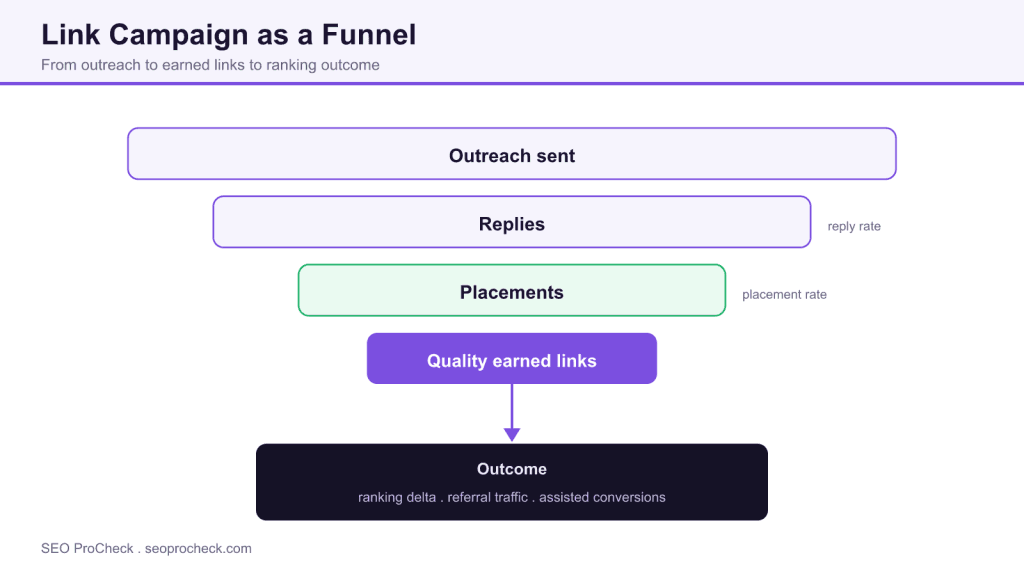
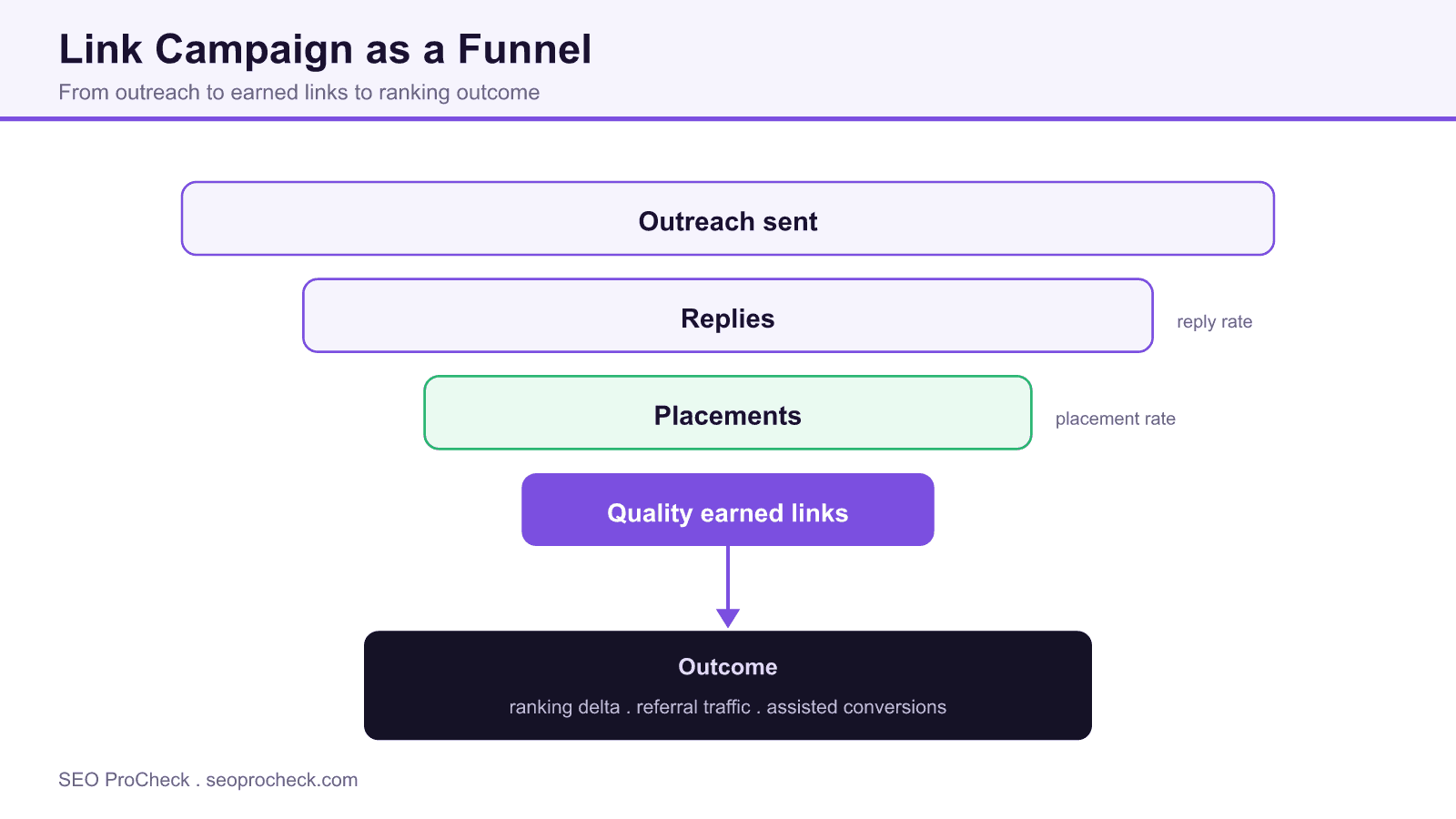
Treat outreach as a funnel: outreach sent, reply rate, placement rate, and cost per earned link. Dividing earned links by content assets produced shows which assets attract links most efficiently. A simple worked example: 200 emails, a 12 percent reply rate yields 24 replies, a 25 percent placement rate on those yields 6 links, so cost per link equals total campaign cost divided by 6. Track these ratios over time to see whether the program is getting more efficient.
Auditing link quality and risk
Scan for low quality patterns: private blog networks, irrelevant directories, and sudden exact match anchor spikes. Most unnatural links are simply ignored by Google, so disavow sparingly and only when a pattern is clearly manipulative and pointed at your site. A disavow file uses this syntax:
# disavow a spammy domain and a single bad URL
domain:spam-example.com
https://bad.example.net/link-page/
Submit the file in the disavow tool, and remember that most sites never need one.
Reporting the campaign
Report monthly with a table of links earned, their authority band, topical relevance, and the ranking delta on the target page. Pairing acquisition with outcome keeps the conversation on value rather than vanity link counts.
Frequently asked questions
Should I count total backlinks or referring domains?
Referring domains. Many links from one site add little, while links from many relevant unique domains signal broad endorsement. Referring domain growth is the more honest measure of a campaign.
Do nofollow links have value?
They can. A natural profile includes nofollow, ugc and sponsored links, they can drive real referral traffic and brand exposure, and an all dofollow profile looks engineered. Judge links by relevance and placement, not the tag alone.
When should I disavow links?
Rarely. Google ignores most spammy links automatically, so disavow only when you see a clear manipulative pattern aimed at your site, such as a paid link scheme or a negative SEO attack.
How do I tie link building to rankings?
Compare the target page ranking before and after links are earned, and track referral traffic and assisted conversions from the linking domains. Movement across these confirms the links carried value.
What is a good outreach placement rate?
It varies by niche and asset quality, so benchmark against your own history rather than a universal number. Track reply rate and placement rate over time and aim to improve efficiency campaign to campaign.
What makes a link high quality?
Topical relevance to your page, an editorial in content placement, a reputable and indexed linking page, and natural anchor text. These traits matter far more than the raw authority score alone.
Related guides: topical authority, structured data returns, and indexation of linking pages.
Claude Vincent is a technical SEO consultant focused on crawlability, rendering, and AI-search visibility. He writes the field guides and case studies at SEO ProCheck, with a bias toward the durable, unglamorous work that decides whether search engines and AI answer engines can actually read and cite a site.
About SEO ProCheck
Technical SEO consulting and GEO strategy with 20 years of enterprise experience. Case studies, resources, and tools for search and AI visibility.
Work With Me
Technical SEO audits, GEO strategy, site migrations, and international SEO. Hourly consulting for teams who need hands-on support, not just reports.
Subscribe to our newsletter!







Recent Posts
- Can AI Crawlers Actually Read Your Site? I Measured 400 of the Biggest September 5, 2026
- The Pre-Publish Quality Gate for AI-Assisted Content August 6, 2026
- AGENTS.md vs llms.txt vs llms-full.txt: Which Agent File Does What July 18, 2026