

Subdomain vs Subdirectory for International Sites
- January 20, 2025
- International SEO and Hreflang, Technical SEO
AI Summary
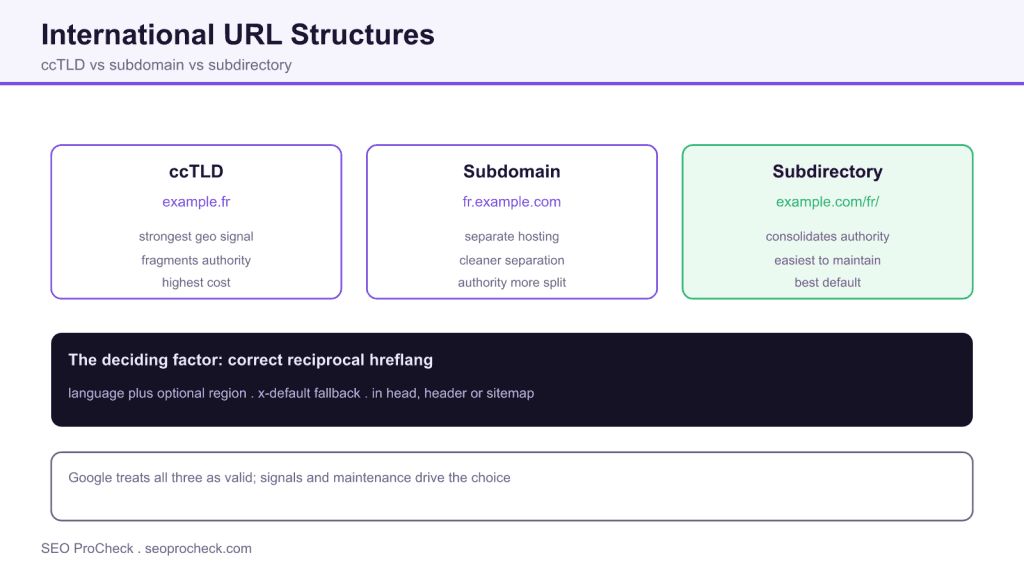
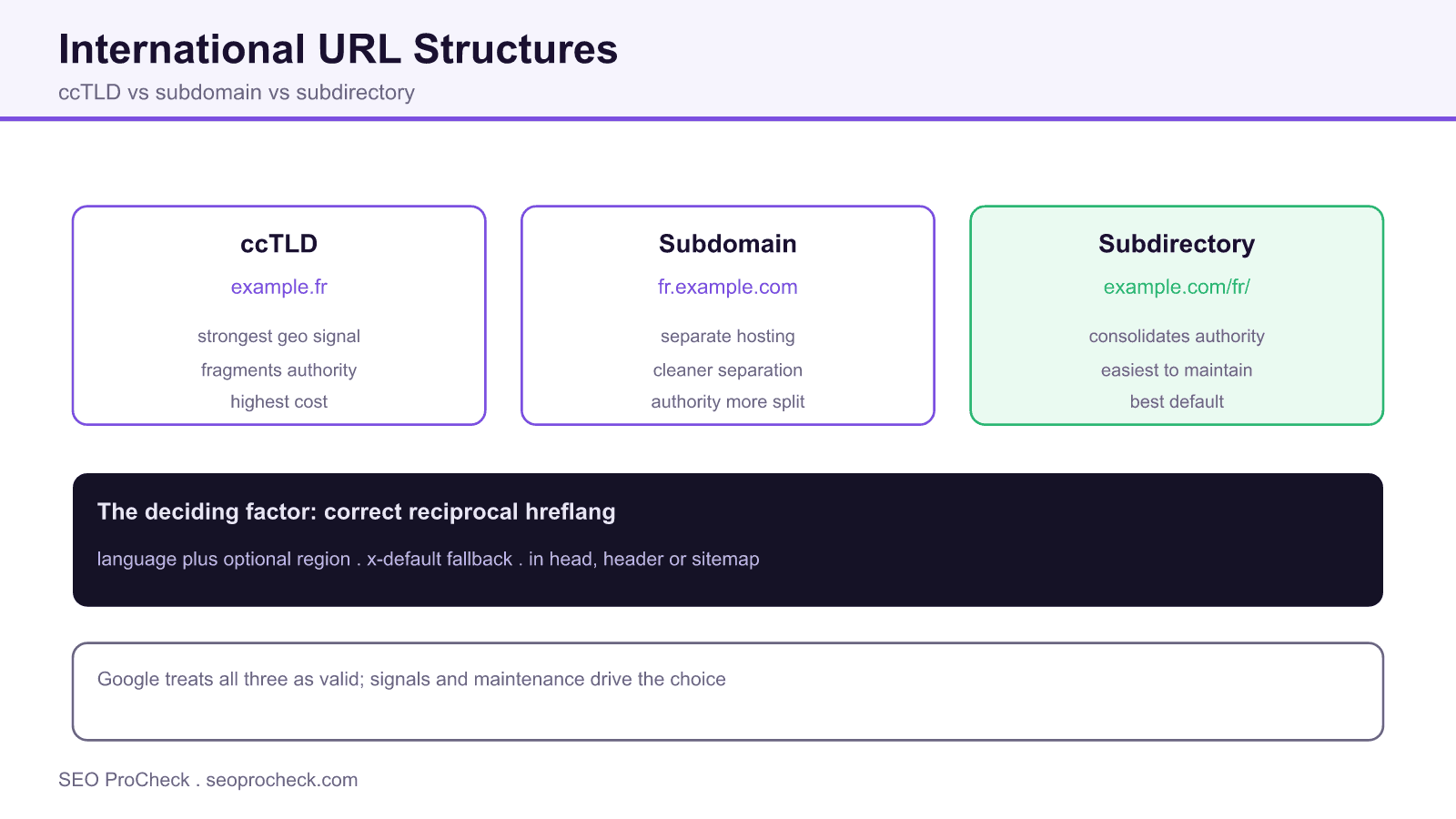
For most international sites, subdirectories such as example.com/fr/ consolidate authority onto one domain and are easier to maintain, while subdomains such as fr.example.com offer cleaner separation and infrastructure flexibility. Google treats both as valid, and the bigger wins come from correct hreflang, not the URL pattern itself.
- Subdirectories (/fr/) inherit root domain authority and are simplest to maintain.
- Subdomains (fr.example.com) allow separate hosting and clearer regional separation.
- ccTLDs (example.fr) send the strongest geo signal but fragment authority and cost most.
- hreflang correctness matters more than the folder versus subdomain choice.
Comparison Overview
Choosing between these options requires understanding the specific strengths and weaknesses of each approach. The right choice depends on your specific situation, resources, and goals. This comparison examines the key factors that should influence your decision, providing an objective analysis to help you make an informed choice.
Feature Comparison
Each option offers distinct capabilities that may or may not align with your needs. We'll examine the core functionality, ease of use, scalability, and integration options. Some features are essential for certain use cases while others provide nice-to-have benefits. Consider which features are must-haves for your specific requirements.
Pricing and Value
Cost considerations extend beyond the sticker price. Factor in implementation time, learning curve, ongoing maintenance, and opportunity costs. The cheapest option isn't always the most cost-effective when total cost of ownership is considered. Evaluate the return on investment potential for each option.
Use Case Recommendations
Different situations call for different solutions. Enterprise organizations may have different needs than small businesses or agencies. Consider your team's expertise, existing technology stack, and growth plans. The best choice today should also accommodate future needs and scaling.
Decision Framework
Use a structured approach to make your decision. List your requirements and weight them by importance. Score each option against your criteria. Consider doing a trial or proof of concept before committing. Make a decision that aligns with both immediate needs and long-term strategy.
URL structure options at a glance
Below the original comparison, here is how the practical options line up. Avoid signaling language or country through URL parameters, which Google discourages for internationalization.
| Structure | Example | Geo signal | Authority | Maintenance |
|---|---|---|---|---|
| ccTLD | example.fr | Strongest | Fragmented per domain | Highest, many domains |
| Subdomain | fr.example.com | Neutral, set via hreflang | Somewhat separated | Separate config and property |
| Subdirectory | example.com/fr/ | Neutral, set via hreflang | Consolidated on root | Lowest, one domain |
| URL parameter | example.com?lang=fr | Weak, discouraged | On root | Fragile, avoid |
How each option affects authority and crawl
A subdirectory keeps every locale on one domain, so links and trust earned anywhere benefit the whole site, and it shares a single Search Console property. A subdomain can be treated as somewhat more separate, which suits teams that need distinct hosting or stacks but means link equity is less unified and each subdomain is its own property. A ccTLD sends the clearest country signal and can lift local trust, but it splits authority across many domains and multiplies cost and maintenance.
hreflang is the deciding factor
Whatever structure you pick, hreflang annotations are what actually route the right users to the right page and prevent duplicate content across locales. Tags must be reciprocal: every page that references an alternate must be referenced back. Use an ISO 639-1 language code with an optional ISO 3166-1 region code, and add x-default for a fallback:
<link rel="alternate" hreflang="en-us" href="https://example.com/us/page/" />
<link rel="alternate" hreflang="fr-fr" href="https://example.com/fr/page/" />
<link rel="alternate" hreflang="x-default" href="https://example.com/page/" />
You can place these in the head, in the HTTP header, or in the XML sitemap. Pick one method and keep it consistent.
Geotargeting and maintenance
Google removed the legacy country targeting setting for generic top level domains, so geotargeting now rests on hreflang plus signals like server or CDN location and local links. A subdirectory needs one property and one deployment; subdomains and ccTLDs each need their own property and often their own hosting, which is real ongoing overhead. Factor that operational cost into the decision.
A practical decision guide
Choose a subdirectory for most sites: it is simplest and keeps authority unified. Choose subdomains when infrastructure, compliance or separate teams genuinely require isolation. Choose ccTLDs when brand, legal or market expectations demand a local domain and you have the resources to maintain several. In every case, invest first in correct, reciprocal hreflang.
Frequently asked questions
Is a subdomain or subdirectory better for SEO?
For most sites a subdirectory is better because it consolidates authority on one domain and is easier to maintain. Subdomains suit cases that need separate hosting or clear organizational separation.
Does Google treat subdomains and subdirectories differently?
Google says it can handle both, and in practice a subdirectory keeps link equity unified while a subdomain may be treated as somewhat more separate. Correct hreflang matters more than the choice between them.
When should I use a ccTLD?
Use a country code domain like example.fr when a strong local signal, brand expectation, or legal requirement justifies it and you can maintain multiple domains. It sends the clearest geo signal but fragments authority.
What is hreflang and why does it matter?
hreflang tells search engines which language and region version of a page to show each user. It prevents duplicate content across locales and is the single most important international signal, more than URL structure.
Can I set country targeting in Search Console?
Google removed the legacy country targeting setting for generic top level domains. Geotargeting now depends on hreflang plus signals such as server or CDN location and local backlinks.
Do subdomains need separate Search Console properties?
Yes. Each subdomain and each ccTLD is typically its own property, while all subdirectories live under one property. That difference adds monitoring and maintenance overhead to subdomains.
Related technical guides: robots and indexation controls, structured data, and topical authority.
Take this with you
The assistant links open with a question about this page already written. Nothing is sent until you press enter.
Claude Vincent is a technical SEO consultant focused on crawlability, rendering, and AI-search visibility. He writes the field guides and case studies at SEO ProCheck, with a bias toward the durable, unglamorous work that decides whether search engines and AI answer engines can actually read and cite a site.
About SEO ProCheck
Technical SEO consulting and GEO strategy with 20 years of enterprise experience. Case studies, resources, and tools for search and AI visibility.
Work With Me
Technical SEO audits, GEO strategy, site migrations, and international SEO. Hourly consulting for teams who need hands-on support, not just reports.
Subscribe to our newsletter!







Recent Posts
- Finding a Competitor's Sitemap, and Turning It Into a Change Log September 15, 2026
- AI Crawler User Agents: The Current Names, and Which Ones Sites Actually Block September 9, 2026
- Can AI Crawlers Actually Read Your Site? I Measured 400 of the Biggest September 5, 2026